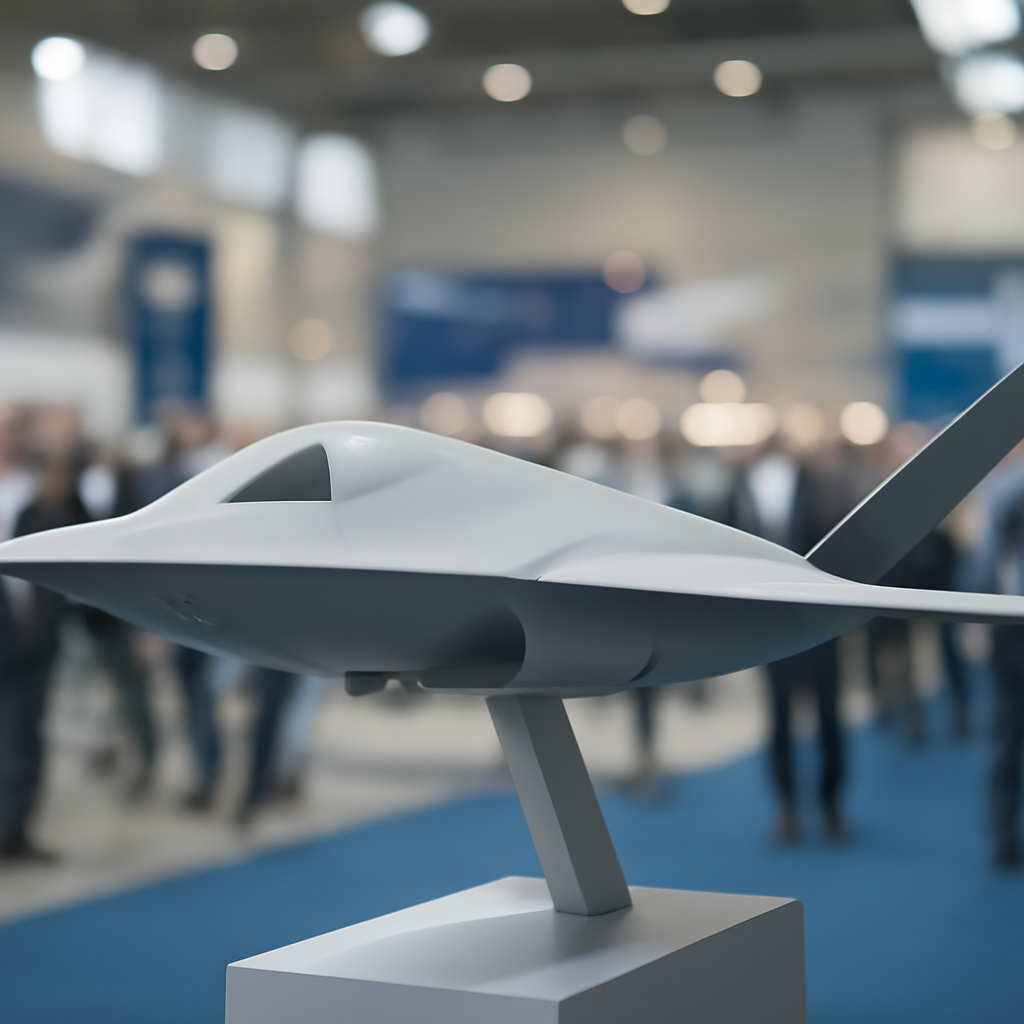
"We're seeing it in multiple platforms," said Air Force Gen. Dale R. White, describing a capacity problem that, in his view, extends beyond any single fighter program and into broader corners of the U.S. defense industrial base.
Gen. Dale R. White: capacity concerns and a qualified confidence in F-47
White — who serves as Director, Critical Major Weapon Systems and in a dual-hatted role as the Pentagon’s top weapons procurement officer and the senior acquisition advisor to the Secretary of the Air Force — told reporters at the Air & Space Forces’ Air, Space and Cyber Conference that industrial-capacity worries are widespread. He stressed that his concerns are “not unique” to the Air Force’s F-47 or the Navy’s F/A-XX, adding that the same stresses appear in “multiple platforms.”
At the same time, White said the F-47 program “continues to progress exceptionally well” and that the program benefits from “many, many years in tech maturation and risk reduction” which gave it “a tremendous head start.” He expressed certainty about a near-term milestone, saying the Air Force F-47 “will fly in the next two years” and that the program is “absolutely on [the] path to be able to hit the mark of flying within this administration.”
Where the pinch points are: people, production, and trade space
White identified three related constraints driving trade-offs: people resources, production capacity, and the need to make “trade space” between programs. He warned that industrial capacity must be managed across design, completion, flight test, software milestones and eventual production ramp. On prime-contractor activity, White noted that “Boeing [is] making smart investments” and that Boeing has “a lot of CAPEX [capital expenditure] that they’re pouring in,” but emphasized that investment must clear the design and test milestones before production strains become the central issue.

This site is the portfolio.
OSINTSights runs on Cloudflare Workers, D1, R2, and Vectorize, with an AI pipeline on Hetzner ARM. Nubivance designed, built, and operates it. We do the same for clients.
See what we buildStatus update: F-47 production and F/A-XX uncertainty
According to the reporting, the first example of the F-47 has been in production for about a year. Despite that progress on the Air Force side, the Navy’s carrier-based next-generation fighter, F/A-XX, has faced more visible turbulence. The Navy has not yet selected a prime contractor; competitors named in the reporting are Boeing and Northrop Grumman. The Navy had been expected to make a decision by last month, but a Navy official told TWZ last week that “the F/A-XX program remains on track, and we have no further information to provide at this time.”
The F/A-XX program’s pause and the Pentagon’s earlier rationale — that the industrial base could not handle simultaneous final development and production of two extremely complex new fighters — provoked controversy and congressional intervention. The story notes the program “remained in question” since the Pentagon moved to effectively shelve it last year, and that senior Navy leaders have publicly acknowledged the program’s uncertainty.
Boeing, Northrop Grumman and commonality between airframes
Industry positions appear mixed but noteworthy. The reporting recalls that last year Boeing Defense and Space CEO Steve Parker said his company did not see a problem in building both the Navy and Air Force next-generation fighters — a stance consistent with Boeing’s reported capital investments. TWZ also flagged that Boeing’s public renderings for a possible F/A-XX concept closely resemble Boeing’s F-47 imagery, suggesting the Navy variant could be a navalized F-47 — a design choice that offers advantages in commonality but would present challenges in navalizing a design not originally intended for carrier operations and then scaling production for two services.
How the Navy, the Air Force, and prime contractors are likely to respond
- Navy: The service will press for the down-select and clarity on a prime contractor while managing operational requirements for a carrier-capable aircraft; senior Navy leaders have stressed the need to operate amid growing anti-air threats and distributed risk.
- Air Force: With the F-47 reportedly on track and its first example in production for about a year, the Air Force will continue to focus on completing design, flight test, and software milestones to meet the stated flight timeline within the next two years.
- Boeing and Northrop Grumman: Boeing, which has publicly invested CAPEX and whose executives have said building both jets is feasible, will need to prove that investment clears design and test hurdles; Northrop Grumman remains a named competitor for the Navy contract and thus a party to any industrial-base impacts from dual development or higher commonality.
The immediate practical question on the table is whether the Pentagon and the services will accept the trade-offs White described — reallocating people and production capacity among high‑profile programs — or find alternative sequencing or industrial solutions to avoid constrained production. A down-select on the Navy’s F/A-XX is expected soon, and TWZ said we should “hopefully finally get a clearer picture in the coming weeks” about both the program’s status and who will build it. That decision will materially shape how the industrial-base concerns White flagged translate into schedules, production rates, and the prospect of shared designs between the Air Force and Navy.