"What I would tell you is that it helped us develop our priorities," said Brig. Gen. Matt Ross.
Operation Clear Horizon at Eglin Air Force Base
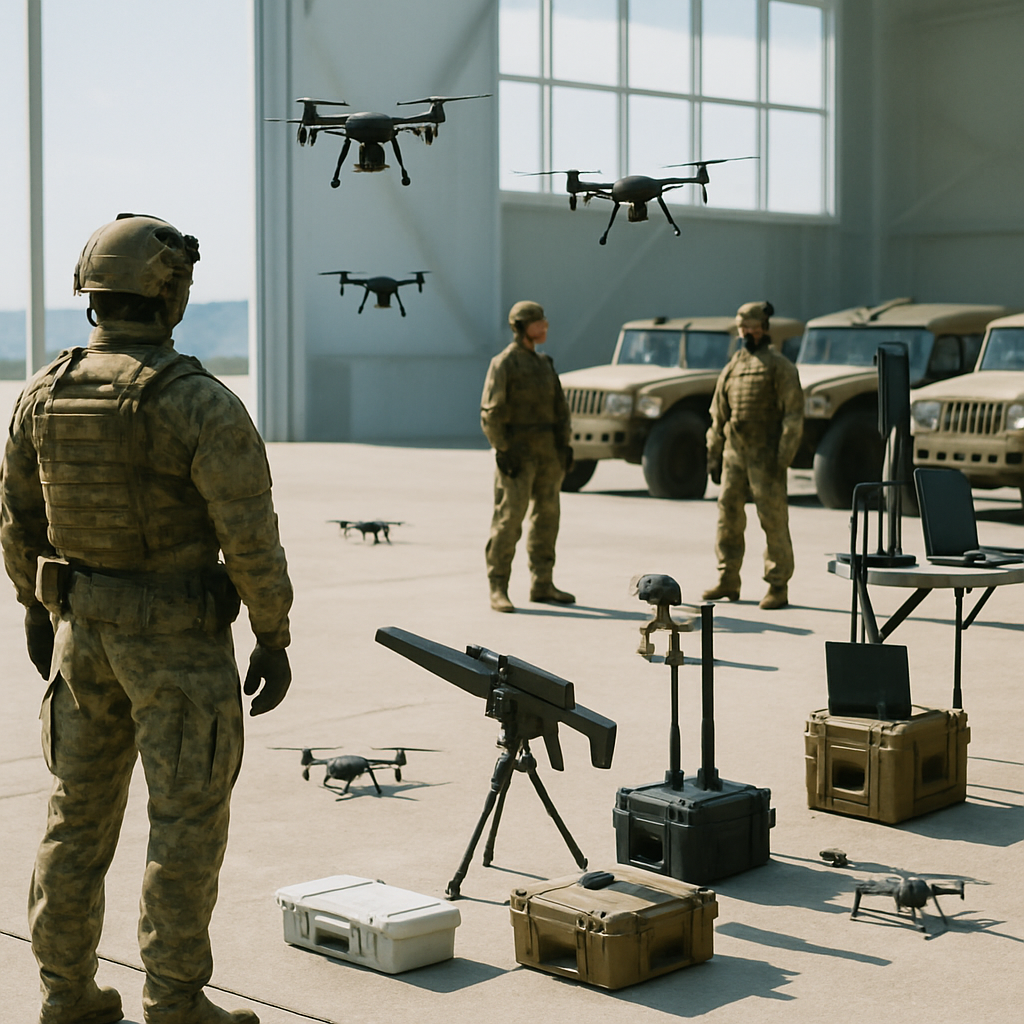
In September, members of the 10th Special Forces Group staged a drone assault at Eglin Air Force Base meant to mirror the “spiderweb” attacks Ukrainian forces had used against Russia. Defenders were U.S. counter‑drone troops who had been trained for a week on technologies the Pentagon has invested billions to develop. The exercise, dubbed Operation Clear Horizon, deliberately set out to replicate the conditions and weapons seen on the battlefields of Ukraine.
Ukrainian "spiderweb" tactics and the drones used
Brig. Gen. Ross described a wide assortment of platforms and control methods used by the special operators: “They flew drones that were regular [radio‑frequency], commercial drones. They flew drones that had directional antennas on them so they're harder to jam, drones that were frequency hopping so they have a more resilient connection.” The range included Group 1s up to Group 3s, and extended beyond RF control to fiber‑optically controlled drones and systems controlled by LTE, the cellular network. Ross noted that LTE control enabled operators in Colorado to launch against targets in Florida — “a first for the U.S. military.”

This site is the portfolio.
OSINTSights runs on Cloudflare Workers, D1, R2, and Vectorize, with an AI pipeline on Hetzner ARM. Nubivance designed, built, and operates it. We do the same for clients.
See what we buildTesting constraints, data gaps, and lessons from Kyiv
The department’s counter‑drone testing landscape has been reshaped by practical limits: electromagnetic effects used to defeat drones can interfere with airplane guidance and cellular service, which restricts when and where the military can run live jamming and denial experiments. Even recent exercises — August’s T‑REX at Camp Atterbury, Indiana, and the Army’s FlyTrap last November in Germany — largely avoided those electromagnetic tests, instead focusing on ways to bring down drones without using expensive missiles.
Between September and December, Ross said, 67 tests were conducted by the services, combatant commands, the Pentagon’s research office, and other DOD outfits. “It was all well‑intentioned. But we couldn't see all of that data in a way that would allow informed comparisons between different systems that were tested at different venues,” he said. To close that gap, the task force has begun referencing performance data observed in Ukraine: Ross said, “We were over in Ukraine about six weeks ago, talking to the Unmanned Systems Force [sic], watching how they defend Kyiv on any given night, understanding what they have along the forward line of troops.”
How Joint Interagency Task Force 401 is changing tracking, integration, and advising commanders in the Middle East
The exercise revealed a pressing need to fuse data from dispersed radars, drones, and counter‑drone systems. Ross described a move to “a single drone‑tracking software solution and interface across the services,” designed so that installations can pass tracks between one another — even across the panhandle of Florida in his example. “If you were to go to a location where you have multiple services working together, and even other federal agencies or international partners, we have seamless air domain awareness and the ability to sense connect any sensor with any effector,” he said.
The task force is also passing lessons to U.S. commanders beyond the continental United States: Ross said the results are being offered to “U.S. commanders, including those in the Middle East.” That advisory role accompanies an operational pivot: a greater emphasis on countering long‑range drones that can strike “high‑payoff targets, which are going to be command‑and‑control, logistics, or air defense,” and on procuring cheaper interceptor drones for Group 1 and 2 threats instead of relying solely on expensive missiles designed to kill missiles.
Budgets, procurement moves, and a threat evolving faster than annual budgets
In the past six weeks, Ross said, the Pentagon has “committed over $600 million to this problem, specifically for the rapid integration of new counter [unmanned aerial system] technology.” At the same time, the department’s 2027 budget proposal requests $75 billion for new drone technology. Ross acknowledged a mismatch in tempos: the threat is changing fast, driven in part by commercial markets and autonomy. He rejected a comparison some senior leaders make between today’s drones and the IEDs of earlier wars, arguing, “For IEDs, you had no commercial application for that technology. With unmanned systems, and specifically with autonomy, there's so many commercial applications that we're going to see this accelerated development in this space… That's going to cause us concerns, from a security perspective.”
Ross also emphasized doctrinal linkage: offensive and defensive drone operations are, he said, “inextricably, inextricably linked,” and maximizing effects will require tying conventional long‑range fires and missile‑defense units together in ways they historically have not been.
Operation Clear Horizon exposed how battlefield adaptations observed in Ukraine — from frequency‑hopping controllers to long‑range, remotely launched systems — are already reshaping U.S. testing, integration, and procurement. The task force has taken the next step of consolidating tracking, sharing Ukrainian performance data with U.S. planners, and investing rapidly; the central question now is whether integration and procurement can keep pace with a commercially accelerated threat.



