"What Ukraine says they need, and obviously it’s the same for the Russians, more or less, is something that’s not very expensive, something that is attritable, something that if lost could be easily replaced," Samuel Bendett, a drone analyst at CNA, CNAS, and CSIS, said in an interview.
Ukrainian volume versus U.S. investment
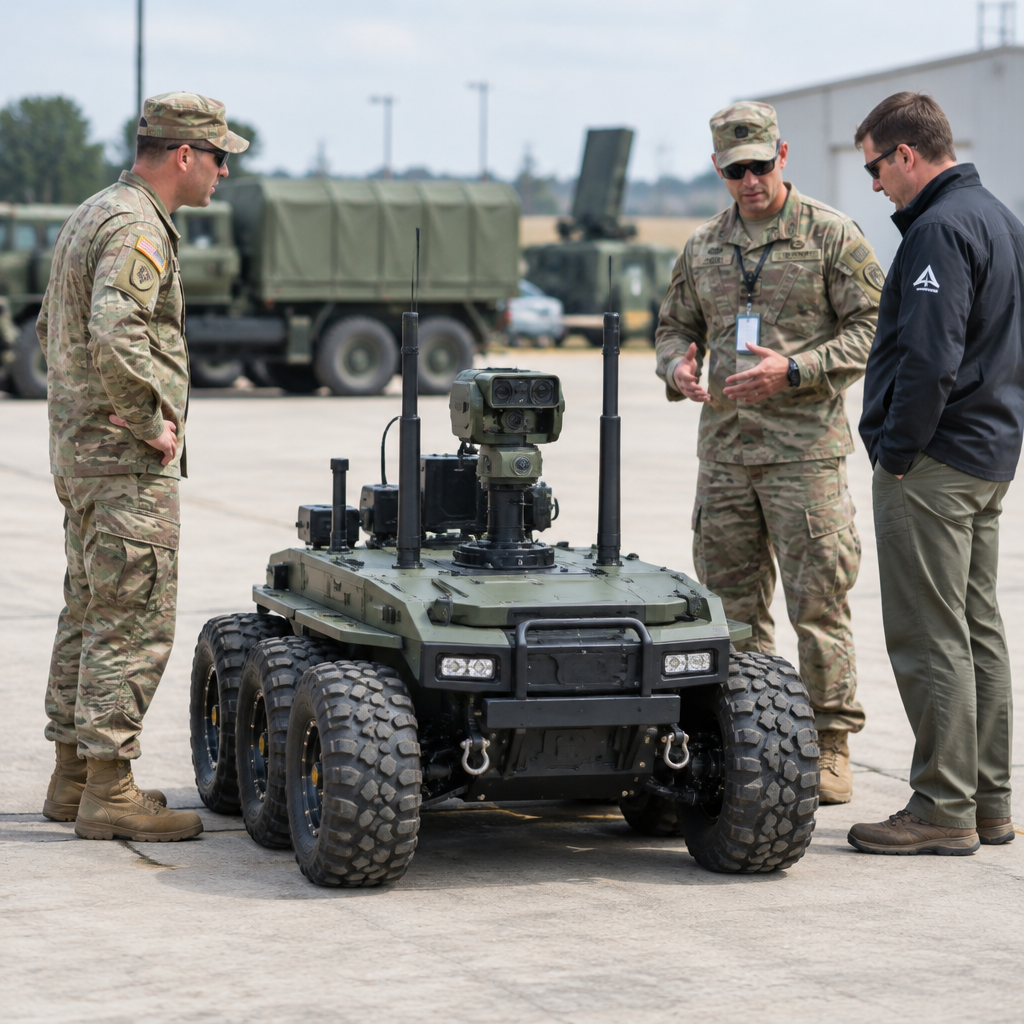
The scale of Ukraine’s purchase and production of unmanned ground vehicles (UGVs) has prompted fresh attention in Washington. The Ukrainian Ministry of Defense says it ordered more than 22,000 UGVs in the first seven months of this year — roughly the same number it ordered in all of 2025. By contrast, the U.S. Defense Department committed more than $115 million to UGV projects in fiscal 2026, according to public records and GovTribe.
Even so, ground robots remain far fewer in number than aerial drones on Ukrainian battlefields. Ukraine produced about 4 million quadcopters and other flying drones in 2025, and ministry officials say 2026 deliveries are moving 3.7 times faster. Russia, meanwhile, is also accelerating production of armed drones. Those dynamics have encouraged manufacturers to keep many UGV designs small and inexpensive, reflecting the expectation that many will be lost in contested zones.
Field roles and combat examples
Ukraine’s UGV fleet has been used for logistics, casualty evacuation and related duties. The TERMIT UGV, for example, can carry up to 300 kg of supplies or wounded soldiers. Combat employment is growing: in the summer of 2025, Ukraine used a Droid TW 12.7 UGV armed with a .50-caliber machine gun to defend a key intersection from repeated attacks, Defense One reported. Russia has employed similar vehicles, including one used as an explosive kamikaze as early as November 2024.
Those battlefield uses illustrate the trade-off nations face between capability and cost: small, commercial-component UGVs that can be attrited quickly, versus larger systems designed to survive and operate in degraded communications environments.

The cyber insurance questionnaire just landed. Now what?
SOC 2, HIPAA, insurance renewals - someone has to own security strategy. Nubivance provides fractional CISO leadership without the full-time salary.
Get a security leadMarine Corps NMESIS and other U.S. programs
The U.S. military’s UGV portfolio reflects a different operational envelope than Kyiv’s immediate needs. Last month the Marine Corps converted an artillery unit into its first Navy‑Marine Expeditionary Ship Interdiction System (NMESIS) battalion. NMESIS outfits UGVs to fire two Naval Strike Missiles at ground and naval targets more than 100 nautical miles away. The system pairs a modified Oshkosh Joint Light Tactical Vehicle with autonomy packages provided by Forterra and Kodiak AI and is part of roughly $92 million in Marine Corps ROGUE Fires orders this year.
Alongside long-range strike concepts, the Marines and the Army’s 75th Ranger Regiment are acquiring more conventional-capability robots. They are spending nearly $25 million to buy more than a dozen IBEX UGVs made by Overland AI for logistics and counter‑UAV defense missions, company officials said. Overland AI also received two contract awards totaling more than $34 million for autonomous breaching capabilities in August and September.
Attritable remote control versus higher-autonomy UGVs
Ukraine’s UGV approach has leaned toward relatively simple, remote-controlled machines using many commercial components. That design philosophy rewards low cost and rapid replacement. U.S. programs, enabled by peacetime research and development budgets, are pursuing higher levels of autonomy and survivability for operations when communications and data networks may be inconsistent.
Byron Boots, Overland AI’s co‑founder and CEO, framed the requirement plainly: “Soldiers train for and are expected to complete the mission in these types of environments, cut off from consistent communications and data networks,” he said in a statement. “Overland AI believes that autonomous systems should be held to the same standard.” Time will tell which approach — mass attritable systems or fewer, more autonomous platforms — proves more successful under fire.
How the Marine Corps, the 75th Ranger Regiment, and Overland AI are responding
- Marine Corps: Converted an artillery unit into a NMESIS battalion and ordered ROGUE Fires systems as part of a $92 million buys package, pairing long-range Naval Strike Missiles with autonomy packages from Forterra and Kodiak AI.
- 75th Ranger Regiment: Participating in purchases of more than a dozen IBEX UGVs alongside the Marines for logistics and counter‑UAV defense, as part of nearly $25 million in buys reported by Overland AI.
- Overland AI: Supplying IBEX vehicles for logistics and counter‑UAV missions, and winning two contract awards totaling more than $34 million for autonomous breaching capabilities in August and September.
The U.S. is not yet buying UGVs at Ukrainian scale, but it is beginning to mirror Kyiv’s embrace of ground robots while pursuing divergent technical paths. Kyiv’s volumes and battlefield usage have demonstrated the tactical utility of small, replaceable machines; U.S. programs are experimenting with autonomy, long-range fires and hardened platforms for contested communications environments. The unresolved question is empirical: whether mass, attritable robots or fewer, higher‑autonomy systems will deliver greater operational advantage when put to the test.