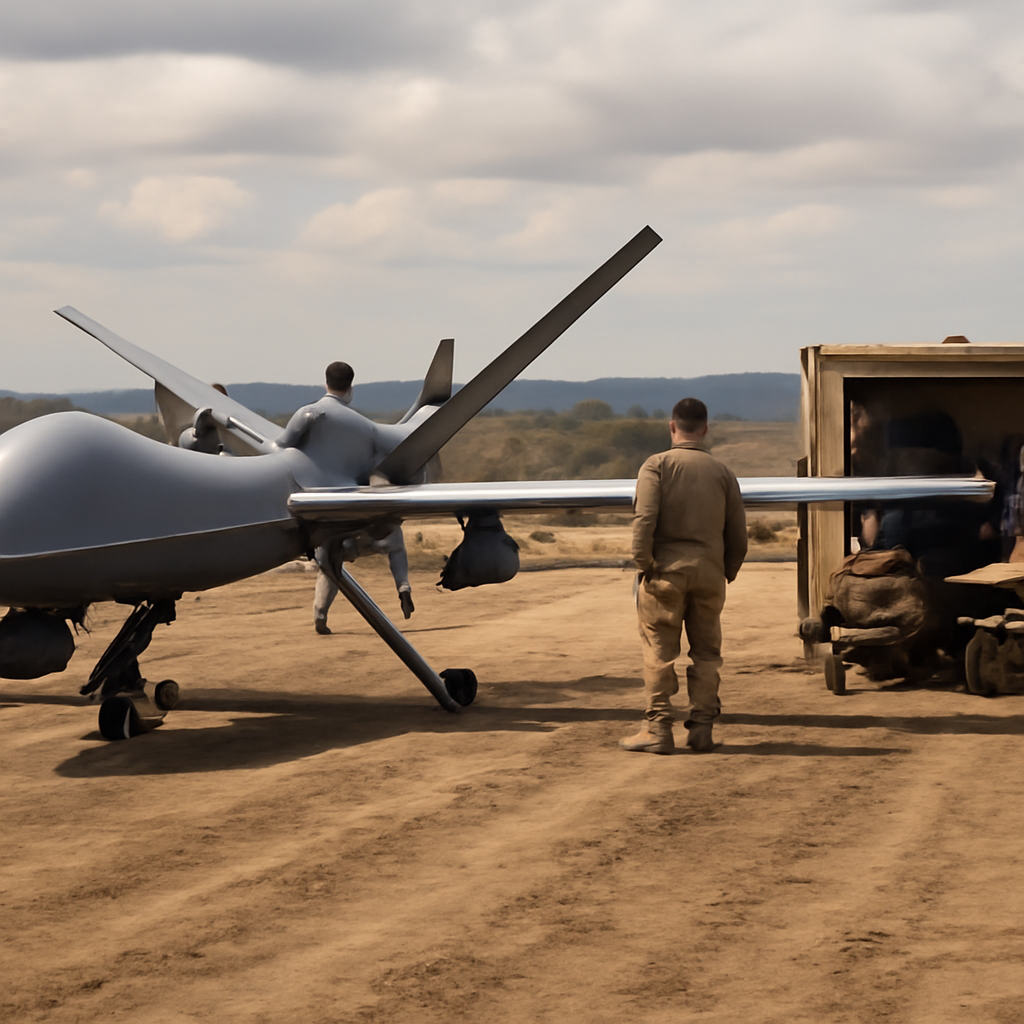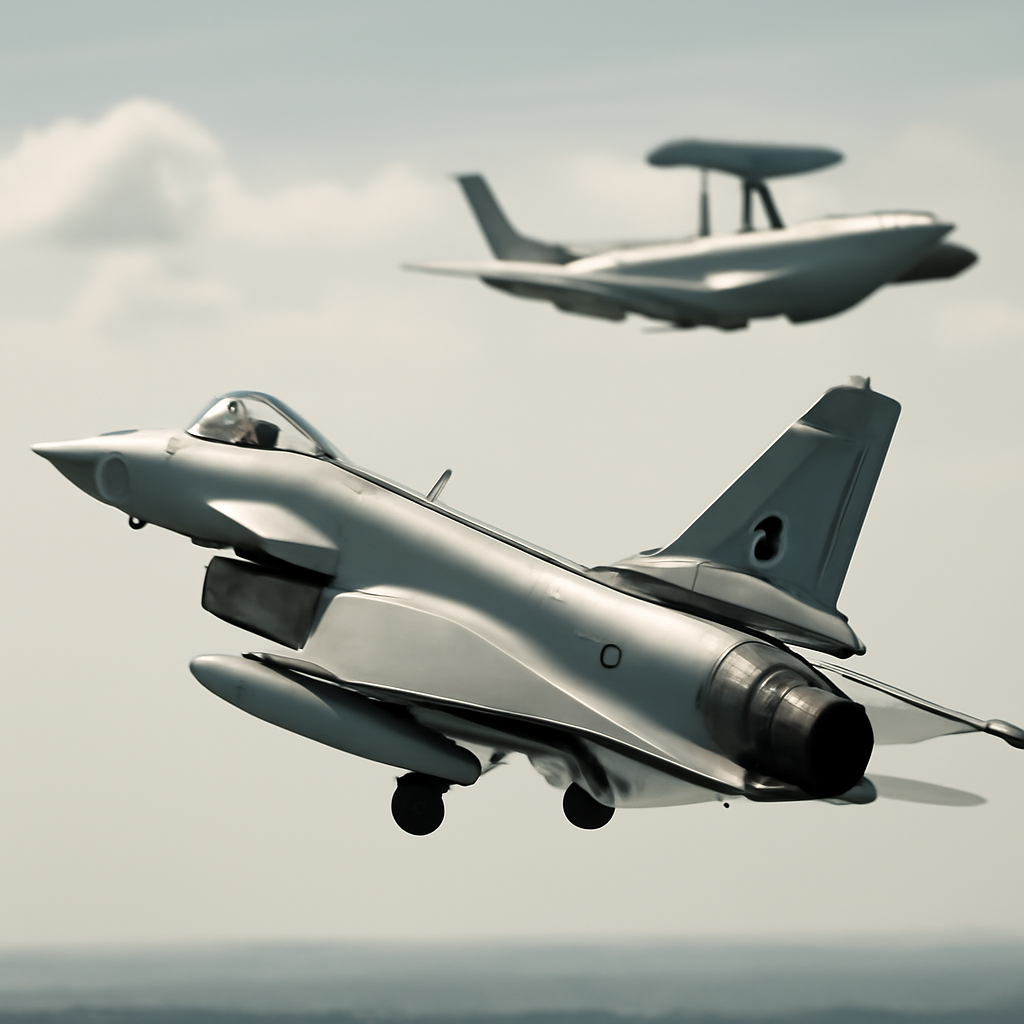
"My radar is then locked onto the target and is linking info to the missile until a certain range, when the missile switches on to its own AESA seeker."
How the AWACS-to-missile narrative coalesced
The now-common account that Pakistan Air Force (PAF) J-10C fighters used PL-15E beyond-visual-range missiles guided midcourse by an Erieye AEW&C first emerged as a layered reconstruction, not as a single confirmed account. The framing began with China Space News on 12 May 2025, which described the engagement in doctrinal terms — a weapon “launched by ‘A’, guided by ‘B’, and hitting the target assigned by ‘C’.” That abstract formulation was taken up and translated into a specific kill-chain hypothesis by Michael Dahm in an interview published on 19 May 2025, who said the sequence “may have started” with ground radar illumination and “probably at range” involved an airborne early warning aircraft using a midcourse datalink to update a missile. Sébastien Roblin described the PL-15’s design to accept AEW&C midcourse guidance in Asia Times on 15 May 2025. Colonel (Retd.) Ajai Shukla introduced the XS-3 designation into public debate on 9 June 2025, suggesting PAF may have “likely switched to Chinese data links such as the XS-3” and offering a hedged “visualization” of an ambush enabled by that link. Over the following months the hypothesis moved from hedged analysis to widespread summarization on platforms from Wikipedia to defence aggregators.
What PAF personnel described to Alan Warnes
The only published account based on PAF access is Alan Warnes’ "Understanding the Rafale Kills" (Key Aero, Sept/Oct 2025), following Warnes’ mid‑July 2025 visit. Warnes records a senior PAF pilot saying the fighter’s radar locked the target and linked information to the missile until the weapon’s own AESA seeker activated — a conventional AWACS-assisted engagement in which the Erieye provided the battlespace picture but the J-10C’s radar performed the final missile guidance. Warnes also relays his own speculation: “Unless of course the J-10 did not switch on its radar, and the target information was data linked to the fighter that then fired the PL-15.” He cites IISS material noting the PL-15 “supports a mini-course two-way datalink led by AEW&C aircraft” via Chinese XS-3, but Warnes does not attribute operational use of XS-3 to PAF officers.

Audit-ready is a season. It shouldn't be.
Evidence in spreadsheets, controls drifting between audits, frameworks multiplying on flat headcount. Nubivance runs continuous compliance on Rapid7 Cyber GRC - SOC 2, HIPAA, ISO 27001, PCI, CMMC.
End the scrambleTechnical lines: Link 17, Skyguard, XS-3 and export realities
Public commentary named several different tactical data-link (TDL) paths. Warnes reports the Erieye assigned targets and provided the air picture via Link 17/Skyguard. Shukla introduced XS-3 as a PLA tactical broadband data link; subsequent reporting repeated XS-3 as if confirmed. The record, however, contains no published confirmation from Pakistani, Chinese, or Western intelligence sources that the PAF operates XS-3 or an equivalent data link. The source material further observes that true AWACS-to-munition capabilities are scarce: “this specific AWACS-to-Munition capability is very limited in availability, perhaps only deployed at scale by China and the United States.” It also states the XS-3 is “unlikely to be available for export at this time,” even as China may be developing analogous offers tied to J-35AE and KJ-500E proposals made in June 2025.
How multiple layers — EW, space, and Erieye — shaped outcomes
Beyond single-link mechanics, Warnes’ PAF-access reporting stresses a multi-layered kill chain. Electronic warfare and cyber operations allegedly disrupted Indian Air Force (IAF) data links, jammed communications, and degraded the Spectra warning system. PAF Space Command provided ISR and GNSS data distribution that bypassed line-of-sight limits. Link 17/Skyguard supplied a unified, encrypted air picture across Western- and Chinese-origin platforms, while the Saab 2000 Erieye managed the battlespace and assigned targets from deep inside Pakistani airspace. J-10Cs then engaged at ranges the fighters’ own radars could plausibly cover — PAF-reported engagement ranges of 160–190 km fall within the J-10CE radar’s assessed detection envelope of approximately 200 km, making full AWACS-to-missile midcourse guidance unnecessary in at least some scenarios.
What this means for the PAF, procurement partners, and analysts
- PAF leadership and planners: The source notes a likely desire within the PAF for a sovereign, distributed sensor–shooter network and for MUM-T workflows, but states such a next‑generation TDL program is probably still developmental and will require co-acquisition of both munitions and guiding sensors to field true AWACS-to-munition capability.
- Procurement partners and co-developers (Turkiye, Aselsan, MilSOFT): The record highlights Pakistan’s earlier use of Turkiye’s MilSOFT for a naval TDL (Link‑Green) and points to Aselsan’s ongoing development of next-gen TDLs as a model for how PAF capability could evolve — constrained, as Warnes notes, by the hardware available at the time of each program’s development.
- Analysts and public reporting: The chain from doctrinal phrasing to firm assertion shows how hedged hypotheses from mid‑May and June 2025 hardened into accepted narrative. Where first‑party PAF testimony exists, it describes radar‑to‑missile handover and AESA seeker activation rather than confirmed AWACS‑to‑missile midcourse control via XS‑3.
The 7 May 2025 engagements produced clear tactical effects. What remains visible in the public record is a kill chain stitched from multiple, interoperating layers — Erieye-managed battlespace control, shared encrypted pictures, space-enabled ISR and GNSS flows, electronic attack, and fighter radars doing the fine work of missile guidance. Whether that chain relied on a single XS‑3‑style link or on a mosaic of Link‑17, Skyguard, and platform radars is the practical question that follows the factual ledger: Pakistan appears to be pursuing a next‑generation TDL capability, but the source material describes that capability as developmental, hardware‑limited, and not yet the straightforward, exportable product some early narratives implied.