“Through the Pakistan Army, we are trying to establish a direct link with Powerus and gain access to prototypes,” a representative of a Pakistani company told Quwa, capturing the practical impulse behind a ripple of private-sector interest in an American drone supplier that signed an MoU with Pakistan’s Ministry of Defence in September 2026.
Powerus MoU with Pakistan’s Ministry of Defence
The September 2026 memorandum of understanding between Powerus, described in reporting as an American drone supplier, and Pakistan’s Ministry of Defence is the immediate catalyst for private-sector outreach. The MoU has prompted Pakistani companies to seek formal or informal ties to Powerus for access to technology and potential collaboration. Quwa reports some firms are pursuing direct channels through the Pakistan Army to obtain prototypes.
Private companies’ aims: prototypes, production scale, and export
Pakistani private sector firms are framing partnerships with Powerus as a way to accelerate domestic production and potentially supply overseas markets. Companies told Quwa they are pursuing direct links to gain access to prototypes and to position themselves as manufacturing or integration partners. The commercial calculus is explicit in the reporting: the Pakistani military is aiming to procure large numbers of drones and is relying increasingly on private companies to expand production capacity rapidly while also reducing acquisition costs.

Audit-ready is a season. It shouldn't be.
Evidence in spreadsheets, controls drifting between audits, frameworks multiplying on flat headcount. Nubivance runs continuous compliance on Rapid7 Cyber GRC - SOC 2, HIPAA, ISO 27001, PCI, CMMC.
End the scrambleTechnologies on display at Indus RAS Expo 2026
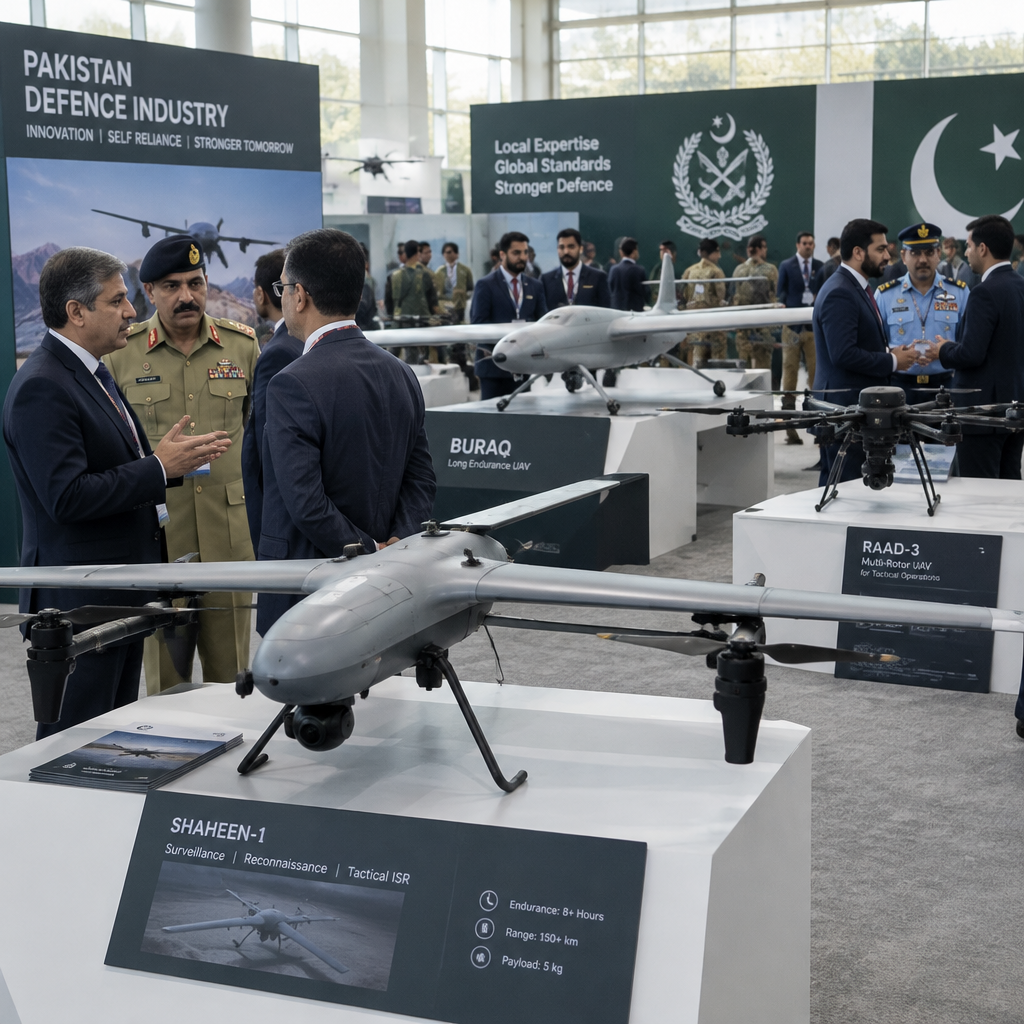
Government-hosted events are part of the backdrop. In July, Pakistan’s Ministry of IT and Telecom held the inaugural Indus Robotics and Autonomous Systems Expo (Indus RAS Expo 2026), which Quwa says showcased the rapid traction of Pakistan’s private sector in drone design and production. Exhibits and demonstrations at that event reflect a growing local capability base: companies are developing one-way attack (OWA) loitering munitions, interceptors, first-person-view (FPV) quadcopters, and supporting technologies such as data links, integration with off-board sensors like radars, and AI-driven autonomous systems.
Pakistan Army negotiations and market dynamics
Quwa notes the Pakistan Army is directly negotiating with certain foreign vendors, including Powerus. That dual approach—direct military-to-vendor talks alongside private-sector outreach—creates parallel channels for technology transfer and procurement. For Pakistani firms, the presence of army-led negotiations is motivating efforts to position themselves as local partners rather than passive buyers. Companies that have engaged other foreign vendors, such as Ukraine’s Fire Point, are now looking to align with Powerus as well, indicating an active search for multiple international collaborations.
What this means for Pakistani drone firms, the Pakistan Army, and foreign vendors
- Pakistani drone firms: They are seeking prototype access and partnership agreements to move from design to volume production, and are explicitly eyeing export opportunities if they can link with foreign suppliers like Powerus.
- The Pakistan Army: By negotiating directly with foreign vendors while leveraging private firms, the army aims to scale procurement quickly and manage acquisition costs—an approach that depends on integrating private manufacturing into military supply chains.
- Foreign vendors (including Powerus and Fire Point): These companies face a market where local partners seek not only contracts but also technical transfers and access to prototypes; the commercial terms and willingness to share prototypes will shape whether Pakistani firms evolve into exporters or remain domestic assemblers.
The facts in the reporting point to a simple but consequential sequence: an MoU with Powerus has sharpened private-sector activity; an inaugural industry expo in July showcased substantive local capabilities; and the Pakistan Army’s parallel negotiations with foreign vendors have encouraged local companies to seek closer ties and prototype access. The central unanswered move is procedural and commercial: whether prototype access and formal partnerships will be negotiated into place so that Pakistani firms can scale production and participate in export markets. For those watching defence industrial development in Pakistan, the MoU and the private sector response together mark a pivot from isolated development to an explicitly collaborative, market-oriented pace of growth.