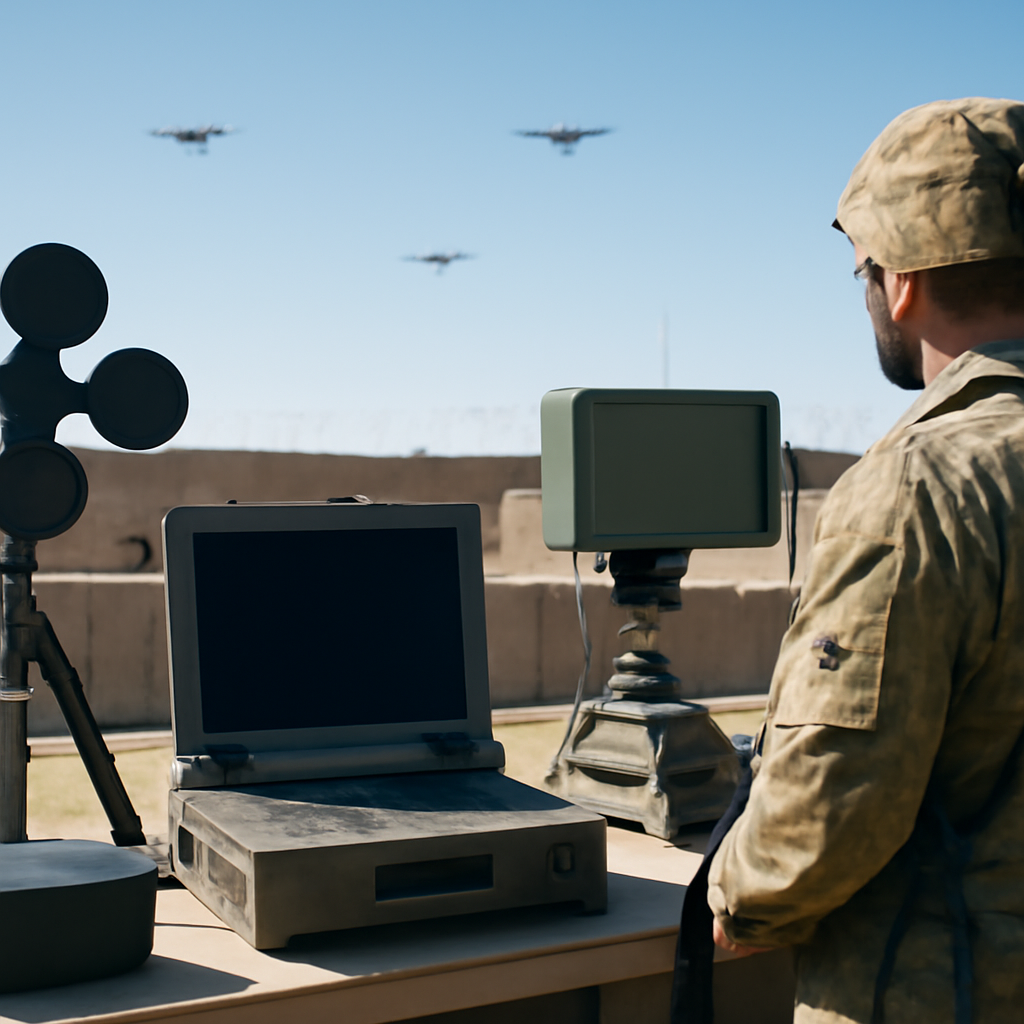
Alsons Group used Eurosatory 2026 in Paris to unveil what it called Pakistan’s first domestically manufactured uncrewed aerial vehicle (UAV) engines.
Alsons Group and Advanced Kinetic Aerospace Labs
The Alsons Group, a Karachi industrial conglomerate better known for auto parts and electronics, announced an in-house division named Advanced Kinetic Aerospace Labs and displayed a family of four small piston engines at Eurosatory 2026. The firm’s move marks a shift: private companies in Pakistan are now taking work that was once the preserve of state plants, building parts and systems for drones and munitions.
The engines: small piston power for low-cost drones
Alsons presented four small piston engines pitched at the lower end of the drone market — the kind of propulsion that turns an inexpensive airframe into a loitering munition or a target drone. Those piston units are intended for attritable hardware: systems designed to be inexpensive and, in many cases, expended in use. The reveal emphasises propulsion rather than airframes, because engines are a limiting input Pakistan has historically lacked at the small end of the scale.

The cyber insurance questionnaire just landed. Now what?
SOC 2, HIPAA, insurance renewals - someone has to own security strategy. Nubivance provides fractional CISO leadership without the full-time salary.
Get a security leadCost dynamics: rupee economics, mass production, and lessons from Ukraine
The company’s timing and pitch reflect a wider procurement logic explained at the showroom: low-cost strike moved to the centre of Pakistan’s thinking after observations of the war in Ukraine, where cheap, mass-produced systems altered the economics of targeting. Engines paid for in rupees rather than hard currency are central to making a domestic loitering-munition line affordable at volume. That calculation is sharpened by budgetary pressure — Pakistan’s 17.65% defence spending increase for 2025–26 was partly eaten by a weaker rupee — strengthening incentives to localise supply chains.
Design choices mirrored across the market
The Alsons example fits a broader pattern: producers lean on proven, licensed designs and commercial off‑the‑shelf subsystems to hold down cost and complexity. At DSEI 2025, MBDA unveiled the Crossbow “one-way effector heavy,” a ground-launched weapon built around the compact PBS TJ100 turbojet and designed to carry up to 300kg out to ranges in excess of 800km; the Crossbow’s appeal is its simplicity. The same approach is shaping other cruise- and strike-weapon programs — fewer sensors, cheaper engines, faster production — and appears in Russia’s and Ukraine’s recent cruise missile developments, including the Swiwin-powered S8000 Banderol. Pakistan already possesses building blocks for that approach in its Fatah-series and Babur cruise missiles, and in smaller programs that trim flight-control sensors back to satellite guidance to reduce unit cost. What Pakistan lacked until now, by its own mid-market calculus, was small propulsion — the gap Alsons and private peers are now targeting.
Launch systems, distribution, and export ambitions
Alongside engines, Pakistan has been testing ways to launch drones and missiles from dispersed, improvised sites rather than fixed airfields — a model that only works economically when the munitions feeding it are cheap and locally made. At Eurosatory, Alsons used the unveiling to court interest and possible export deals that would justify scaling its line. The company’s engines are still a starting position rather than a finished capability; whether international or domestic demand materialises, and whether other firms follow with electric and turbojet designs, is a thread the source says to watch through the rest of 2026.
What this means for the Pakistan military, private firms, and potential buyers
- The Pakistan military: cheaper, locally produced engines could make dispersed launch concepts practical by reducing per-unit cost for loitering munitions and target drones, enabling broader operational patterns that depend on mass-produced ordnance.
- Private firms and domestic supply chains: Alsons’ move signals a pathway for other private companies to enter propulsion and subsystems production; success at scale will hinge on securing orders and possibly export deals to justify investment.
- Potential buyers and export markets: the engines were displayed at Eurosatory to attract interest — export demand, if realised, would underpin scaling — but the engines remain an initial step rather than a proven export catalogue item.
Alsons’ piston-engine reveal is a clear, concrete pivot: move propulsion from foreign supply toward domestic, low-cost production and the arithmetic behind massed, attritable strike systems changes. The central question left on the table is pragmatic rather than technical — will commercial interest and follow-on development through 2026 turn these engines from a showpiece into a volume line, and will other firms bring electric or turbojet alternatives to complete the small‑end propulsion ecosystem?
Source: Quwa — Pakistan’s First Home-Built Drone Engines Point to a Cheaper, Bigger Strike Arsenal