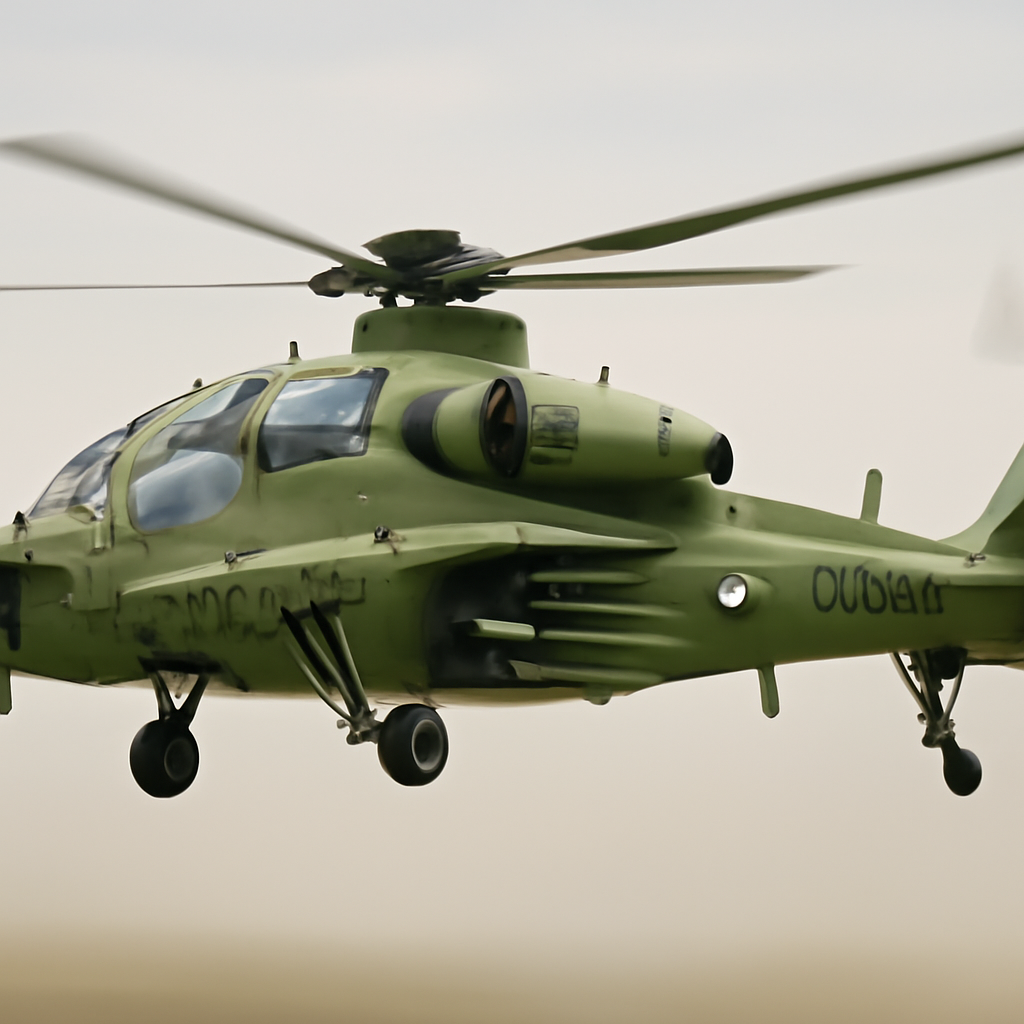
On 25 September, a photo on Chinese social media showed a Pakistan Army Aviation Corps Z-10ME-02 marked “786-305,” indicating it is the fifth helicopter of that particular variant in Pakistan’s service.
Photo, designation, and immediate status
The image surfaced publicly on 25 September and portrays an apparent Z-10ME-02 flying in tests with the unit designation 786-305. According to Quwa’s reporting, the designation confirms this airframe as the fifth Z-10ME-02 in Pakistan Army Aviation Corps (PAA) service. The PAA formally inducted its first Z-10ME-02 in August 2025 and currently operates two of the type, with additional units on order but not publicly disclosed in number.
What the Z-10ME-02 is and how it differs from earlier helicopters
Manufactured by Changhe Aircraft Industries Corporation (CAIC) and sold by Aviation Industry Corporation of China (AVIC), the Z-10ME-02 is an upgraded derivative of the Z-10. Quwa lists specific platform improvements: reinforced armour around the canopy and under the fuselage; improved sand and small debris filtration; a revised engine exhaust; and upgraded electronics subsystems. Compared to the PAA’s existing Bell AH-1F/S Cobra fleet, the Z-10ME-02 adds modern capabilities such as the capacity to employ fire-and-forget anti-tank guided missiles, electro-optical/infrared (EO/IR) turrets, and an integrated defensive aids suite (DAS).

The cyber insurance questionnaire just landed. Now what?
SOC 2, HIPAA, insurance renewals - someone has to own security strategy. Nubivance provides fractional CISO leadership without the full-time salary.
Get a security leadLonger-range weapons, sensors, and new mission geometry
The Z-10ME-02 brings capabilities to Pakistan’s helicopter arm that go beyond the Cobra’s traditional close air support, anti-armour and anti-infantry roles. Quwa highlights two capability clusters that reshuffle mission options: stand-off weapons (SOWs) and millimeter-wave (mmW) radar sensors. Pakistan’s envisioned SOWs include the CM-501GA and other cruise missiles such as the Rasoob 250. Those weapons, the analysis argues, permit precision strikes from beyond the reach of short-range air defence systems (SHORADS).
Concurrently, a mmW radar package would enable high-resolution ground awareness at low altitude — allowing nap-of-the-earth employment with better situational awareness in dusty or rough-weather environments. The platform’s potential to carry air-to-air missiles (AAMs) also gives it a measure of self-defence and the ability to engage helicopters and drones.
How the Z-10ME-02 fits into Pakistan’s strike and sensing architecture
Quwa frames the helicopter as a force-multiplier within a broader Pakistani strike ecosystem. In the scenario described, the Pakistan Air Force (PAF) and the Army Rocket Force Command (ARFC) might first attack an adversary’s air-defence node using airstrikes or land-based rocket/cruise strikes. Satellites — potentially including an interferometric synthetic aperture radar (InSAR) constellation Pakistan is trying to build — could carry out battle damage assessment. If targets remain, Z-10ME-02s equipped with SOWs could follow up with low-altitude, precision strikes.
That loop — long-range strike, space-based assessment, and low-altitude helicopter follow-up — would depend on data flows into a larger integrated battlefield management system (IBMFS) and, critically, tactical data-links (TDLs). Quwa acknowledges the outcome is contingent on the quality of Pakistan’s ongoing network-enabled warfare efforts, but also notes the Army is actively building air, land, and long-range precision strike capabilities that make such integration plausible at least within the Army’s own systems.
Procurement history, fleet plans, and lingering program choices
The Z-10ME-02 is the culmination of nearly 15 years of effort to replace aging Cobras. The PAA had earlier contracted Bell-Textron for 12–15 AH-1Zs and Turkish Aerospace Industries (TUSAŞ) for 30 T129 ATAKs, but both programs failed to reach fruition. Quwa states those programs collapsed because of a U.S.-led restriction on the use of Foreign Military Financing (FMF) for the AH-1Zs and a refusal to release engines for the T129s. Following those setbacks, the PAA selected the Z-10ME-02 and contracted CAIC to adapt the platform for improved desert operability — an environment for which the PAA originally wanted the AH-1Z.
Quwa infers the initial tranche of Z-10ME-02s may be in the 12–15 range and that the PAA is likely planning for a total fleet of 45–60 units. The report also notes Pakistan previously tested the lighter-weight Chinese Z-19 in 2015–2016 and trialled the T129 in high-altitude and austere-temperature conditions, suggesting the Army has tested a mix of heavier and lighter helicopters for different operational theatres. TUSAŞ had indicated the TS1500 turboshaft engine could be integrated into the T129, prompting Quwa’s observation that the PAA might still reconsider the ATAK for counterinsurgency and counter-terrorism missions.
What this means for the Pakistan Army, the Pakistan Air Force, and the Army Rocket Force Command
- Pakistan Army Aviation Corps: The Z-10ME-02 expands the Army’s low-altitude strike and sensing options, enabling stand-off strikes, mmW-enabled nap-of-the-earth operations, and tighter integration with ground and long-range strike assets if TDLs and the IBMFS mature.
- Pakistan Air Force: The platform is described as a complementary, lower-altitude element to the PAF’s “high-altitude” presence; its arrival could change tasking between services for battlefield suppression and localized follow-up strikes.
- Army Rocket Force Command: The Z-10ME-02 offers a rapid, mobile means to deliver follow-up precision strikes against hardened or surviving targets identified after ARFC strikes and satellite reconnaissance.
The photographed airframe marked 786-305 is a visible sign that the Z-10ME-02 program is moving from procurement to operational testing. The key variables now will be how many airframes are delivered, how quickly tactical data-links and the integrated battlefield management layers solidify, and whether the PAA ultimately complements the Z-10ME-02 fleet with lighter or alternative attack helicopters for counterinsurgency and western-region operations.
https://quwa.org/pakistan-army-news/photo-emerges-of-pakistans-5th-changhe-z-10me-attack-helicopter/