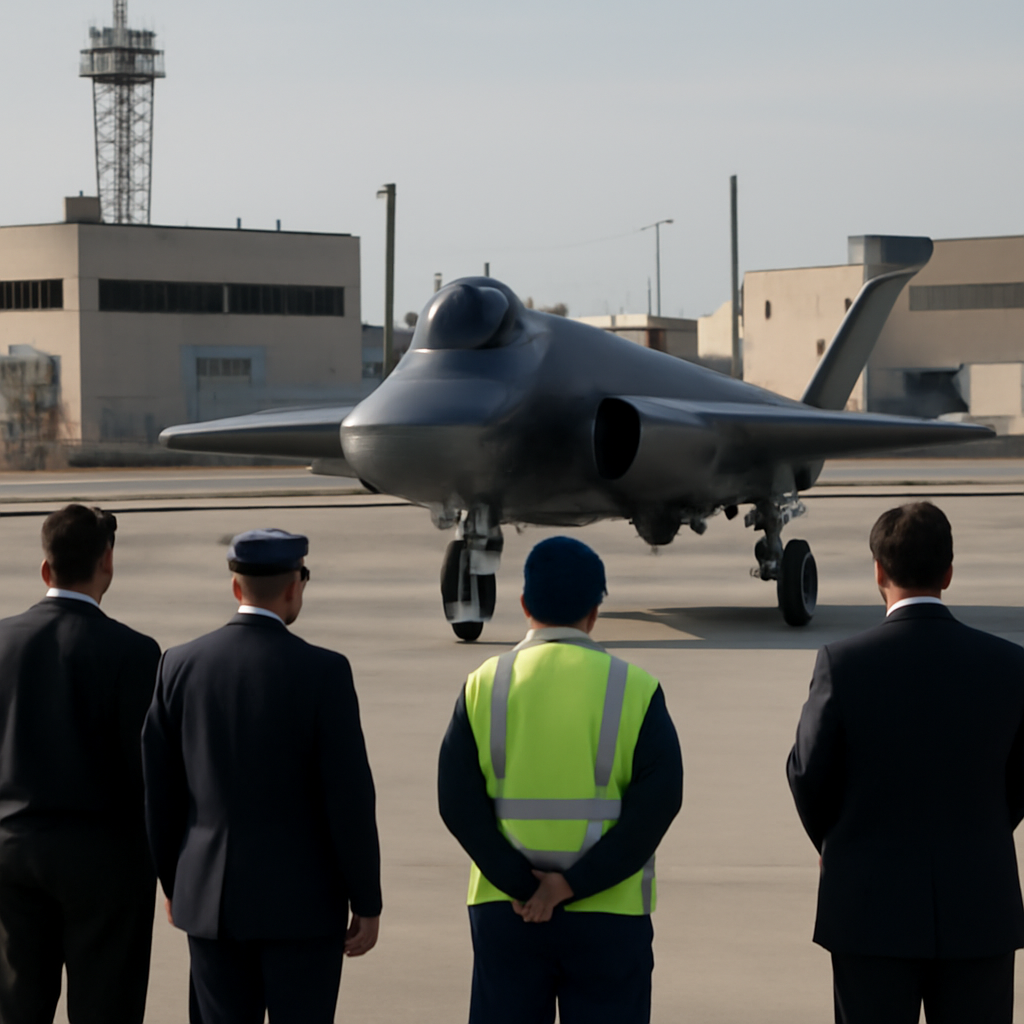
"Pakistan should have joined," Aseem argues — a verdict aired on Quwa's Pulse Check as Türkiye's KAAN program moves from prototype taxi tests toward deliveries and Pakistan reconsiders its fighter-replacement options.
Where KAAN stands and what it offers
Turkish Aerospace Industries (TUSAŞ) has completed the first taxi test of P1, the second KAAN prototype and the first airframe assembled as a fully integrated test article. TUSAŞ is targeting first deliveries to the Turkish Air Force by the end of the decade, and plans for Block 30 aircraft to fly on the indigenous TEI TF35000 turbofan from around 2033. That timeline places KAAN squarely inside the Pakistan Air Force’s (PAF) requirement to replace its oldest F-16A/B Block-15 airframes by 2040 — a competition the PAF now faces between KAAN and China’s Shenyang J-35AE.
How Türkiye organised TF‑X/KAAN differently
Aseem’s central claim: Türkiye treated TF‑X as a national-priority program with sustained funding, a dedicated TUSAŞ division, and engineers rather than administrators in charge. TUSAŞ built new factories and wind tunnels, invested in upstream work (alloys, gas turbines, composites), and acknowledged limits by contracting BAE Systems “to lend it a workforce to learn from.” NATO membership further opened technologies and supplier relationships that, the episode argues, Pakistan has never had.

The cyber insurance questionnaire just landed. Now what?
SOC 2, HIPAA, insurance renewals - someone has to own security strategy. Nubivance provides fractional CISO leadership without the full-time salary.
Get a security leadThe Pakistani engineers at TUSAŞ — what the numbers actually mean
Several hundred Pakistani engineers have worked at TUSAŞ, but their presence has been widely misread as official PAF or Pakistan Aeronautical Complex (PAC) participation. Most arrived through BAE Systems, which offered its workforce deployments and found a large number of Pakistani‑origin engineers — many British citizens, some second‑ or third‑generation, and several who had never lived in Pakistan. TUSAŞ also hired globally and maintains a subsidiary office in Pakistan for extended support work. A separate, much smaller cohort did come through an arrangement with Pakistani state-owned enterprises; Aseem declined to put a figure on it but said it was well short of numbers circulated publicly.
Crucially, TUSAŞ partitioned the aircraft’s work: roughly 80 percent of parts were open to engineers from anywhere, while radars and electronic systems were restricted to Turkish nationals working through ASELSAN and TÜBİTAK. That security posture — different from the F‑35 model of citizenship-and-clearance gating the entire program — is what allowed Türkiye to recruit at scale.
Why 2016 was the window Pakistan declined
Türkiye began inviting Pakistan into TF‑X from at least 2016. Quwa recommended taking that offer in 2016 and 2017 on the simple logic that there was no reason to run identical programs in parallel when a partner was willing to carry the industrial burden. Entering early, when program risk was highest and the price of entry lowest, would have yielded substantially better co‑production, offset and technology‑sharing terms than are likely available today.
Two factors impeded Pakistan’s move at the time, according to the episode: Pakistani decision‑makers misjudged TUSAŞ as merely an assembly operation comparable to PAC — a view that collapsed for anyone who visited Ankara — and the decision to decline was taken without transparency or external expertise weighing in.
PAC’s constraint and the nuclear-program analogy
TUSAŞ delegations toured PAC’s Aircraft Manufacturing Factory (AMF) and concluded Pakistan could manufacture KAAN components; but they also saw what they were not shown: Pakistan does not produce the raw materials those parts require — they arrive from China — and prohibited import lists would block sourcing them elsewhere even with funding. Aseem characterised AMF as functioning like a Chinese factory inside Pakistan rather than a Pakistani factory building Pakistani aircraft.
Bilal Khan responded by drawing a parallel with Pakistan’s nuclear effort: when export controls barred materials, Pakistan treated the Pakistan Atomic Energy Commission (PAEC) as a national champion and forced indigenous development of alloys and forging capability. Khan Research Laboratories began with metallurgical work; firms such as Descon and other private companies gained experience through an early public‑private partnership. Türkiye faced the same material barrier — “nobody sells stealth‑grade alloys to anyone” — but sustained the horizontal industrial work that Pakistan did not maintain after clearing its security threshold.
What this means for the PAF, Pakistani firms, and TUSAŞ
- Pakistan Air Force and defence policymakers: The PAF’s next procurement cycle opens around 2030, and the choice to commit early will materially affect the terms it can secure on KAAN or the J‑35AE. The Makkah Joint Defence Agreement (signed 07 August 2026 by Saudi Arabia, Türkiye and Pakistan) could offer a capacity‑building route into Turkish programs with Gulf capital attached, potentially changing bargaining leverage.
- Pakistani aerospace firms and engineers (PAC, NESCOM, private sector): Declining to join KAAN in 2016 foreclosed an immediate path to co‑production and technology transfer; had Pakistan joined, NESCOM might have taken roles such as loyal‑wingman UCAV work and domestic firms might have absorbed graduates rather than exporting them. Rebuilding the upstream base (alloys, turbines, composites) remains a prerequisite to true independence.
- TUSAŞ and Turkish partners (ASELSAN, TÜBİTAK, BAE Systems): Türkiye’s model — a dedicated TF‑X division, deliberate security partitioning, foreign workforce integration, and targeted upstream investment — has created an industrial path to fielding KAAN and offers a replicable template for partners who bring capital and clear political will.
Conclusion: The record since 2016 is not encouraging for those who believe Pakistan missed a decisive industrial opportunity. KAAN is now a live, maturing competitor for the PAF’s post‑2040 fighter needs; the strategic choice Pakistan made a decade ago left it building a parallel Project AZM instead. Whether the Makkah Joint Defence Agreement and Gulf capital will reopen better terms, or whether Pakistan will replicate the horizontal industrial investments Türkiye made, are the concrete questions the next procurement cycle will answer.