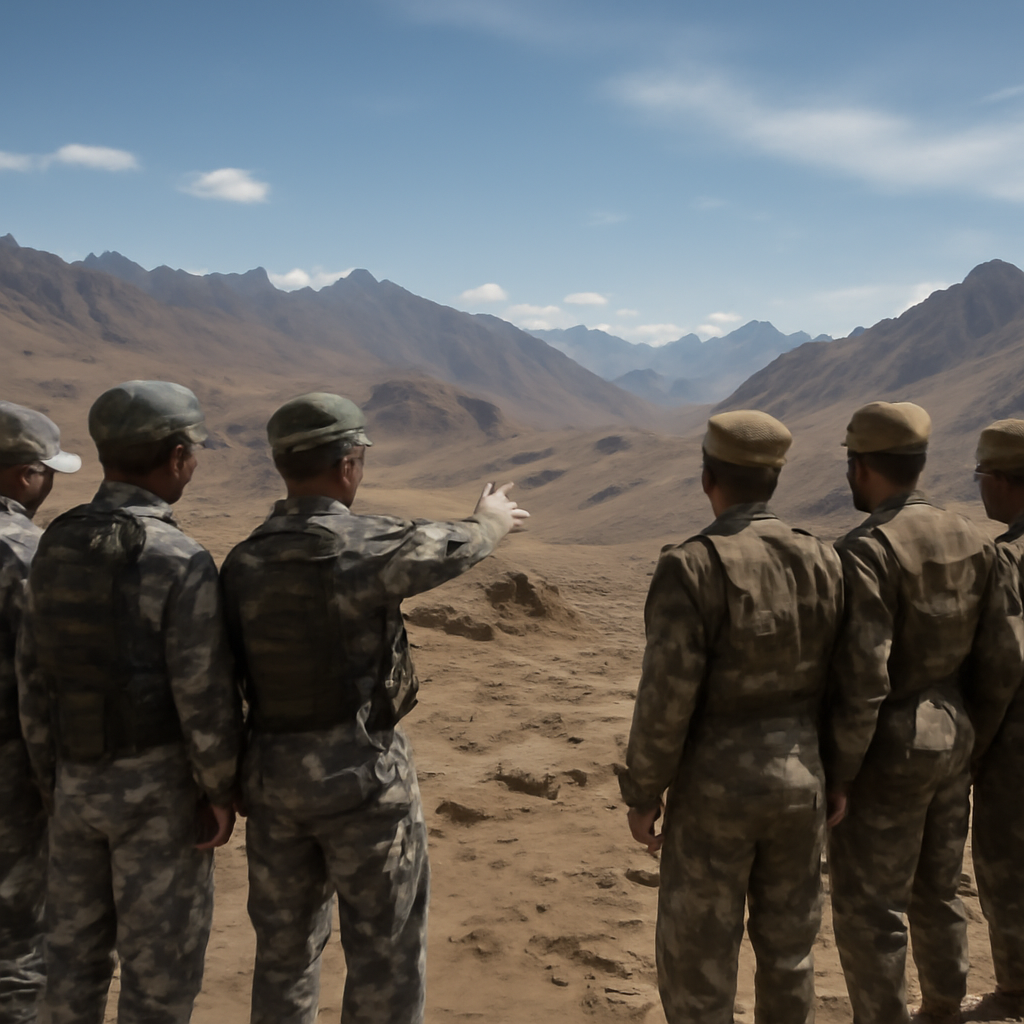
What happens when a state that has long pursued an indirect approach decides to strike at the heart of its foe? Pakistan’s recent strikes, according to reporting, indicate a clear shift: the country is prepared to take the fight directly to the Taliban leadership’s inner circle if the Taliban regime continues to support groups that act against Pakistani interests.
What the reported strikes signal
The central fact reported is straightforward: Pakistan has carried out strikes and those strikes signal an intent. The reporting frames them as a deliberate message that Pakistan is willing to escalate the geographic and political scope of its operations to directly target the Taliban leadership’s inner circle should support for anti-Pakistan groups persist. That framing turns a tactical action into a strategic posture: strikes are not merely responses but a signal intended to shape the Taliban regime’s calculations.
Context and immediate implications
Viewed through the lens of the reported statement, the situation presents a dilemma. On one hand, the strikes can be read as a deterrent—an effort to alter behavior by raising the cost of continued support for hostile actors. On the other, they risk provoking an escalation if the Taliban regime interprets the strikes as an attack designed to decapitate or destabilize its leadership rather than as targeted pressure to change policies toward anti-Pakistan groups.
Because the report ties Pakistan’s intent to conditional behavior by the Taliban regime—continuing support for anti-Pakistan groups—the strikes function as both punishment and warning. That dual character makes them an instrument of coercive diplomacy as much as of military action, and it compels actors across the region to reassess risk calculations and contingency plans.

This site is the portfolio.
OSINTSights runs on Cloudflare Workers, D1, R2, and Vectorize, with an AI pipeline on Hetzner ARM. Nubivance designed, built, and operates it. We do the same for clients.
See what we buildWhy this matters: perspectives to consider
- Policymakers: The reported willingness to strike the Taliban leadership’s inner circle reshapes strategic choices. Decision-makers must weigh whether the strikes will achieve compliance from the Taliban regime or harden its stance. They must also consider escalation ladders and the potential for miscalculation if deterrence fails.
- Security analysts and military planners: The strikes suggest a readiness to expand target sets from peripheral actors to principal leadership, which implies changes in intelligence priorities, rules of engagement, and cross-border operational planning. Planners must prepare for rapid shifts in the operational environment if the Taliban regime responds asymmetrically or escalates in kind.
- Regional actors and neighbors: Even without additional details, the reported posture forces neighboring states to review their own threat assessments. A campaign that targets leadership figures can have spillover effects—political, humanitarian, or security-related—that may necessitate diplomatic engagement or contingency readiness.
- Nonstate users and adversaries: Groups that have relied on sanctuary or support could see the strikes as a signal that tolerance for their presence is decreasing. They may alter tactics—dispersing leadership, relocating assets, or accelerating attacks—to adapt to a higher-risk operating environment.
- Technologists and information operators: In any modern campaign, messaging and information control matter. The strikes, framed as a signal, will be shaped and amplified across media and communication channels. Actors with technological means can exploit narratives of provocation or victimhood to mobilize support, complicate attribution, or obfuscate chains of command.
Potential trajectories and risks
The reported posture opens multiple plausible trajectories. One path leads to successful coercion: sustained pressure compels the Taliban regime to curtail support for anti-Pakistan groups, reducing cross-border attacks and restoring a fragile stability. Another path leads to tit-for-tat escalation, which could broaden clashes, endanger civilians, and invite third-party involvement. A third path involves strategic muddling, where neither side fully capitulates and conflict becomes a protracted low-intensity contest with periodic spikes.
Each trajectory carries risks. Targeting a leadership inner circle raises the stakes politically and militarily. Even if intended as a calibrated signal, such strikes can be misread, mishandled, or leveraged by actors seeking to exploit instability. The conditionality embedded in the reported statement—action contingent on continued support for hostile groups—creates a policy lever but also an accountability dilemma: how will continued support be verified, and what constitutes sufficient change?
Conclusion
The strikes reported to be undertaken by Pakistan do more than punish; they are a strategic communication intended to shape Taliban behavior by threatening to reach the core of its leadership if support for anti-Pakistan groups continues. That posture tightens the link between policy and military action, but it also narrows margins for error. If deterrence fails, how will regional actors manage an escalation whose first sparks were cast as a calibrated signal? The answer will depend on choices yet to be made—by the Taliban regime, by Pakistan, and by the wider set of states and nonstate actors watching this signal unfold.