PAF DGPR footage and the JF‑17 Block‑1 (09‑109)
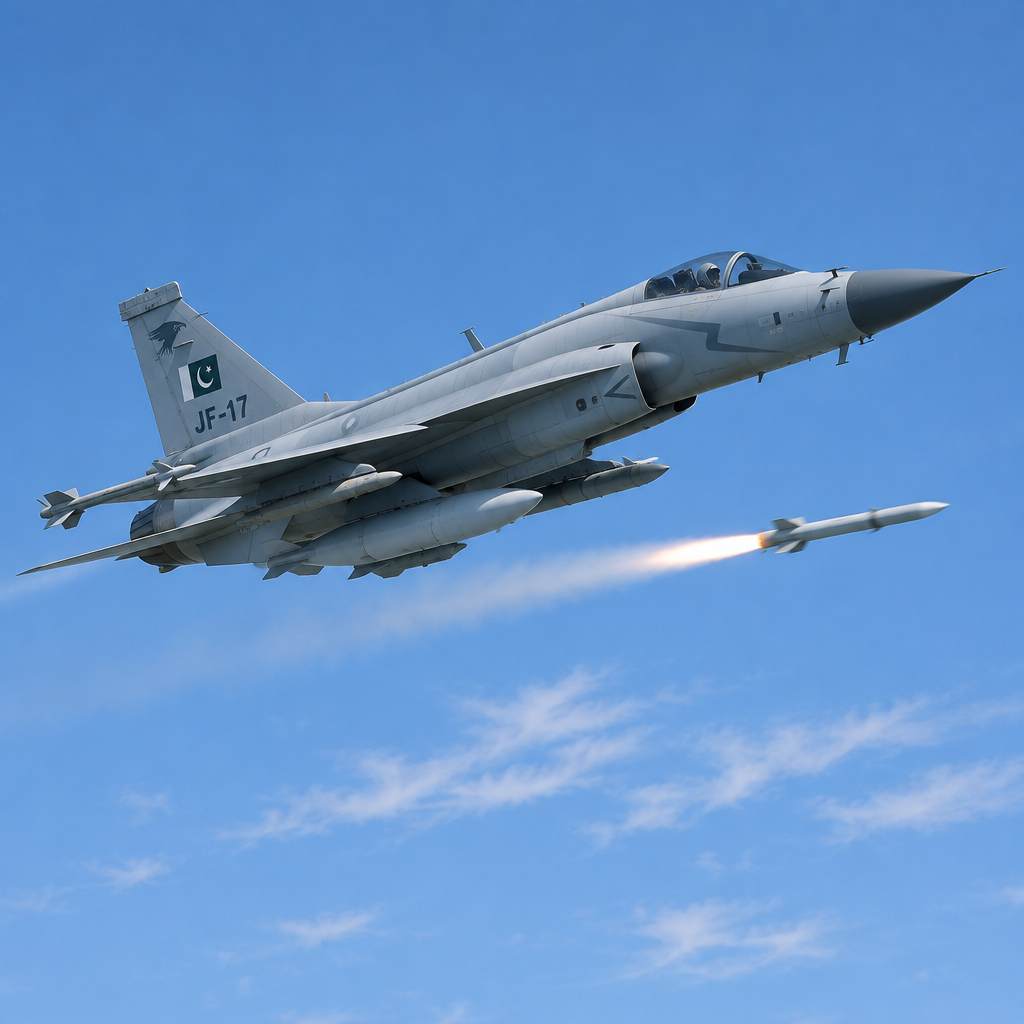
The DGPR published a short video showing a JF‑17 Thunder Block‑1, tail number 09‑109, launching a Fa’az air‑to‑air missile (AAM) from an underwing pylon. The DGPR described the trial as a “successful flight test” and said Fa’az “will significantly enhance operational flexibility of Pakistan Air Force, further strengthening the country’s overall defense posture.” The specific aircraft shown — 09‑109 — was among the first JF‑17s to undergo a major overhaul at Pakistan Aeronautical Complex (PAC) since 2019, a detail the DGPR released that indicates this is one of Pakistan’s older Thunder airframes.
Official Fa’az specifications from AWC and NESCOM
The Fa’az was officially unveiled by Global Industrial and Defence Solutions (GIDS) in 2023 and is credited to the National Engineering and Scientific Commission’s (NESCOM) Air Weapons Complex (AWC), which also developed the Ra’ad and Taimur air‑launched cruise missiles. AWC lists the Fa’az at 3,950 mm in length, 203 mm in body diameter and 205 kg in weight. The missile uses a dual‑thrust rocket motor, data‑link mid‑course guidance, an active laser proximity/impact fuze, and a blast‑fragmentation warhead.
AWC provides seeker and performance figures: the imaging infrared (IIR) seeker reportedly detects targets to roughly 40–45 km, while the active radar‑homing (ARH or RF) seeker is reported at about 25 km detection. AWC’s published performance claims state the Fa’az RF (ARH) variant has a range of over 100 km and a top speed above Mach 3.5; the Fa’az IIR variant has a range over 75 km and a top speed above Mach 3.2. NESCOM is also developing a Fa’az 2 with a listed range of 180 km and a maximum speed of Mach 3.5.

This site is the portfolio.
OSINTSights runs on Cloudflare Workers, D1, R2, and Vectorize, with an AI pipeline on Hetzner ARM. Nubivance designed, built, and operates it. We do the same for clients.
See what we buildFa’az variants and the Fa’az‑SL surface role
AWC and GIDS are positioning Fa’az across multiple roles. Besides the AAM configurations (IIR and ARH), AWC is configuring a surface‑to‑air derivative, the Fa’az‑SL, which GIDS markets as an enhanced short‑range air defence (E‑SHORAD) system. As a SAM, AWC lists Fa’az‑SL range up to 35 km and an altitude reach of 12 km, intended to cover Pakistan’s short‑to‑medium‑range air defence layer. The DGPR’s statement indicates the PAF will induct Fa’az as an AAM, and the reporting notes it is likely the service will also field the SAM variant to gain production economies of scale by using a common missile family.
How Fa’az compares to the SD‑10A and program choices
Visually and dimensionally the Fa’az resembles the SD‑10A/PL‑12 family: both use cruciform mid‑body wings and cruciform tail fins, and both share a 203 mm body diameter. The Fa’az’s published length (3,950 mm) is 16 mm longer than the SD‑10A’s listed 3,934 mm, and the Fa’az is roughly 6 kg heavier. The programs differ in internals and performance: AWC lists a dual‑thrust motor, an active laser fuze and blast‑fragmentation warhead for Fa’az, while the SD‑10A is presented by its exporter with a different fuze and a discrete‑rod warhead. CATIC lists the SD‑10A with a top speed above Mach 5; AWC lists Fa’az top speeds above Mach 3.2–3.5 depending on variant. Defence Uncut co‑host Arslan Khan has identified a different solid‑fuel composition for Fa’az compared with the SD‑10A, underlining that NESCOM has developed critical inputs — rocket motor, guidance, and seekers — rather than simply producing a licensed copy.
What this means for the PAF, NESCOM, and JF‑17 operators
- Pakistan Air Force (PAF): The PAF gains a domestically fielded AAM and a candidate SAM family that could be integrated with local radars and command‑and‑control suites. The DGPR framed Fa’az as an operational enhancement; the Fa’az‑SL is presented as a means to augment the Spada 2000 Plus short‑to‑medium‑range layer.
- NESCOM / AWC: Successful flight testing and continued development of a dual‑thrust motor and modular seeker approach represent investments in core propulsion and guidance inputs. AWC’s work on Fa’az and Fa’az‑2 provides a technological foundation for further missile variants and potential export offers via GIDS.
- JF‑17 operators and sensors (NASTP, NRTC): As the PAF pursues indigenous sensors such as an AESA radar from the National Aerospace Science & Technology Park (NASTP), having a domestic missile family reduces the risk that weapons and radars will be incompatible due to external source‑code or supply restrictions, enabling the PAF to pair indigenous sensors with indigenous effectors.
The test marks a visible step in Pakistan’s approach: develop core missile inputs domestically, field a family of weapons across air and surface roles, and pair those weapons with home‑grown sensors to maximize operational flexibility. The DGPR’s posted footage and AWC’s published figures now place Fa’az on a defined technical and programmatic trajectory — one that the PAF and NESCOM appear set to follow into both aerial and ground‑based short‑to‑medium‑range defence roles.