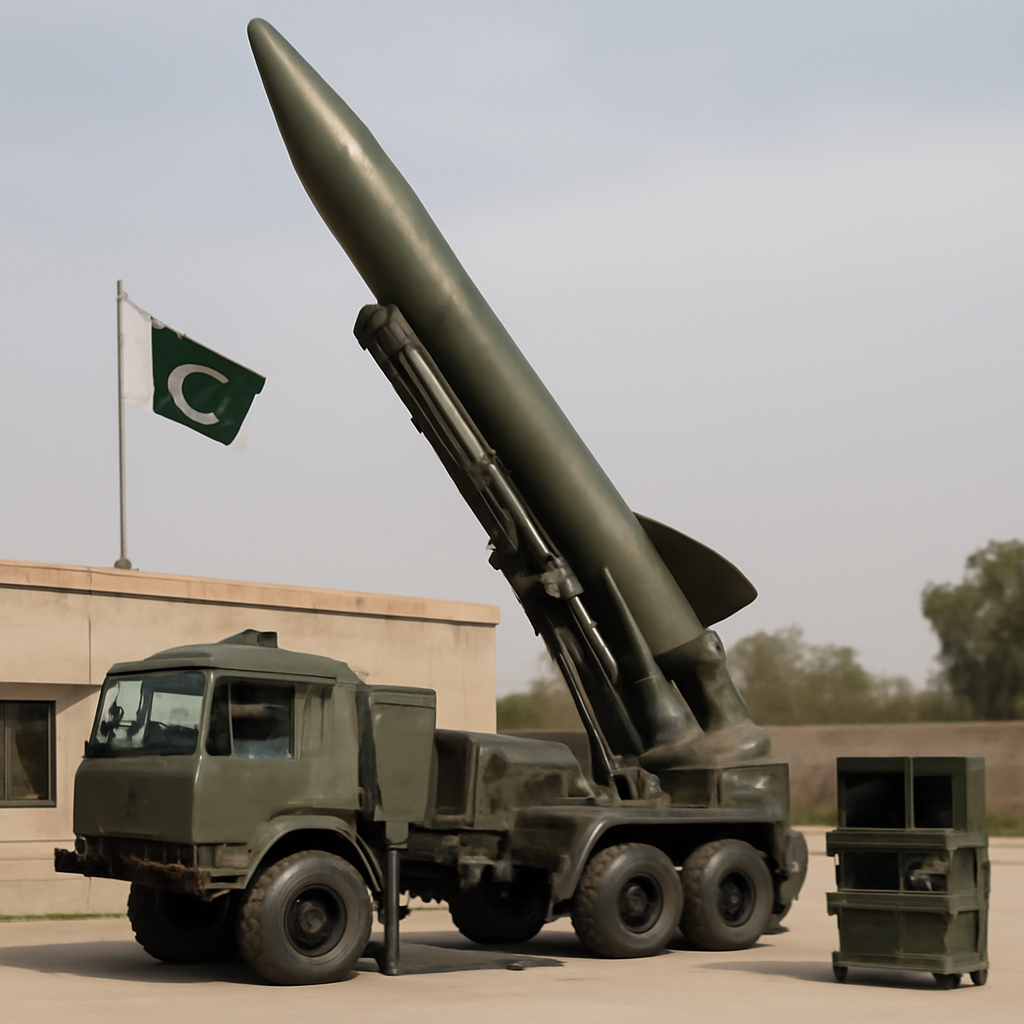
"The most conservative outlook is to expect a range extension of the Fatah-2 lineage," Bilal Khan said — a line that frames every other defence choice the podcast explored.
Fatah‑5 and the Fatah‑2 lineage
The Fatah‑5 mention came in a state‑television interview around the anniversary of the May 2025 conflict, when a Pakistan Army rocket officer said a Fatah‑5 had been tested. Both hosts treated hypersonic speculation cautiously. Bilal Khan argued the likeliest reading is evolutionary: an extended‑range iteration of the Fatah‑2 family, designed for scale and modularity rather than an entirely new propulsion regime. The comparison drawn was to Turkey’s Tayfun program, which lengthened an existing baseline to increase range across blocks.
NESCOM and the shared‑launcher logic
Central to the Fatah analysis is the National Engineering and Scientific Commission (NESCOM). Bilal noted NESCOM built the Fatah‑2 around standardization and modules so it could be repurposed, and Arslan Khan emphasized the launcher as the organising principle: "The key behind the Fatah name is maybe less about the system and more about the common launcher." The hosts likened the launcher to a HIMARS‑style wheeled platform able to carry mixed Fatah rounds, enabling cross‑service use and production economies.

Audit-ready is a season. It shouldn't be.
Evidence in spreadsheets, controls drifting between audits, frameworks multiplying on flat headcount. Nubivance runs continuous compliance on Rapid7 Cyber GRC - SOC 2, HIPAA, ISO 27001, PCI, CMMC.
End the scrambleArmy Rocket Force Command and cross‑service integration
Both hosts described the Army Rocket Force Command (ARFC) as a ground‑operating analogue to an air force: "The ARFC’s purpose is to operate like the PAF, but from the ground," Bilal said — to target radars, air‑defence sites, bridges, and fuel depots to slow escalation. They stressed organizational friction as the harder problem: training is in hand, but managing hybrid service arms that draw on PAF Space Command for targeting and pool production lines across Army, Navy, strategic forces and eventually the PAF presents process and institutional challenges.
PAF air‑base defence: high‑energy lasers, HPM, and interceptor drones
Protecting Pakistan Air Force (PAF) air bases drove a distinct set of trade‑offs. Bilal argued high‑energy lasers (HEL) are "sequentially scalable" — cheap per shot and useful at fixed sites against sporadic drone attacks — but not horizontally scalable against swarms, and vulnerable to atmospheric degradation. Arslan highlighted high‑power microwave (HPM) systems' ability to strike multiple targets but noted directional coverage and recharge constraints. Both hosts preferred kinetic interceptor drones as a near‑term, scalable layer. Airbus Defence and Space’s March 2026 flight of the uncrewed 'Bird of Prey', which autonomously detected a one‑way attack drone and engaged it with a Frankenburg Technologies Mark I missile (sub‑2 kg, ~1.5 km range), served as a concrete, tested proof of concept they say Pakistan could adapt. The discussion also flagged likely HEL suppliers and power‑class choices, citing Poland’s roughly 150‑unit program as a comparator.
Surface fleet choices: MILGEM, Jinnah‑class, and commercial hulls
The naval segment traced a familiar procurement trade‑off: bespoke naval standards versus commercial hulls. Bilal mapped Germany’s fallback from an over‑specified F126 to the mature MEKO A‑200 onto Pakistan’s options, while noting the Babur‑class (MILGEM) standard has aged well and spread beyond Turkey. The Jinnah‑class frigate, with its lead ship under contract at Karachi Shipyard, sits alongside commercial Yarmook‑class (Damen OPV 1900) designs. Arslan championed a Danish modular approach — hulls designed with empty volume to host containerised payloads so sensors and weapons can be swapped over decades — arguing this amortises the costly parts of a warship and lowers entry costs for capabilities like VLS, UUVs or loitering munitions.
PAF fighters and sovereign control: J‑35AE, Typhoon, KJ‑500 and KAAN
The PAF faces a major replacement cycle as F‑16A/B Block‑15 airframes begin to age in the 2030s. Bilal described the Shenyang J‑35AE as the apparent frontrunner in industry RFIs and noted a since‑withdrawn 2025 government post that framed a Chinese package including the J‑35AE, KJ‑500 AEW&C and an HQ‑19 BMD offering — a post the air force asked to be withdrawn because nothing had been signed. Arslan rejected claims that a KJ‑500 is already in service, identifying a contested satellite photo as a ZDK‑03 instead and saying he "doesn’t see any scenario where the Pakistan Air Force inducts the KJ‑500." Bilal warned against closed, out‑of‑the‑box buys that foreclose modification: "We value Pakistan controlling the stack," he said, stressing sovereign control of tactical data links to integrate indigenous UCAVs, decoys and missiles. He also argued the Eurofighter Typhoon should not be discounted — a proven multilateral platform with a supply chain and potential industrial anchors via Turkey — while Arslan counseled against rushing to fifth‑generation buys before shoring up the fourth‑generation backbone and training pipeline.
Bilal’s parting forecast anchors the decade ahead: "The 2030s are going to be a major procurement cycle for the PAF." The record laid out on Defence Uncut makes clear that the immediate choices — whether to iterate the Fatah stack, to layer lasers and interceptor drones at bases, to favour modular commercial hulls or bespoke ship standards, and to buy open versus closed fighter systems — will determine how affordable, adaptable and sovereign Pakistan’s new capabilities actually are.