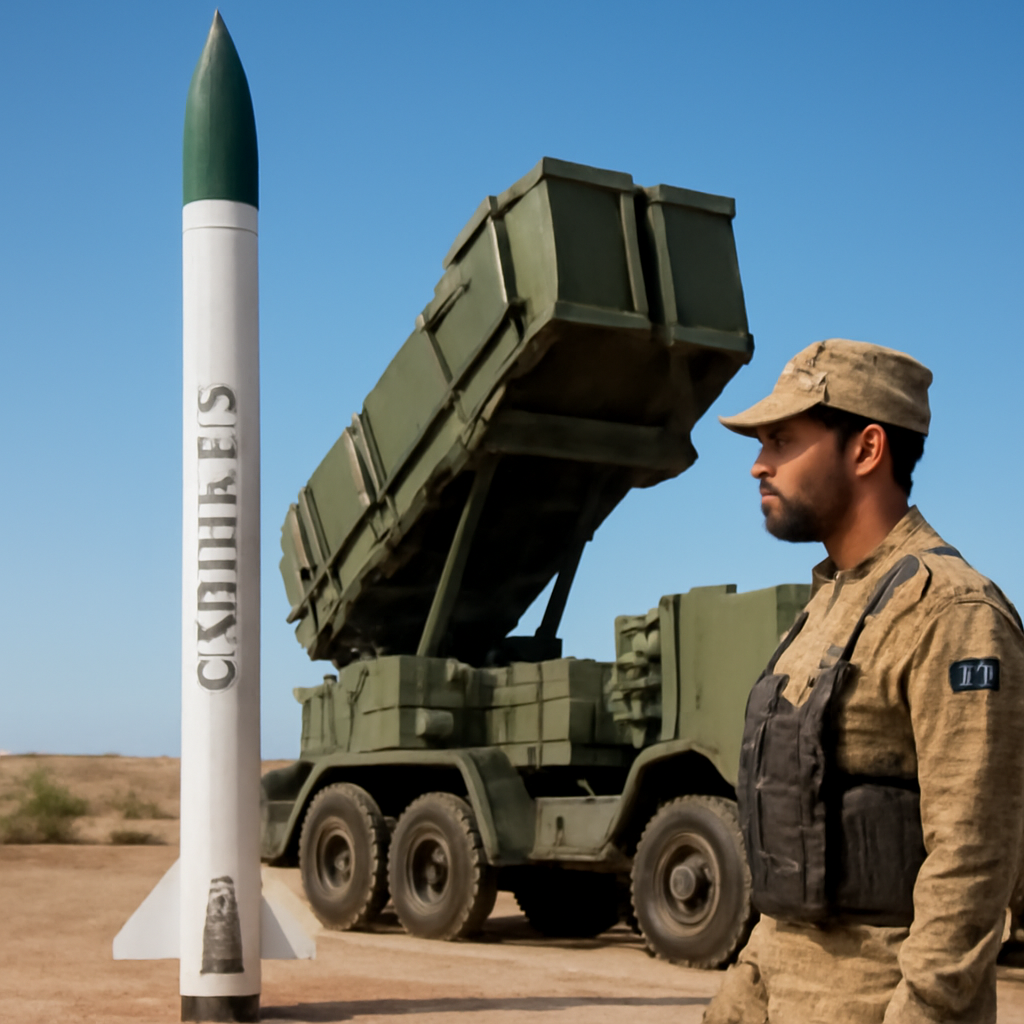
"Pakistan is reportedly the launch customer for the Albatros‑NG," a designation that makes the CAMM‑ER the most advanced surface‑to‑air missile type yet integrated into any Pakistani service.
CAMM‑ER: design lineage and key specifications
The CAMM‑ER (Common Anti‑air Modular Missile — Extended Range) is MBDA’s extended‑range member of the CAMM family, developed by the multinational missile consortium jointly owned by Airbus, BAE Systems, and Leonardo. The missile uses an active radar‑homing (ARH) seeker built with gallium‑nitride (GaN) solid‑state power‑amplifier technology, a two‑way datalink, thrust‑vectoring control (TVC), and a new Avio rocket motor with a 190 mm diameter and a 4.2 m length. MBDA reports the CAMM‑ER achieves a range exceeding 45 km, supersonic speeds of Mach 3+, and engagement altitudes around 10 km.
The CAMM family traces to the UK MOD’s FLAADS Technology Demonstration Programme (2004). The baseline CAMM entered Royal Navy service as Sea Ceptor in May 2018. The CAMM‑ER variant qualified in 2023 after extended‑range trials that MBDA said validated performance at high altitude and in challenging manoeuvre scenarios.
Albatros‑NG integration aboard Babur‑class corvettes
MBDA secured its first contract for the Albatros‑NG naval‑based air defence (NBAD) system in June 2021 from an undisclosed international customer — widely assessed to be Pakistan for the Babur‑class corvette programme. The Babur‑class corvettes, designed and built in Turkey by STM Savunma, integrate the Albatros‑NG as their primary anti‑air warfare (AAW) system. The Albatros‑NG pairs the CAMM‑ER interceptors with a soft vertical launch mechanism that ejects missiles to roughly 30 metres before a thruster orients them toward the target, providing true 360‑degree coverage without the launch‑arc constraints of inclined launchers.
Albatros‑NG is described as compatible with multiple ship combat management systems and supports quad‑packing — four CAMM‑ER missiles occupying the footprint of a single conventional vertical‑launch cell — increasing magazine depth on compact hulls.

This site is the portfolio.
OSINTSights runs on Cloudflare Workers, D1, R2, and Vectorize, with an AI pipeline on Hetzner ARM. Nubivance designed, built, and operates it. We do the same for clients.
See what we buildArchitectural advantages over SARH systems
The CAMM‑ER’s ARH seeker and two‑way datalink eliminate the continuous illumination requirement that defines semi‑active radar‑homing (SARH) systems. Quwa’s assessment in the source highlights that Pakistan’s existing LY‑80, HQ‑9, and Spada 2000‑Plus fleets depend on SARH illumination channels, a primary limitation in saturation engagements. By contrast, CAMM‑ER missiles guide autonomously in the terminal phase; the two‑way datalink supports mid‑course updates and retargeting while any compatible 3D radar can provide the fire‑control track.
That architecture, Quwa argues, increases the number of simultaneous engagements because a SARH battery is limited by the number of illumination channels (typically two to four), whereas CAMM‑ER can, in principle, engage as many targets as it has missiles in flight. The missile’s thrust‑vectoring and soft‑launch profile also deliver exceptional agility in the immediate post‑launch phase, a point of advantage against legacy fixed‑fin SARH missiles.
Weight, logistics, and force‑structure implications
The CAMM‑ER weighs 160 kg, lighter than the Aspide 2000 (240 kg) and far lighter than the HQ‑9 class missile (approximately 2,000 kg, as cited in the source). That weight‑to‑range efficiency means platforms can carry more interceptors per launch cell, benefit from quad‑packing, and simplify logistics and sustainment for a force with constrained platform numbers. MBDA designs the missile to be maintenance‑free in its launch canister over its operational life, and the CAMM family uses a programmable open systems architecture (PrOTeUS), supporting integration flexibility.
What this means for the Pakistan Navy, Pakistan Air Force, and Pakistan Army
- Pakistan Navy: The Albatros‑NG with CAMM‑ER gives Babur‑class corvettes area air defence with true 360‑degree coverage and deeper magazines via quad‑packing. As the first export NBAD application of CAMM‑ER, the integration sets a new baseline for shipborne short‑to‑medium air defence in PN service.
- Pakistan Air Force: Quwa identifies a ground‑launched CAMM‑ER as a feasible replacement for the Spada 2000‑Plus in PAF service, offering a move away from SARH dependence toward fire‑and‑forget engagements and simplified fire‑control requirements.
- Pakistan Army: A CAMM‑ER‑based ground system could supplement or succeed LY‑80 and FM‑90 batteries, offering a path to tri‑service standardisation with common missiles, datalinks, and logistics chains.
MBDA’s export and industrial footprint is growing: SIPRI has tracked CAMM family exports; Poland signed a £4 billion CAMM‑ER ground air defence contract in 2023; Italy is replacing Aspide/Spada inventories with CAMM‑ER; and MBDA has previously established local production ties, a model noted as a potential pathway for licensed production or co‑production in Pakistan.
The CAMM‑ER arrives as more than a new missile type for Pakistan; it represents an architectural pivot in how air defence can be distributed, sustained, and scaled across sea, land, and air services. With MBDA developing a longer‑range CAMM‑MR ( >100 km) alongside Poland, the CAMM family could eventually offer a contiguous ARH‑based stack from short through medium to long ranges — but whether Pakistan pursues tri‑service standardisation, licensed production, or a CAMM‑MR procurement path are concrete decisions that remain to be taken.
Source: https://quwa.org/pakistan/air-defence-pk/mbda-camm-er-albatros-ng-naval-air-defence-system/