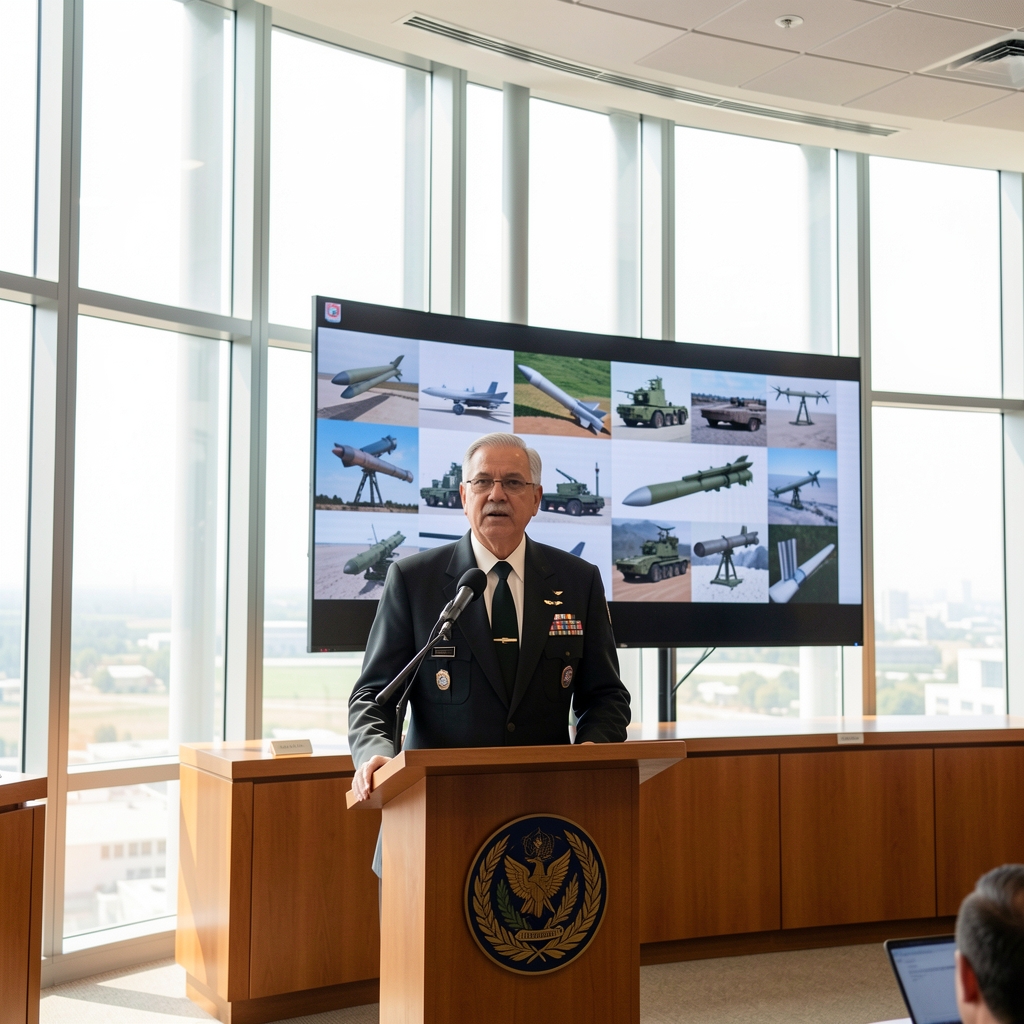
"We have shown India only '10 percent' of our military potential," Lieutenant General Ahmed Sharif Chaudhry told reporters at the Joint Services Press Conference on May 7, 2026, as a slide deck rolled past images of supersonic cruise missiles, turbojet loitering munitions, reconnaissance satellites, and the newly operational Army Rocket Force Command (ARFC).
Army Rocket Force Command and the Fatah missile family
The ARFC is the central structural change of Pakistan’s post‑May 2025 rearmament: a single command consolidating surface‑to‑surface ballistic missiles, subsonic cruise missiles, supersonic cruise missiles, and one‑way attack drones under a chain separate from the Pakistan Air Force and the Strategic Plans Division. Quwa Pakistan’s reporting and the Defence Uncut panel frame this as a doctrinal shift from denial‑centric to deprecation‑centric deterrence—moving from preventing strikes to building a capacity that can rapidly degrade an opponent’s warfighting infrastructure.
The ARFC fields the Fatah guided‑missile family. The Fatah‑1 is a guided multiple‑launch rocket system for targets within 140 km; the Fatah‑2 is a tactical ballistic missile with a range exceeding 400 km and shares an airframe with the SMASH anti‑ship ballistic missile; the Fatah‑3 is a supersonic cruising missile in development; and the Fatah‑4 is a ground‑launched subsonic cruise missile derived from the Babur platform. Panelists emphasized multimodal strike options and interchangeability—Aseem noted the Fatah‑2 and SMASH are “basically identical airframes,” implying ground launchers could, without modification, fire either variant.
The Fatah‑3 debate: HD‑1 derivative or strategic signal
Images of a ramjet‑powered supersonic cruise missile dominated official presentations, but analysts on Defence Uncut urged caution. Observers have drawn parallels to the Chinese HD‑1, an export‑oriented supersonic missile, yet Arslan Khan warned that visual reuse of stock footage has occurred before in ISPR material. Bilal Khan argued that, rather than a direct import, Pakistan’s NESCOM may be leveraging Chinese commercial supply chains to build an indigenous derivative, possibly including newer subsystems such as an AESA seeker. The panel also noted an absence of visible tests—no NOTAMs or test‑site imagery—suggesting the Fatah‑3 images may illustrate intent as much as operational capability.

Audit-ready is a season. It shouldn't be.
Evidence in spreadsheets, controls drifting between audits, frameworks multiplying on flat headcount. Nubivance runs continuous compliance on Rapid7 Cyber GRC - SOC 2, HIPAA, ISO 27001, PCI, CMMC.
End the scrambleShahed‑style drone production and the operational concept
Defence Uncut’s discussion distinguished between expensive, jet‑powered loitering munitions and low‑cost, mass‑producible piston‑powered designs modelled on Iran’s Shahed series. Pakistan has unveiled jet‑powered one‑way attack drones—the NESCOM Sartoforosh (reported 1,000 km range), the Woot‑Tech HiMark‑25 TJ, and the Delta Buzz—but panellists argued strategic value lies in cheap, easily produced drones. Aseem described Shahed‑type production as feasible with simple fibreglass moulds and hand layup processes; Bilal Khan highlighted Pakistan’s dense urban and rural geography as enabling distributed small workshops.
The operational concept mirrors practices seen elsewhere: launch low‑cost loitering munitions first to saturate and deplete short‑range air defences (cited examples include Akash and MRSAM), then employ higher‑value Fatah missiles against pre‑mapped military targets—airbases, radar sites, command nodes, and logistics depots—to achieve tempo and depth in strikes.
Pakistan Air Force choices: J‑10CE and JF‑17 expansion, fifth‑gen deferred
Contrary to speculation about an immediate move to stealth fighters, the PAF’s May 7 presentation confirmed near‑term priorities: expansion of the J‑10CE and JF‑17 fleets, with fifth‑generation options kept under evaluation for the early 2030s. Aseem praised the clarity of that approach: “We’re doubling down on J‑10s and JF‑17s,” he said, noting that Pakistan will procure advanced fighters only “when there’s a need.” Bilal Khan described the force‑employment logic: J‑10s provide top cover while JF‑17s serve as lower‑cost platforms to deliver munitions—accepting higher attrition risk while preserving more capable assets for decisive roles.
Satellite constellation and closing the kill chain
Space assets are the connective tissue of the new architecture. SUPARCO has placed six satellites in orbit since May 2024—three PRSC electro‑optical satellites (EO‑1, EO‑2, EO‑3), a synthetic aperture radar (SAR) satellite, and a hyperspectral imaging satellite. A $406 million deal with China’s PIESAT will add a 20‑satellite interferometric SAR constellation for persistent change detection along the India‑Pakistan border. Panelists argued these capabilities enable an internal, persistent strike–battle‑damage‑assessment–restrike cycle so the entire kill chain—find, fix, track, target, engage, assess—can be closed without relying on allied or commercial imagery. As Aseem asked rhetorically, are commanders going to “blindly fire 15 Fatah‑2s, or… fire two Fatah‑2s with satellite coverage to ensure we’re targeting correctly?”
What this means for Pakistan’s military leadership, Indian planners, and regional policymakers
For Pakistan’s military leadership: the hardware and infrastructure—missiles, drones, fighters, satellites—are being assembled rapidly. The critical constraint, panelists warned, is decision‑making speed at the highest levels. Bilal Khan posed the operational test bluntly: will leaders be able on the next night of crisis to decide in minutes whether to employ these assets? The political‑military interface that produced last year’s escalation—mutual distrust, suspended treaties, and absent communications—remains a backdrop to any operational plan.
For Indian planners: the emergence of integrated ARFC strike options, mass‑produced loitering munitions, and persistent SAR and EO coverage changes targeting calculus and defensive requirements; saturation doctrines followed by high‑value strikes require adjustments in short‑range air‑defence posture and resilience of basing. For regional policymakers: the International Crisis Group’s characterization of the 2025 conflict as “opaque” and Christopher Clary’s caution that upgrades may amount to a “Red Queen’s race” underscore that material changes do not automatically reduce the risk of rapid escalation.
Pakistan’s rearmament in the past 12 months is demonstrably fast and multidimensional. The unanswered question in the source material is not the arrival of equipment, but whether command processes, communications, and crisis decision‑making will evolve quickly enough to make those systems decisive in a future conflict.
Source: Quwa — Pakistan India Conflict 2025: How Pakistan’s Military Rearmed in 12 Months