An Army role in space superiority
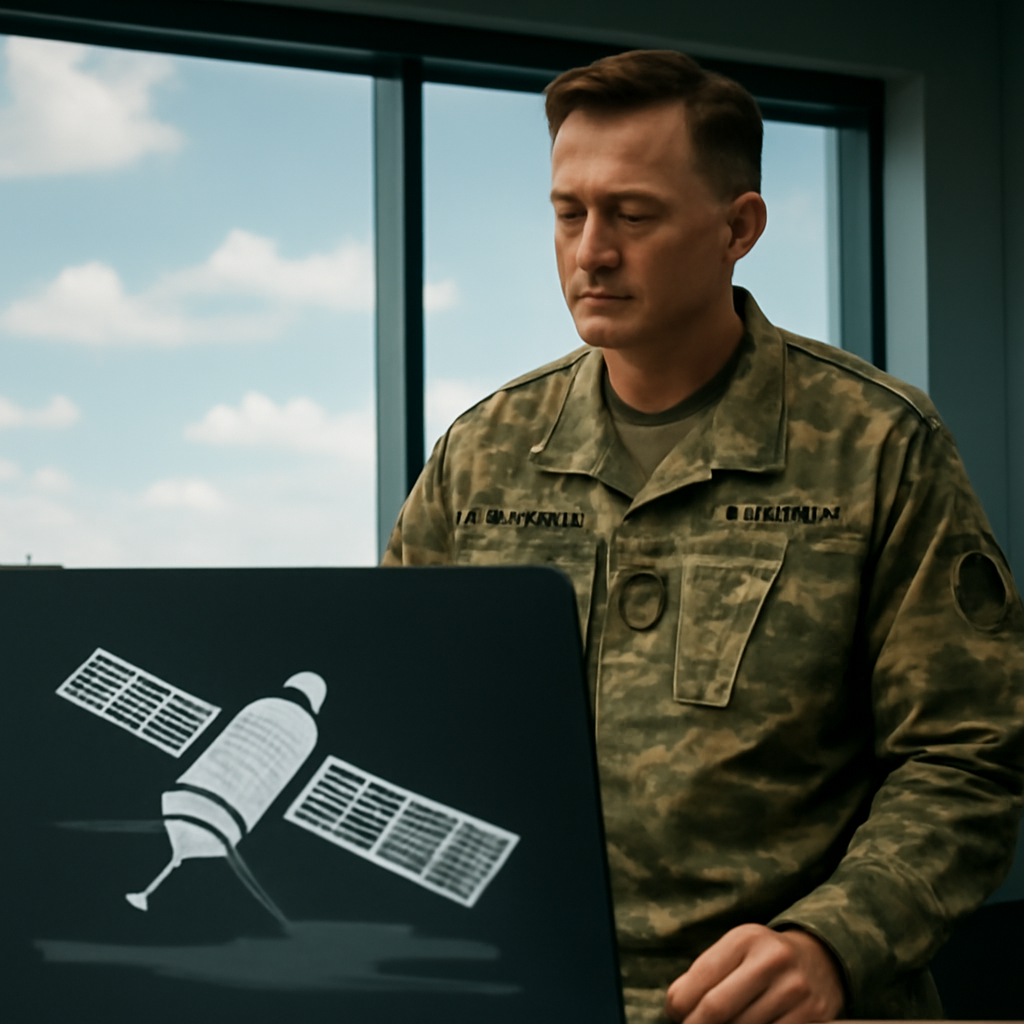
Col. Joe Mroszczyk, director of Army Space and Missile Defense Command’s Transformation Integration Directorate – Space Superiority (TID-SS), told Breaking Defense that the Army is preparing systems to “engage” adversary satellites from the ground, particularly when those sensing satellites are used to target U.S. forces. Mroszczyk said that this work is part of the Army helping U.S. Space Command achieve space superiority and that the service will operate within national space policy, which the Army interprets as avoiding destructive kinetic anti-satellite attacks that would create long-lived debris.
The TID-SS office, Mroszczyk explained, functions as a connector between Army operators and service acquirers — specifically coordinating with the program executive office for Counter Command and Control — so that operational requirements are integrated into acquisition programs as they develop. According to an Army posting on Facebook, TID-SS is responsible for overseeing “the design, development and modernization of space-enabled, missile defeat, and high-altitude architectures, as well as synchroniz[ing] combat concepts, scientific analysis and the acquisition of new technology.”
Counter-surveillance and reconnaissance: closing adversary eyes and ears
Mroszczyk said one of the Army’s priority areas is “counter-surveillance and reconnaissance” that focuses on adversary space-based sensing. The stated aim is to “actually prevent the collection” of targeting data on U.S. forces and facilities by enemy intelligence, surveillance and reconnaissance (ISR) satellites, thereby denying adversaries a space-enabled targeting advantage.
Until recently, Army public discussion emphasized electronic warfare to jam adversary SATCOM receivers and command-and-control nodes. But Mroszczyk and others signaled a broader approach: “space superiority is a relative measure against the enemy,” he said, adding that the Army wants “to have an advantage overall in both how we use space capabilities, but also how we can take away their use [of space].”

Audit-ready is a season. It shouldn't be.
Evidence in spreadsheets, controls drifting between audits, frameworks multiplying on flat headcount. Nubivance runs continuous compliance on Rapid7 Cyber GRC - SOC 2, HIPAA, ISO 27001, PCI, CMMC.
End the scrambleNon-kinetic options: directed-energy and electromagnetic effects
The Army’s push features non-kinetic means to affect on-orbit sensors when kinetic ASATs are disfavored, a point underscored by the observation in the reporting that the phrase “long-lived debris” is not precisely defined in current policy. Army leaders and U.S. Space Command officials have identified directed-energy weapons as a promising category because of their relatively low “cost-per-shot,” according to Lt. Gen. Rick Zellmann, deputy U.S. Space Command head, who spoke at the SMD Symposium.
Directed-energy approaches cited include high-energy lasers and high-power electromagnetic systems such as millimeter wave and microwave weapons. The report describes specific effects: visible-light and infrared imaging sensors on ISR satellites could be disrupted or blinded via laser dazzling, while synthetic aperture radar imaging could be degraded by high-power microwave weapons or by heavy radio-frequency noise designed to “deafen” those sensors.
Stratospheric warfare: balloons, UAS, and alternative trajectories
Mroszczyk described a parallel investment in “stratospheric warfare,” experimenting with both lighter-than-air high-altitude balloons and heavier-than-air fixed-wing platforms. He said balloons are closer to being ready for operational use, while large fixed-wing craft for high altitudes “have had some struggles.”
The Army has “validated requirements for multiple sizes of balloons” and included some funding in the fiscal 2027 five-year budget plan “to start fielding” an initial capability with “a couple of units.” Mroszczyk highlighted an operational concept in which balloons serve as high-altitude launch platforms for unmanned aerial systems (UAS), enabling the UAS to reach further into the battlespace without expending climb energy: “the balloon gets you 90 percent of the way, and keeps you up without having to burn energy to get up to altitude. And then the UAS can take advantage of the altitude and the duration from that altitude that you get.”
He also noted practical trade-offs: for experimentation and peacetime missions over ocean, recovery of balloon payloads is a priority; in conflict, the emphasis would be on delivering payloads deeper into the battlespace, and “I’m not worried about getting it back.”
How the Army, U.S. Space Command, and adversary ISR operators are affected
- Army acquisition teams and program offices: expect closer integration of operators’ requirements into Counter Command and Control acquisition efforts via TID-SS and initial fielding funds for high-altitude balloon units in the fiscal 2027 budget plan.
- U.S. Space Command and military operators: will press for service contributions to a broader space superiority mission, including non-kinetic, ground-based options to deny adversary satellite collection, and may favor directed-energy and electromagnetic approaches noted for low “cost-per-shot.”
- Adversary ISR operators: are the explicit targets of these capabilities. The Army’s stated goal is to “take away that advantage” of ubiquitous sensing from space by degrading or denying satellite collection through non-kinetic means and by augmenting space effects from high-altitude stratospheric platforms.
The Army’s statements at the SMD Symposium outline a deliberate pivot: expand from jamming and ground-node attacks toward ground-based, non-kinetic effects against on-orbit sensors and to field stratospheric platforms that can substitute for disrupted satellite services. The next concrete milestones in the record are the planned initial balloon units funded in the fiscal 2027 five-year budget plan and the continued integration of operational requirements into Counter Command and Control acquisitions — all while operating under a policy posture that constrains kinetic, debris-creating options and leaves technical and definitional boundaries, such as what constitutes “long-lived debris,” unsettled.
Source: Breaking Defense — “Army gears up to ‘engage’ enemy surveillance satellites,” August 2026