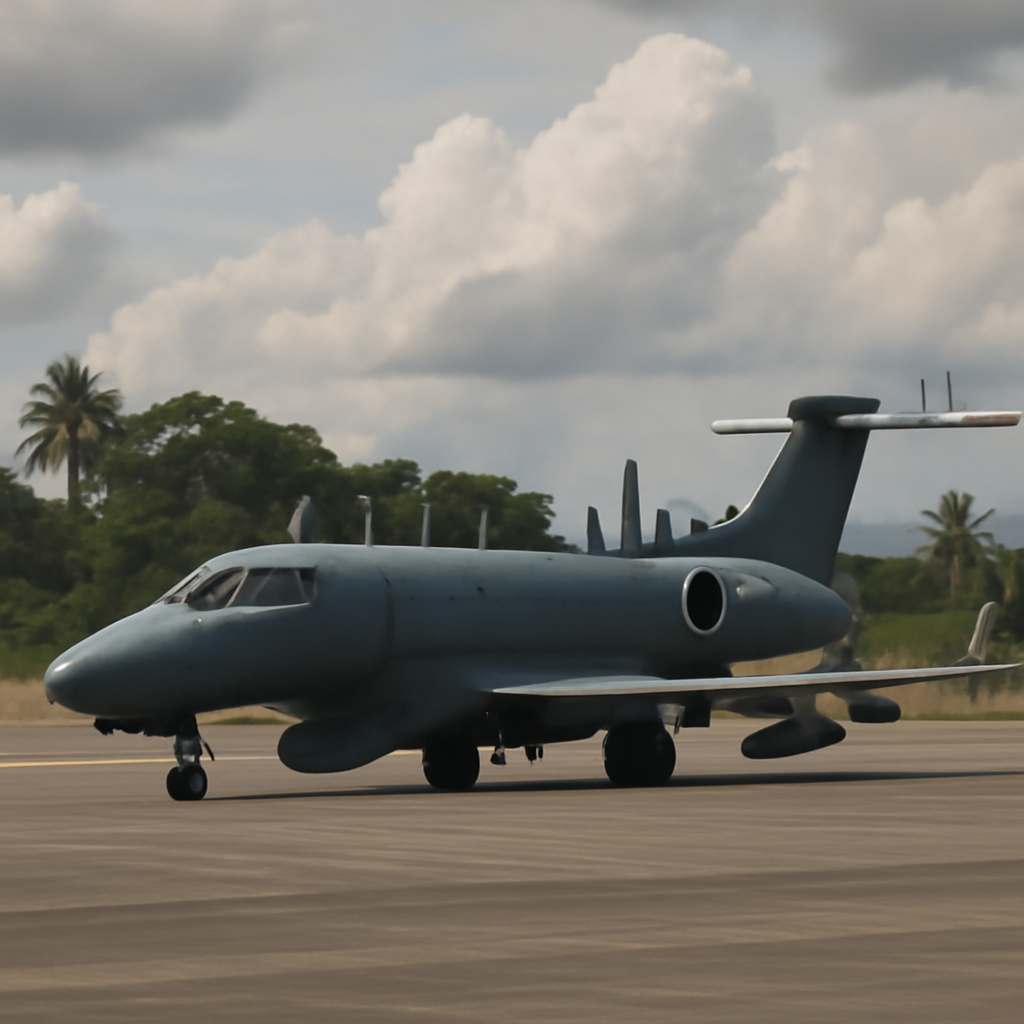
"First overseas deployment. An Australian MC-55A Peregrine ISREW aircraft has been flying missions out of Clark AB in the Philippines since end‑July. Missions are 4‑8 hours in duration and has on occasion gone further into the South China Sea." — Mike Yeo 杨启铭 (@TheBaseLeg), August 13, 2026
Deployment timeline and flight data
Public flight‑tracking records show the Royal Australian Air Force MC‑55A serial A51‑004 departed its home at RAAF Base Edinburgh in South Australia and arrived at Clark Air Base near Manila on July 28, 2026, according to Flightradar24. Data compiled by Australian Defense Magazine records seven missions flown out of Clark between July 30 and August 7. Missions typically lasted between four and nine hours and were concentrated in and around Philippine airspace near Mindoro and Palawan islands; on four missions the aircraft penetrated further west into the South China Sea.
“Going dark”: transponder outages and mission profiles
For the stretches of those flights over the South China Sea the MC‑55’s transponder was switched off for intervals of roughly three to four hours, according to the flight‑tracking aggregators the reporting cites. The Australian Defense Forces told Australian Defense Magazine that the deployment forms part of its longstanding engagements in the Indo‑Pacific, but the ADF provided no further operational details about the missions or the reasons for the transponder outages.

Audit-ready is a season. It shouldn't be.
Evidence in spreadsheets, controls drifting between audits, frameworks multiplying on flat headcount. Nubivance runs continuous compliance on Rapid7 Cyber GRC - SOC 2, HIPAA, ISO 27001, PCI, CMMC.
End the scramblePlatform, unit and delivery status
The MC‑55 Peregrine is a highly modified Gulfstream G550 derivative configured for combined electronic warfare (EW), signals intelligence (SIGINT) and ISR roles. The platform is assigned to No. 10 Squadron at RAAF Base Edinburgh, the unit that formerly operated the AP‑3C (EW) Orion. TWZ reports the first MC‑55 touched down at Edinburgh on January 22, 2026, after a multi‑leg delivery from Greenville, Texas, via Davis‑Monthan AFB, Hickam AFB, Wake Island and Andersen AFB, Guam. A second and third MC‑55 arrived in March and June; a fourth airframe remains to be delivered.
Capabilities in theatre: networking, fusion and RC‑135 heritage
TWZ notes the MC‑55 combines EW, SIGINT and ISR sensors and can act as a networking relay and data‑fusion node to link aircraft, surface combatants and ground forces. The reporting also states that TWZ has previously confirmed the MC‑55 incorporates technology ported directly from the RC‑135 Rivet Joint; TWZ has earlier speculated the jet may also carry active electronically scanned array capability for standoff electronic tasks.
Regional context: claims, outposts and routine patrols
The report places these flights against the dense, contested geography of the South China Sea. The Spratly Islands are claimed in whole or in part by China, Malaysia, the Philippines, Taiwan and Vietnam; they are largely uninhabited yet may overlay significant natural‑resource reserves. China’s presence in the Spratlys includes artificial islands with long runways and aircraft hangars, supported by missiles, radar stations and other defenses, TWZ records. Both China and the Philippines claim Scarborough Shoal (Huangyan Island), which the article notes lies a little more than 100 miles from the Philippines and about 500 miles from China. China "routinely backs up its expansive claims with naval patrols, in the air and at sea," the reporting adds. The United States, TWZ records, says it does not take sides but sends warships and aircraft close to disputed islands as part of freedom‑of‑navigation operations; the ADF conducts similar missions, historically operating from Clark Air Base, Butterworth in Malaysia and Singapore using P‑8A Poseidon and previously the AP‑3C (EW) Orion.
What this means for the ADF, the Philippines, and China
- Australian Defense Forces: The MC‑55’s first overseas deployment represents a marked expansion of the ADF’s airborne SIGINT/EW footprint in the Indo‑Pacific, supplementing maritime patrol platforms such as the P‑8A with a dedicated, highly specialized electronic‑intelligence and electronic‑attack capability. The ADF also plans future MC‑55 deployments to the Cocos Islands, increasing reach into the Indian Ocean.
- The Philippines: Clark Air Base hosted the MC‑55 missions, placing Australia’s new ISR/EW capability physically within Philippine territory for these operations. The presence of the platform operating from Clark highlights bilateral basing and mission cooperation in the region.
- China: The MC‑55’s capacity to surveil radar, communications, air‑defense and naval activity touches directly on areas in which TWZ documents China already maintains a substantial and hardened presence; the flights coincide with an environment in which China routinely asserts sovereignty through patrols at sea and in the air.
The MC‑55’s arrival in the South China Sea marks a discrete step in Canberra’s operational use of advanced SIGINT/EW assets in contested waters. With three MC‑55s now in Australia and a fourth due, and with planned deployments beyond the Philippines to locations such as the Cocos Islands, the ADF is rapidly fielding a new airborne intelligence backbone. The most immediate open question left on the record is how this enhanced electronic‑intelligence reach will shape routine operations and interactions in the air and at sea around disputed features such as the Spratlys and Scarborough Shoal.