"ASELSAN identifies aircraft, helicopters, unmanned aerial vehicles and certain missile threats among its intended targets," the manufacturer states — and Pakistan publicly displayed the system in September 2026.
ASELSAN's published KORKUT specifications
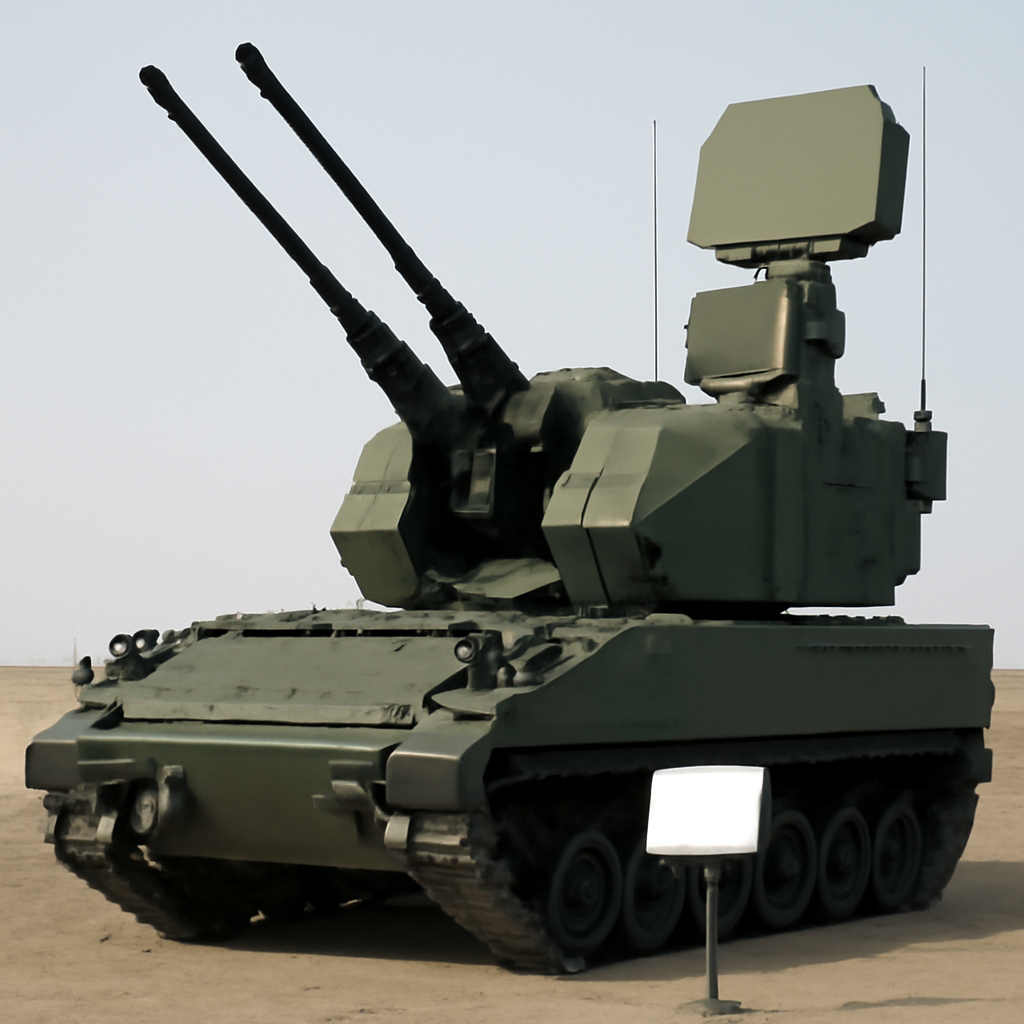
ASELSAN markets two documented Korkut configurations: the KORKUT 150/35 and the KORKUT 140/35. Both centre on twin 35 mm cannon using ASELSAN's programmable ATOM 35 airburst ammunition. ASELSAN's brochures (March 2026) list an effective gun range of 4 km, a combined firing rate of 1,100 rounds per minute across both guns, and an architecture that pairs gun-system tracking with fire-control radar and electro‑optical sensors. The company also describes a separate command-and-control element that includes a 3D search radar.
ASELSAN and related materials repeatedly stress that these are product specifications: the 4 km figure is labelled an effective gun range, not the distance at which a radar can first detect or track a target, and the published firing rate is a mechanical figure rather than a measure of interception success. ASELSAN's Eurosatory 2024 announcement highlighted the combination of guns, ATOM ammunition and tracking equipment as the defining package.
Tracked ACV-30 150/35 and the FNSS role
The tracked KORKUT 150/35 is commonly presented as a self‑propelled anti‑aircraft gun (SPAAG). FNSS is documented as the supplier of the ACV‑30 tracked platforms that host both the gun and command vehicles: a development agreement dates to June 2011 and a serial‑production subcontract to December 2016. ASELSAN's 2025 annual report identifies the tracked 150/35 specifically and records the system's first overseas delivery, though that report does not name the customer in that passage.
FNSS programme descriptions separate sensor functions across the group: a command vehicle searches for and tracks targets to build a local air picture, while each gun vehicle uses onboard fire‑control equipment to follow its assigned target. That division explains why documents refer to both "ASELSAN Korkut" (the air‑defence system developer) and "FNSS Korkut" (the vehicle supplier).

This site is the portfolio.
OSINTSights runs on Cloudflare Workers, D1, R2, and Vectorize, with an AI pipeline on Hetzner ARM. Nubivance designed, built, and operates it. We do the same for clients.
See what we buildKORKUT 140/35 wheeled variant and marketing
ASELSAN presented an 8×8 wheeled Korkut at Eurosatory in June 2024 and identified it in the company's 2024 annual report (page 83) as the KORKUT 140/35. ASELSAN markets the 140/35 to protect stationary and mobile units, explicitly including mechanised formations. The company also uses the KORKUT 141/35 designation in connection with a Calidus integration; ASELSAN and FNSS documentation caution that those model numbers are not interchangeable and describe distinct arrangements.
ASELSAN advertises a stabilised turret and firing‑on‑the‑move capability in its Eurosatory material. That capability is presented as a product feature, not as a PAF‑verified operational test.
Korkut's intended role in Pakistan's air defence
Quwa identified ASELSAN Korkut among systems publicly revealed by the Pakistan Air Force in September 2026, alongside the HQ‑17AE, LD‑76 and ASELSAN ŞAHİN. Quwa and ASELSAN materials describe Korkut as a gun‑based point‑defence option at the short end of an air‑defence network: it is intended to engage aircraft, helicopters, unmanned aerial vehicles and certain missile types, using programmable airburst ammunition to detonate near targets.
The public reveal establishes a dated reference for identification but does not establish when negotiations began, how many systems Pakistan has acquired, whether the delivered variant is the tracked 150/35 or the wheeled 140/35, or when any particular unit became operational. ASELSAN's catalogue notes that a standard 150/35 grouping contains three gun vehicles and one command vehicle, but Quwa's review emphasises that catalogue groupings cannot be used to calculate a customer's holdings. Likewise, the co‑appearance of several systems in the same public display does not demonstrate a shared fire‑control network.
What this means for the Pakistan Air Force, procurement officials, and regional defence analysts
- Pakistan Air Force: The displayed Korkut bolsters short‑range, gun‑based point defence in public order-of-battle reporting; determining the fielded variant (150/35 tracked or 140/35 wheeled), the number of groupings, and integration with command radars will define its operational contribution.
- Procurement officials: ASELSAN's published package — guns, ATOM 35 airburst rounds, fire‑control sensors, and a separate command element with a 3D search radar — highlights the components that must be contracted and sustained; ASELSAN's marketing statements about mobility and firing‑on‑the‑move inform logistics and training choices but are not verification of in‑service performance.
- Regional defence analysts: The September 2026 reveal provides a new snapshot for air‑defence inventories, but analysts must avoid inferring quantities or integration from public displays alone; ASELSAN's own documents caution that advertised ranges and firing rates are technical specifications, not direct performance guarantees in operational settings.
Pakistan's public reveal in September 2026 places ASELSAN Korkut on the service map as a short‑range, gun‑based point‑defence option using programmable airburst ammunition. Yet the core operational picture — which variant was delivered, how many systems, and the nature of any integration with existing missile and radar systems — remains defined by the manufacturer's catalogue entries and the limited information released at the reveal. Those facts frame practical questions about how Korkut will be employed and sustained in Pakistan's layered air‑defence architecture.