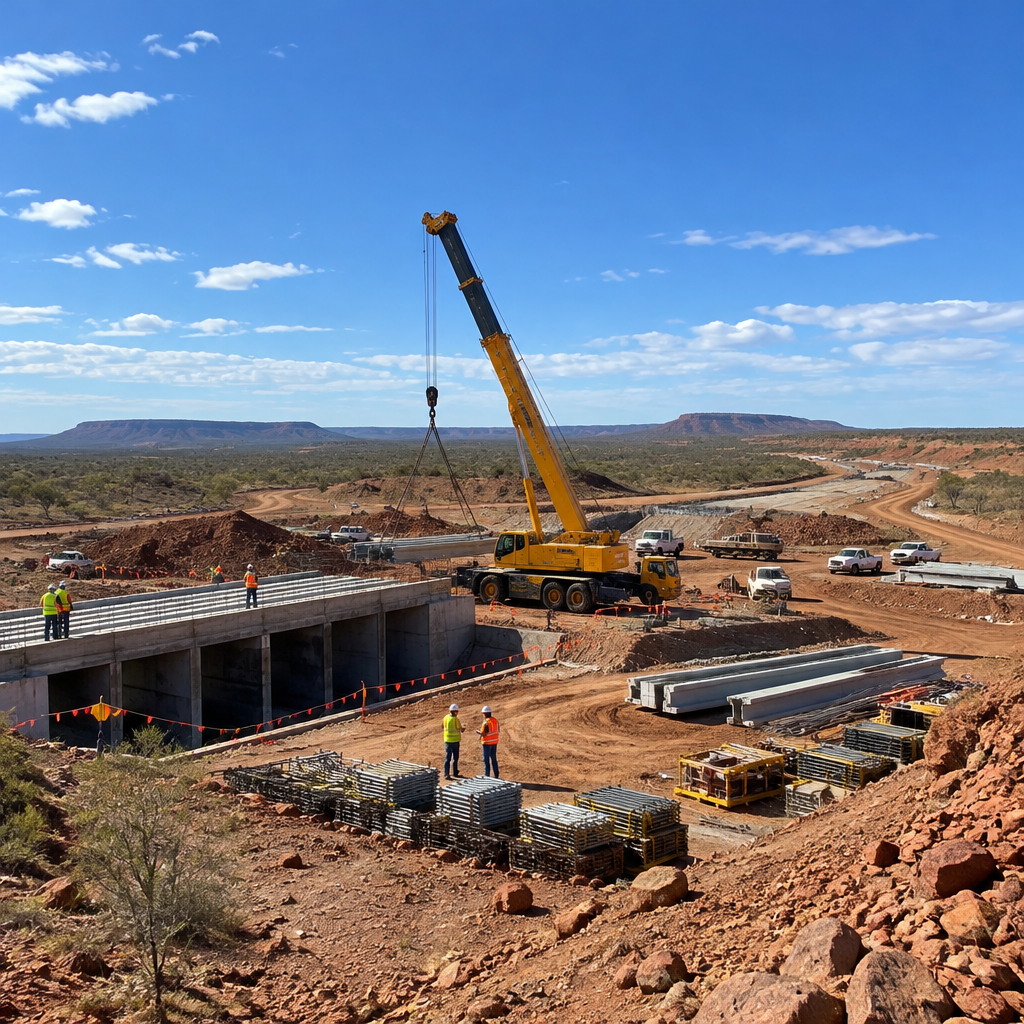
The Northern Australia Infrastructure Facility has passed $3 billion in funding drawdowns — a concrete number that underlines a larger shift: several long‑held development ambitions in the north are moving from plans to simultaneous reality.
Madeleine King’s 24 November statement
Minister for Northern Australia Madeleine King’s annual statement to parliament on 24 November highlighted a cluster of milestones: first gas from the Beetaloo Basin’s Shenandoah South project, the commencement of construction at Arafura’s Nolans rare‑earths project, and a federal focus on preserving established industries such as aluminium and copper processing in Queensland. The statement also announced up to $74 million in NAIF financing for an additional, 402‑bed student accommodation facility at Charles Darwin University.
Projects that are arriving together — Beetaloo, Nolans, established heavy industry and defence
Those projects exemplify different development pathways. In 2027, further Beetaloo development will test whether gas production can scale economically and supply competitively priced energy to industries including minerals processing, manufacturing and digital infrastructure. At Nolans, construction progress and cost discipline will determine whether commercially sustainable rare‑earths production materialises. Defence expenditure, meanwhile, offers opportunities to establish maintenance, engineering and logistics businesses that could persist after construction crews depart. For Queensland’s heavy industries, the immediate policy question is whether government assistance translates into long‑term commercial viability.

This site is the portfolio.
OSINTSights runs on Cloudflare Workers, D1, R2, and Vectorize, with an AI pipeline on Hetzner ARM. Nubivance designed, built, and operates it. We do the same for clients.
See what we buildLabour, housing and infrastructure: the bottlenecks that can undermine many projects at once
What makes the current moment different is simultaneity. Northern Australia, home to about 5 percent of the national population, has relatively small labour markets. A construction worker building a defence facility in Darwin cannot at the same time build a house in Palmerston or a gas processing facility near Katherine — yet the business cases for those projects may each assume the necessary workforce will be available. Governments can announce multiple major projects in an afternoon; training workers, building housing and expanding electricity supply can take years. A project can therefore be commercially sound in isolation and still contribute to a collectively unsustainable investment pipeline, while projects that look marginal alone may become viable if infrastructure costs and demand are shared.
NAIF, a rolling five‑year assessment and the Cooperative Research Centre successor
The article proposes a practical way to reduce risk: the Northern Australia Ministerial Forum could commission a rolling five‑year assessment of anticipated demands on labour, housing, energy, water and transport, drawing on information from governments, project proponents and infrastructure providers. That analysis should distinguish committed investments from speculative proposals, construction requirements from operational demand and local bottlenecks from broader constraints — recognising that Darwin, Townsville and the Pilbara are distinct economies even if they compete for some of the same national resources.
NAIF could use such analysis to identify common‑user infrastructure that unlocks multiple commercially credible projects, addressing genuine market failures rather than insulating proponents from commercial risk. The government’s work on successor arrangements for the Cooperative Research Centre for Developing Northern Australia is cited as an opportunity to retain research expertise and direct it toward emerging cross‑sector challenges. Future annual statements could then track movement from investment commitments to operational capacity, permanent employment, Indigenous ownership and improvements in regional prosperity.
What this means for northern communities, defence planners and mining and processing firms
- Northern communities: housing, health care and education are singled out as fundamental constraints on prosperity; increased Indigenous ownership of productive assets is framed as a way to translate development into intergenerational wealth.
- Defence planners: delays to military infrastructure could affect operational preparedness, and defence spending creates windows to build enduring maintenance, engineering and logistics capacity if workforce and facilities are ready.
- Mining and processing firms: international competition for energy, critical minerals and secure supply chains means firms face a race between geopolitical opportunity and the commercial competition to host processing — a race that depends on local infrastructure and labour availability.
The practical ledger is stark. International demand for energy and critical minerals, growing defence requirements, and bipartisan political support for NAIF to 2036 expand the region’s prospects, but they also increase the chance that overlapping projects will outpace the region’s workforce, housing and utility capacity. The task for 2027, as the ministerial statement suggests, is not only attracting projects but ensuring the workforce, infrastructure and institutions are ready when investors arrive. In that light, the ultimate measure of successful northern development won’t be the number of major projects Australia can attract, but what their presence enables northern Australians to build.