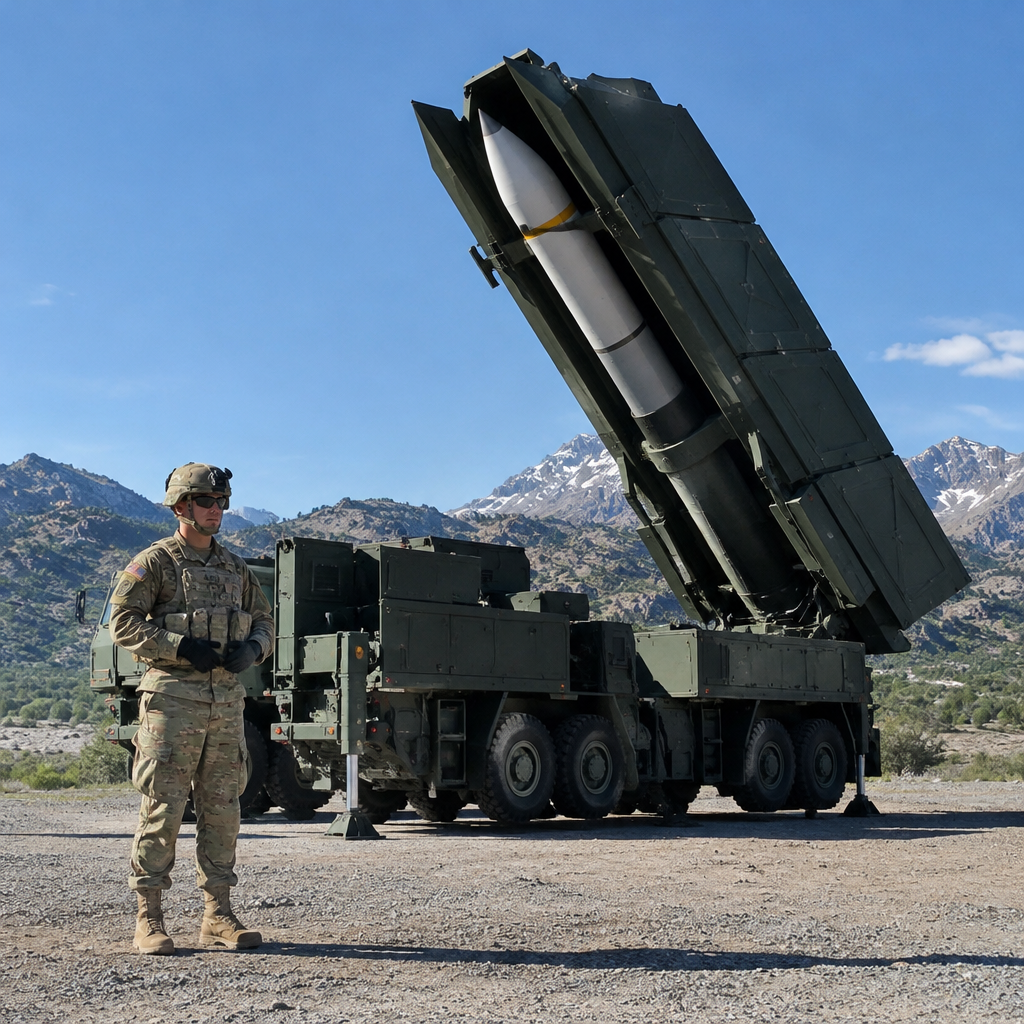
"It is fully fielded. It is ready to go," Lt. Gen. Frank Lozano told Breaking Defense on Nov. 19, confirming what the Army's hypersonic program office had long sought to deliver: an operational Long Range Hypersonic Weapon battery, also known as Dark Eagle.
Lt. Gen. Frank Lozano’s declaration and the limits of disclosure
Lozano, the Army’s Program Acquisition Executive for Fires, announced the milestone but declined to say when or where the first battery was fielded. He described the capability as "a global deployable and employable warfighting capability" and said soldiers "have everything that they need to employ, fight and win." When pressed on prior reporting that suggested the battery remained unfunded or incomplete, Lozano said he would not "go so far as to say that," adding that the program is "rapidly evolving" and that the Army is being "very, very aggressive" about producing and fielding Dark Eagle.
What a Dark Eagle battery contains and how it performs
The Army’s Dark Eagle battery is a land-fired hypersonic system built around a four-trailer transporter erector launcher (TEL) arrangement. Each trailer carries two all-up rounds plus canisters, and the battery includes a battery operations center and a support vehicle. The weapon’s glide body is shared with the Navy’s Conventional Prompt Strike program, though the Army integrates it on ground launchers. The Dark Eagle is described as capable of speeds over 3,800 miles per hour with a range of up to 1,725 miles.

Audit-ready is a season. It shouldn't be.
Evidence in spreadsheets, controls drifting between audits, frameworks multiplying on flat headcount. Nubivance runs continuous compliance on Rapid7 Cyber GRC - SOC 2, HIPAA, ISO 27001, PCI, CMMC.
End the scrambleDevelopment timeline and testing setbacks that pushed fielding back
The Army initially planned to field the first LRHW battery in 2023 but encountered testing problems, including "a mechanical engineering problem with the launcher," which prevented meeting that target. The fielding goal was later moved to September 2025 and missed again. Bloomberg reported in October 2026 that the Army had still not completely fielded the first battery, a delay that the outlet described as nearly three years behind the original schedule. At the time, the Army’s program office told Bloomberg it "continues fielding activities" and must complete further training and sustainment work before declaring the system fully fielded.
Manufacturing and quality-control issues raised by the GAO and Lozano’s response
A July Government Accountability Office report found that production was paused while the Army and Navy addressed problems identified in testing and that "the contractor [Lockheed Martin] has continued to experience issues at its facility." The GAO said those issues resulted in "missing, inconsistent, and unclear work standards for missile production." Lozano declined to give additional detail about current manufacturing issues but said preventing future problems will require more rigorous qualification testing of missile components — specifically naming solid rocket motors, integrated guidance sections, inertial navigation units, and seeker and seeker components as items that must be tested and qualified.
Production posture, vendor competition, and next batteries
Lozano said the Army is working on the second and third batteries but would not provide firm dates for their readiness because of operational security concerns. He noted the service is "already over halfway through production" of the third battery and expects the second and third batteries to reach full capability "at a faster pace and a faster rate than the first battery did." The GAO report and Lozano’s comments together document that production pauses occurred while testing and quality issues were addressed, and Lozano signaled a desire to open the LRHW program to additional vendors so the Army could have "production flexibility and options" should one vendor face manufacturing or quality problems.
How the 1st Multi-Domain Task Force, the Army program office, and Lockheed Martin are positioned
- 1st Multi-Domain Task Force, 5th Battalion, 3rd Field Artillery Regiment — Breaking Defense previously reported that soldiers in this unit at Joint Base Lewis-McChord received system components and training in anticipation of becoming the first operational Dark Eagle unit in 2023; Lozano did not confirm whether that unit is the one now designated as operational.
- Army Program Office (PAE Fires) — The program office continues fielding activities and, per Lozano, is prioritizing more rigorous qualification testing of components and faster production of follow-on batteries while balancing operational security concerns about dates and locations.
- Lockheed Martin — The GAO report recorded ongoing issues at the contractor’s facility, including inconsistent and unclear work standards; the Army is holding production and qualification steps as central to avoiding repeat problems.
The announcement marks a declared transition from a years-long development and testing phase to operational status for a program that repeatedly missed early targets. Lozano’s confirmation that the battery is "fully fielded" closes one chapter while leaving specific dates, locations and the pace of broader rollout of additional batteries open — and underscores the Army’s stated intention to accelerate production and increase vendor competition as it moves forward.