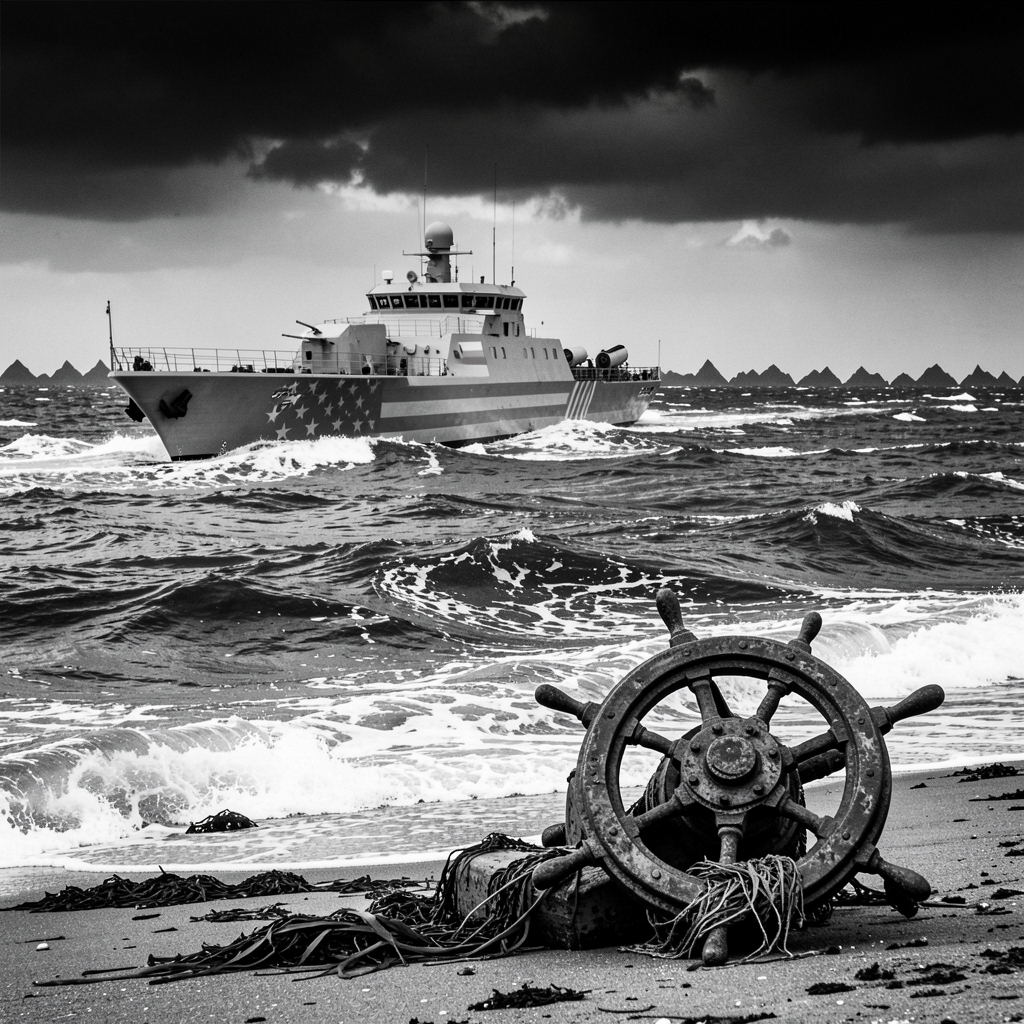
“That was a glimpse of the future force,” Adm. Caudle said at Sea‑Air‑Space — a single sentence that compresses a larger dilemma for a service that, by his account, is reshaping how it fights and adapts. The remark came in the wake of an incident described in the reporting: a submarine that sank an Iranian warship. The chief of naval operations framed that action not as an isolated tactical event but as a signal of broader change.
What happened, and what the CNO said
The reporting links a submarine’s sinking of an Iranian warship to a wider effort inside the Navy to adapt to new challenges. Adm. Caudle, speaking at the Sea‑Air‑Space conference, distilled the significance into a single line: “That was a glimpse of the future force.” The phrase, offered publicly by the CNO, ties an operational outcome to strategic intent — implying the Navy sees in that engagement a model worth studying and, perhaps, replicating.
Relevant context and constraints
The source material offers a narrow factual record: a submarine sank an Iranian warship, and Adm. Caudle, the CNO, described the episode as a preview of the Navy’s future force at Sea‑Air‑Space. Beyond that, the report does not specify which submarine, when the sinking occurred, the circumstances of the engagement, or the capabilities employed. Those omissions matter: they limit what can be stated as fact and require caution in drawing conclusions about doctrine, technology, or policy.

This site is the portfolio.
OSINTSights runs on Cloudflare Workers, D1, R2, and Vectorize, with an AI pipeline on Hetzner ARM. Nubivance designed, built, and operates it. We do the same for clients.
See what we buildWhy the CNO’s framing matters
- Signaling strategic intent: By calling the incident a “glimpse of the future force,” the CNO converts an operational event into a message about priorities. Even without further detail, the language indicates an emphasis on outcomes the Navy values and wants to make characteristic of its future posture.
- Agenda setting at a public forum: The remark came at Sea‑Air‑Space, a venue where service leaders and industry meet. That setting amplifies the CNO’s words — they are directed at sailors, defense executives, and policymakers simultaneously, shaping expectations about procurement, experimentation, and training.
- Limits of public information: The sparse reporting highlights a perennial tension: how much the Navy will reveal about capabilities and tactics it considers sensitive, and how much it will use public statements to influence partners, competitors, and domestic audiences.
How different actors might read the moment
- Technologists and industry: For companies and engineers, a public endorsement by the CNO that an operational event illustrates the future force acts as a market cue. It suggests where investment and experimentation could meet service demand — but the lack of detail obliges them to interpret the cue cautiously.
- Policymakers and budgeteers: Lawmakers and civilian leaders may see the CNO’s characterization as justification for funding shifts or program priorities. Again, the statement’s value depends on corroborating detail — operational evidence and requirements — that the short report does not provide.
- Adversaries and allies: Public language that frames a single engagement as forward‑looking can serve both deterrent and diplomatic purposes. It signals adaptation without disclosing precise methods, forcing outside observers to infer capability at their own risk.
- Operational commanders and sailors: Internal audiences may read the remark as validation of training, doctrine changes, or procurement choices. Whether it translates into concrete changes in platforms, tactics, or force structure will depend on decisions not detailed in the report.
The source material is intentionally concise; it supplies a vivid quote and a clear linkage crafted by the CNO, but it leaves open nearly every operational and technical detail. That combination — a pointed public framing without granular disclosure — is itself meaningful. It reflects a communication strategy that elevates an outcome as emblematic while protecting specifics that could be sensitive or contested.
Adm. Caudle’s line prompts a final, practical question: if a single engagement can be presented as the harbinger of a future force, how will the Navy, Congress, industry and foreign observers judge which elements of that engagement are worth institutionalizing — and which are one‑off circumstances? The answer will shape procurement, doctrine, and the balance between secrecy and signals in the years ahead.