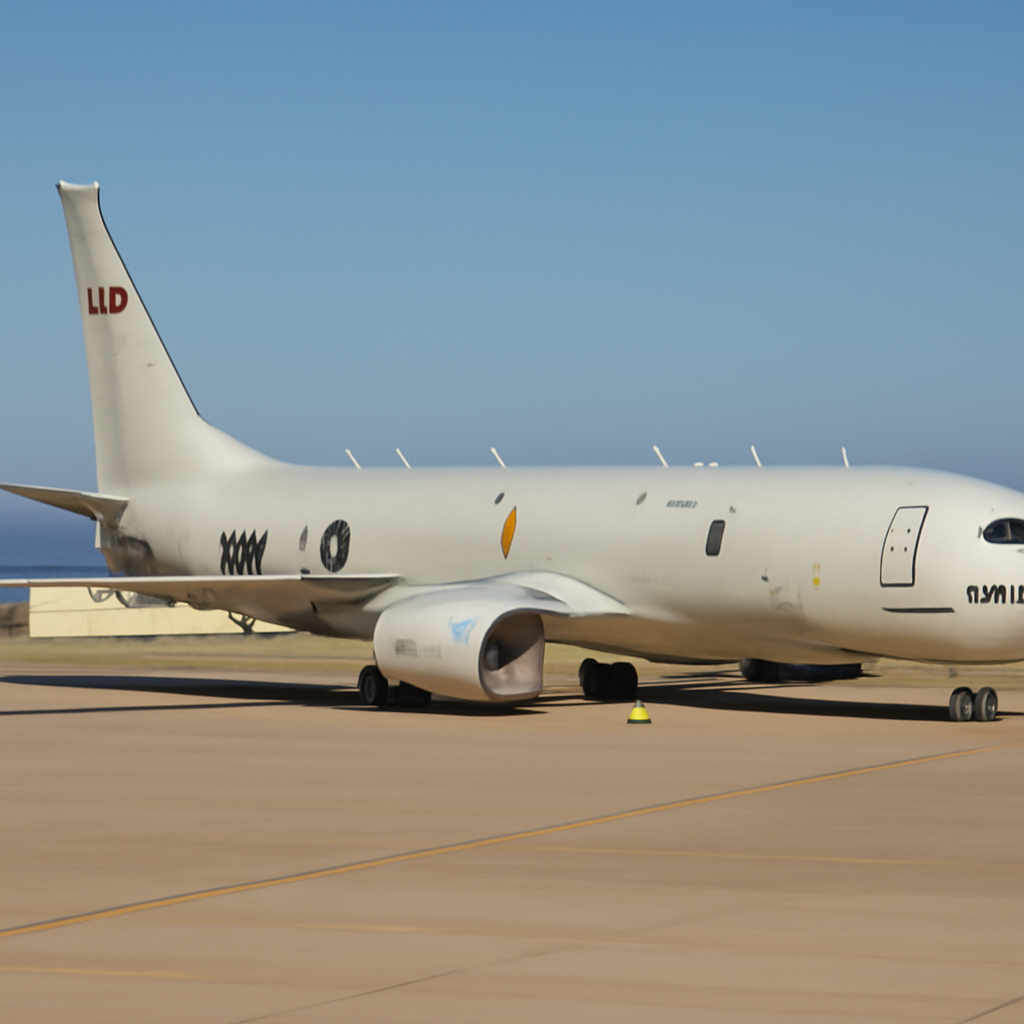
The very first P-8A Poseidon aircraft — the program’s T-1, which made its maiden flight in 2009 — has been reassigned to Air Test and Evaluation Squadron 30 (VX-30), the Navy’s “Bloodhounds,” to support long-range missile and other testing missions from Naval Air Station Point Mugu.
Air Test and Evaluation Squadron 30 (VX-30) and Point Mugu
VX-30 operates from Naval Air Station Point Mugu, part of Naval Base Ventura County, with direct access to the Point Mugu Sea Range. The offshore ranges there are regularly used by the Navy, other U.S. military branches, and defense contractors for missile and other tests, and VX-30 provides airborne support for those activities. The squadron’s personnel shared photographs of the P-8A arriving at Point Mugu on their Facebook page.
T-1 and T-2: the first P-8A airframes and planned roles
The P-8A that arrived is the very first production Poseidon, referred to in program parlance as T-1. VX-30 is also slated to receive the second test P-8A, known as T-2. According to a NAVAIR spokesperson last year, “T-1, the airworthiness P-8 aircraft, will have a radar modification to integrate an APY-10 in the airframe, as one does not currently exist. This will provide T-1 with a supportable radar configuration and capability that mirrors the baseline P-8 fleet. T-2 will be unmodified.”

Audit-ready is a season. It shouldn't be.
Evidence in spreadsheets, controls drifting between audits, frameworks multiplying on flat headcount. Nubivance runs continuous compliance on Rapid7 Cyber GRC - SOC 2, HIPAA, ISO 27001, PCI, CMMC.
End the scrambleHow the P-8A suits range surveillance and test support
The P-8A’s baseline sensors and platforms were singled out as well matched to VX-30’s immediate needs. Raytheon’s AN/APY-10 maritime search radar — the standard P-8 radar — is designed to spot and track vessels on the surface and masts from submarines, and it includes a synthetic aperture radar (SAR) mode that can capture still imagery through cloud, smoke, dust, and at night. Standard Poseidon aircraft also carry sensor turrets with electro-optical and infrared full-motion video, plus signals intelligence capabilities, meaning even unmodified P-8s can gather imagery, telemetry, and other test-relevant data while supporting range operations.
Fleet context: replacing aging P-3 Orions and modernizing test assets
VX-30 already operates a mixed test fleet: P-3 Orions, KC-130T Hercules tanker/transports, and the unique NC-20G and NC-37B jets. The NC-37B was acquired to replace one of the squadron’s NP-3D Orions, the variant nicknamed the “Billboard.” The squadron’s aircraft are equipped to collect imagery, telemetry, and other data and to pass that information to test facilities ashore for live monitoring and post-flight analysis.
The P-8A is markedly younger and more modern than the P-3s VX-30 flies. The Navy took delivery of its last new-production P-3C in 1990; “this means the very youngest Orion is 36 years old now,” the reporting notes. That age, combined with shrinking availability of trained P-3 crews after the broader fleet’s transition to the P-8, has made sustaining Orion operations progressively difficult. A NAVAIR spokesperson told TWZ last year, “The two P-8s will reduce sustainment costs and increase availability over the four P-3 aircraft VX-30 currently flies. P-8s also help alleviate P-3 manning challenges now that the FRS and operational squadrons have all transitioned to P-8 or decommissioned.” The P-3 also requires a Flight Engineer position that VX-30 must train in-house because the Fleet Replacement Squadron for the Orion no longer exists.
What this means for VX-30, NAVAIR, and defense contractors
- VX-30: The P-8s will assume range surveillance and clearance duties and reduce sustainment burdens associated with aging P-3s, while enabling longer-duration flights through aerial refueling capability from boom-equipped tankers.
- NAVAIR: The program office has already signaled modular modification plans — integrating an APY-10 into T-1’s airframe to mirror baseline fleet capabilities — and has left open the possibility of further adaptations as test needs evolve.
- Defense contractors and range operators: The P-8’s modern sensors and communications/data-sharing suites should enhance live monitoring and telemetry collection for missile and weapons testing conducted from Point Mugu and other U.S. range complexes.
The arrival of T-1 at VX-30 marks a clear shift in the squadron’s test support architecture: a transition from a shrinking, aging Orion-based fleet to newer P-8 platforms with built-in growth capacity. NAVAIR’s stated plan to fit T-1 with an APY-10, the unmodified status of T-2, and the Navy’s existing examples of deeper P-8 modifications — including aircraft carrying an AN/APS-154 Advanced Airborne Sensor pod — all point to a phased approach in which baseline P-8 capabilities will first relieve immediate sustainment and manning pressures and then potentially be expanded to meet broader test and intelligence missions. It remains to be seen how T-1 and T-2’s configurations will evolve as VX-30 integrates them into its operations across the Pacific and beyond.