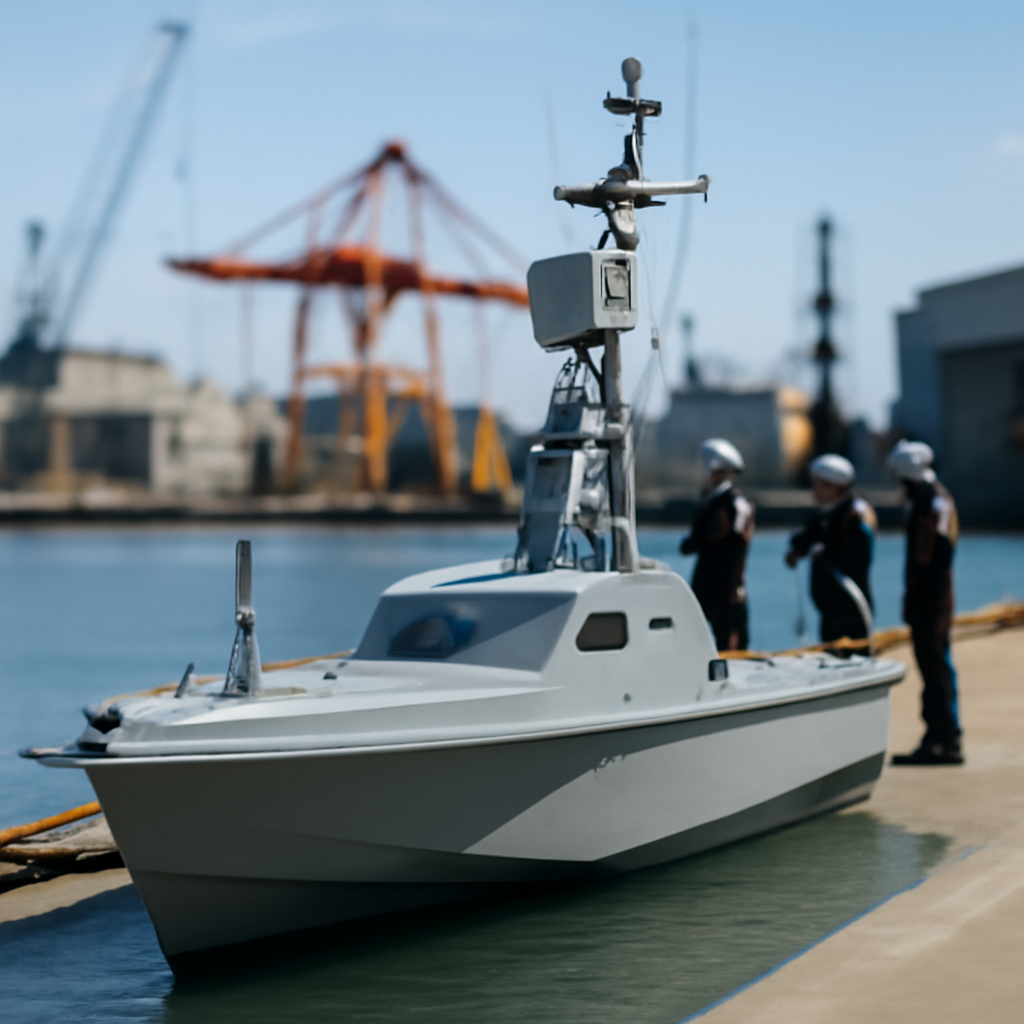
"Our warfighters don’t have time to wait on bureaucracy while our adversaries pace forward," Acting Secretary of the Navy Hung Cao said. "Build fast, deliver on time, and match the urgency of the threat." That urgency underpins the Navy's decision to buy 30 medium unmanned surface vessels (MUSVs) following a summer of at-sea testing and a rapid move to seed a recurring online marketplace for unmanned surface platforms.
Awards to Galliano Marine Services, Huntington Ingalls Industries, and Saronic Technologies
The Navy announced awards today for 30 MUSVs, contracting three firms for 10 systems each: Galliano Marine Services, Huntington Ingalls Industries (HII), and Saronic Technologies. The service said deliveries are expected to begin by the end of fiscal 2027 and that each MUSV will cost roughly $40 million, according to the Navy. Those systems will also be made available for purchase through the Navy’s MUSV marketplace.
Who advanced from at-sea testing and who did not
Seven companies were selected in May to participate in the Navy’s Phase I at-sea demonstrations, which ran from July through October. Of those, six successfully completed testing and will move into the online marketplace: the three awardees (Galliano, HII, Saronic) plus Leidos, PacMar Technologies, and Sea Machines. Birdon was selected initially but did not successfully complete the demonstration.
The six companies that advanced have each received $15 million and are now eligible for follow-on production contracts, the Navy said.

Audit-ready is a season. It shouldn't be.
Evidence in spreadsheets, controls drifting between audits, frameworks multiplying on flat headcount. Nubivance runs continuous compliance on Rapid7 Cyber GRC - SOC 2, HIPAA, ISO 27001, PCI, CMMC.
End the scrambleWhat the at-sea testing evaluated
At-sea testing focused on operational and safety-critical performance areas. The Navy evaluated each vessel’s visibility and maritime awareness, its ability to complete a long-duration mission, and its ability to navigate independently in accordance with the International Regulations for Preventing Collisions at Sea (COLREGs). Those criteria shaped which platforms the service considered ready for procurement and marketplace inclusion.
Phase II solicitation: changed size, endurance, and payload requirements
The awards arrive as the Navy moves into Phase II of the MUSV program. On Sept. 23 the service published a solicitation for that subsequent phase, which will integrate and test MUSVs and add additional options to the online marketplace. The Phase II notice sets specific parameters: vessels no longer than 90 meters, the ability to complete at least 10 days of unmanned operations, and a payload capacity of at least two standard 20-foot shipping containers. That payload requirement is explicitly smaller than Phase I’s earlier requirement of two 40-foot containers.
Christopher Miller, Direct Reporting Portfolio Manager for robotic and autonomous systems (DRPM RAS), said all companies that successfully completed Phase I will move into the Phase II marketplace and be eligible for follow-on production agreements. Miller explained the solicitation changes as a deliberate effort to "open the aperture" to new entrants and broaden opportunities for dual-use designs by easing some of the more challenging Phase I requirements—specifically noting that raising requirements such as speed created production challenges and affected vessel designs.
What this means for Galliano, HII, Saronic, Leidos, PacMar, Sea Machines, and the Navy
- Galliano Marine Services, Huntington Ingalls Industries, and Saronic Technologies now hold production contracts for 10 MUSVs each, with deliveries due by the end of fiscal 2027 and an approximate unit cost of $40 million.
- Leidos, PacMar Technologies, and Sea Machines, though not awarded the initial production contracts, were validated by testing and will be added to the MUSV marketplace for follow-on production agreements and eligible to receive funds and contracts under Phase II.
- Birdon—selected for Phase I testing in May—did not complete the demonstration successfully and therefore did not advance into the marketplace under this Phase I cohort.
- For the Navy, the program represents a move toward a recurring, production-oriented marketplace hosted on drones.mil, with plans to expand beyond MUSVs. Miller said the service is coordinating with the Direct Reporting Portfolio Manager for autonomy (DRPM UxS) to broaden the maritime marketplace to include other surface vessels as well as systems in the air, undersea, and counter-UxS domains.
The decision threads together fast-tracked procurement, predefined operational criteria, and a marketplace model intended to speed fielding. The Navy has converted this round of demonstrations into committed buys and adjusted Phase II requirements to widen competition and reduce engineering friction—concrete steps that will be measurable when deliveries begin by the end of fiscal 2027 and when the expanded marketplace on drones.mil accepts additional platforms.