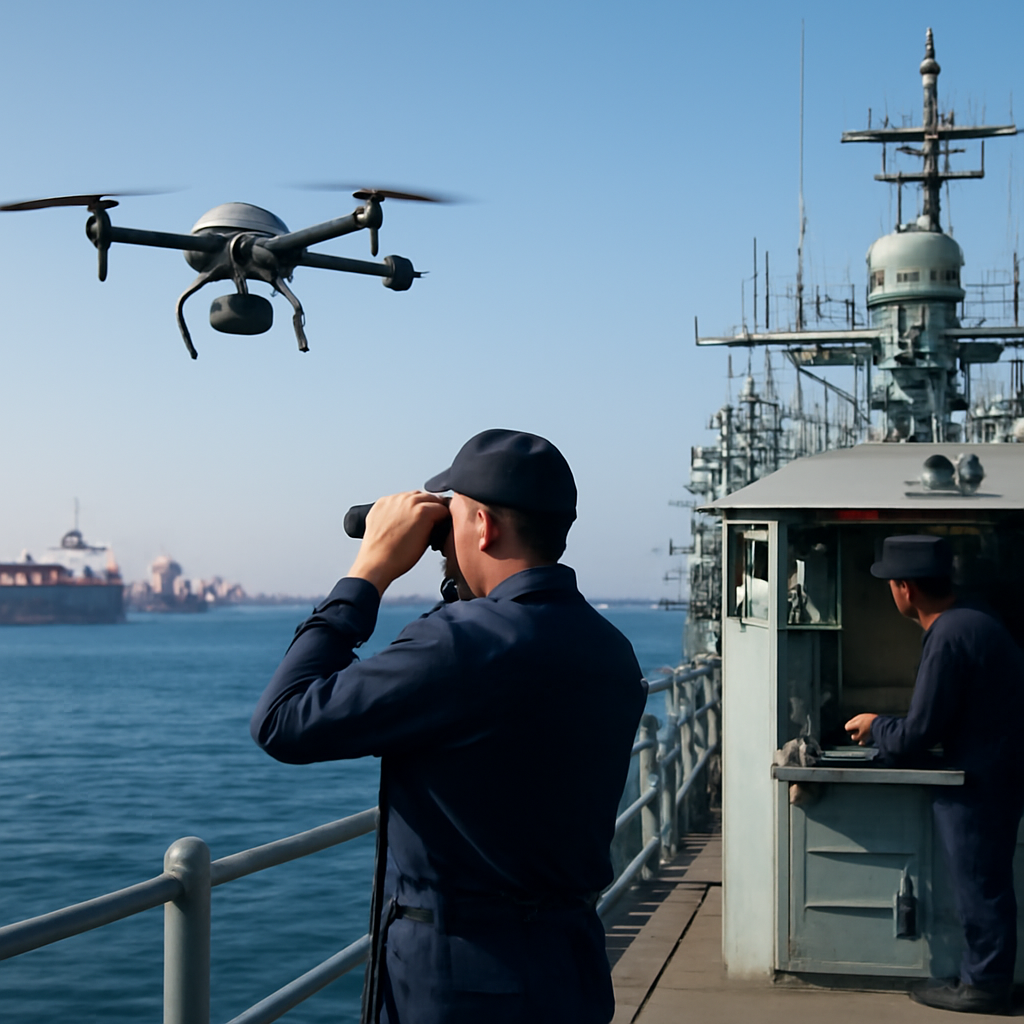
At stake is whether drones will make navies obsolete — and with that question hangs the security of maritime trade, the capacity to deter and coerce at sea, and the diplomatic and constabulary presence that underpins a stable Indo‑Pacific.
Black Sea: Ukrainian uncrewed systems changed posture but not control
Combat in the Black Sea, the article reports, shows drones can change behaviour without delivering strategic victory. Ukrainian uncrewed boats and aircraft "have caused the Russian navy to withdraw from the more exposed areas of the Black Sea," but that effect fell short of turning control to Ukraine. The piece notes a pragmatic equilibrium has emerged: "Both countries’ need for access for trade purposes has created a truce of sorts, allowing Russian and Ukrainian trade to move unhindered."
Strait of Hormuz: limited denial, outsized economic effect
Similarly, Iran's use of maritime disruption in the Strait of Hormuz produced significant economic consequences without achieving sea control. The article says Iran "achieved limited denial in the Strait of Hormuz, and by doing so in a chokepoint gained great effect on global energy flows." The distinction matters: tactical disruption and pressure on commerce are not the same as the persistent command of maritime approaches.

Audit-ready is a season. It shouldn't be.
Evidence in spreadsheets, controls drifting between audits, frameworks multiplying on flat headcount. Nubivance runs continuous compliance on Rapid7 Cyber GRC - SOC 2, HIPAA, ISO 27001, PCI, CMMC.
End the scrambleThe three claims that underpin the argument against navies — and why they fall short
- Saturation: Swarms of strike drones and uncrewed boats can overwhelm defences. "A destroyer might intercept most of the incoming threats, but a few weapons that got through would still damage a ship," the article observes — the logic of attrition by mass.
- Cost asymmetry: Surface combatants are expensive — "between US$1.2 billion (A$1.7 billion) and US$2 billion" — while a maritime drone "may cost tens of thousands." That inversion creates strategic discomfort for navies built around costly platforms.
- Complication of sea control: Drones can deny access to ports, threaten logistics hubs and impose persistent surveillance, forcing forces farther from shore and compressing decision cycles.
But the article stresses these challenges echo earlier waves of alarm — from mines, torpedoes, submarines, aircraft and antiship missiles — and that each era produced adaptation rather than obsolescence.
Why navies still matter: strategic functions beyond single engagements
The core argument is that sea power is broader than the survivability of individual platforms. The article lists four strategic functions that sustain navies' relevance: securing maritime trade routes (drones can disrupt shipping, but "they cannot guarantee its safety"); supporting deterrence and coercive presence (drone swarms "cannot signal resolve, uphold freedom of navigation or reassure partners"); providing diplomatic and constabulary functions as instruments of statecraft; and sustaining campaigns rather than only winning tactical moments. In short, drones "can harass maritime trade but can’t secure it" and "can impose risk, but they can’t project sovereignty, uphold maritime order or provide the diplomatic and constabulary presence that underpins a stable Indo‑Pacific."
How navies and national strategy must change
Adaptation, not abandonment, is the prescription. The article argues that the real shift is conceptual: navies must operate with intermittent visibility, under persistent surveillance, and within compressed decision cycles. They must assume their signatures will be detected and targeted, and build "depth, magazines, repair capacity and industrial surge." Rather than continuous dominance, forces must generate "fleeting, localised windows of superiority." History, the article notes, shows new naval technologies are absorbed into fleets and doctrine rather than simply rendering them obsolete.
What this means for Australia, maritime trade operators, and naval planners
For Australia, the piece is explicit: national advantage in the drone era will not come from choosing between ships and uncrewed systems but from a combined capacity to survive intelligence, surveillance and reconnaissance saturation; sustain operations under fire; and adapt faster than adversaries. The determinants, the article says, are "mass, dispersion, industrial depth and maritime logistics — not the drones themselves." Maritime trade operators should expect drones to remain a disruptive hazard, since drones can harass shipping and threaten logistics hubs, even when they do not enable permanent sea denial. Naval planners are advised to prioritise repair capacity, magazines and industrial surge so fleets can sustain campaigns when decision cycles are compressed and signatures are exposed.
That is the narrow contest the article leaves on the table: drones disrupt, but they do not replace sea power. The future, it concludes, "belongs to countries and navies that understand that."
https://www.aspistrategist.org.au/why-navies-still-matter-in-the-age-of-drones/