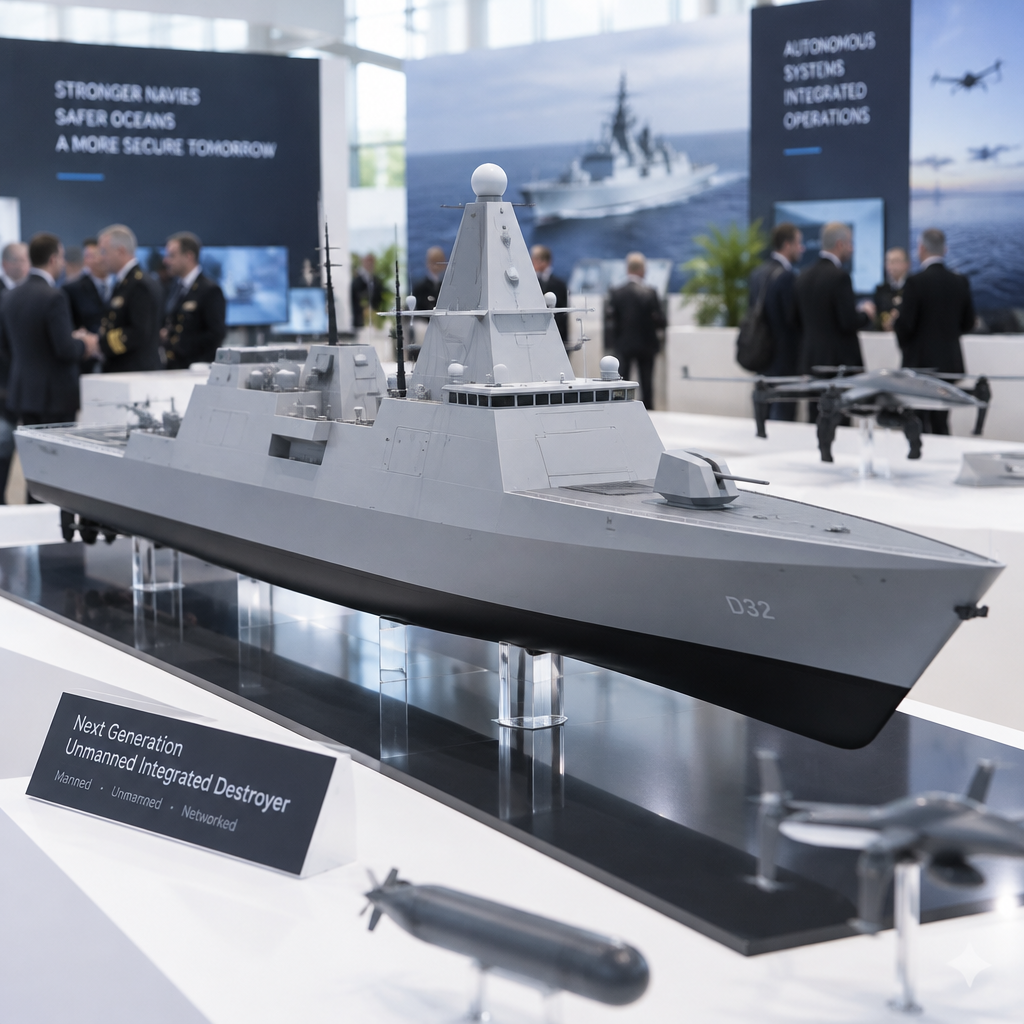
“The SCX26 measures approximately 558 feet long and 79 feet wide, with a reported full-load displacement of around 8,000 metric tons.” That numerical snapshot, released by Naval Group at Euronaval 2026 in Paris, frames the company’s argument: future surface combatants will be larger, stealthier, and built to operate as motherships for uncrewed systems rather than as single-purpose gunboats.
SCX26 dimensions, propulsion, and intended role
Naval Group unveiled the SCX26 concept at the Euronaval 2026 exhibition and presents it explicitly as a research platform — “a platform for testing ideas about future naval combat,” not a production design. The concept displaces roughly 8,000 metric tons, is about 558 feet long and 79 feet wide, and is designed for 30 knots and an 8,000-nautical-mile range. The proposed propulsion arrangement is CODLAG (combined diesel-electric and gas turbine), contrasted in the source with the French Navy’s FDI frigates, which use CODAD and displace about 4,460 metric tons (400 feet by 59 feet).
Twin‑island superstructures, radar satellites, and distributed sensors
The SCX26’s most conspicuous external feature is its split or “twin‑island” superstructure. Naval Group places sensors and bridges in two separate deckhouses: a broad forward tower with large square radar panels and an aft tower that is taller, narrower, and topped by a pole mast. Mer et Marine reports that the largest panels intend to host a new‑generation UHF radar, complemented by a multifunction AESA derived from the Sea Fire family used on FDI frigates.
Naval Group says the design explicitly considers detection from above — including by radar satellites — and places “particular attention to the upper surfaces of its superstructures.” Distributing sensor suites between two towers is described as a way to reduce blind arcs, widen coverage, and improve resilience through redundancy.

Audit-ready is a season. It shouldn't be.
Evidence in spreadsheets, controls drifting between audits, frameworks multiplying on flat headcount. Nubivance runs continuous compliance on Rapid7 Cyber GRC - SOC 2, HIPAA, ISO 27001, PCI, CMMC.
End the scrambleLayered weapons fit: Sylver VLS, Rampart, railgun, and a 100‑kW laser
The concept’s reported missile fit includes 12 Sylver vertical‑launch installations — eight forward and four aft — which could accommodate up to 96 missiles depending on configuration, with named payloads including Aster 30 surface‑to‑air missiles and MdCN land‑attack cruise missiles. Naval Group also identifies options to push missile capacity beyond 100 through quad‑packing CAMM missiles and future Sylver NG launchers. Two multifunctional Rampart launchers for short‑range missiles, guided rockets, and decoys are shown on the model just forward of the flight deck.
Beyond missiles, the SCX26 concept lists developmental or conceptual weapons: a large‑caliber electromagnetic gun described as a railgun and a conventional 57mm gun, each housed in shrouded cupolas to preserve low observability. The source notes the known technical challenges for railguns — especially power generation, sustained operation, and barrel wear — and cites testing of a prototype electromagnetic railgun aboard the Japanese warship Asuka last year as the first successful ship‑mounted firing at an actual target vessel.
Naval Group also proposes a 100‑kilowatt laser mounted high on the forward superstructure to engage drones, missiles, and other threats. The source compares that output with the U.S. Navy Laser Weapon System Demonstrator (LWSD) Mk 2 Mod 0 installed on USS Portland in 2019, and notes the operational tradeoffs for high‑energy lasers: effective at the speed of light and with a potentially vast magazine if power and cooling are available, but constrained by atmosphere, range, and sustained beam requirements.
Internal mission bay, drone “factory,” and aviation facilities
A central design tenet for the SCX26 is its role as a drone mothership. A large internal mission bay beneath an extensive stern flight deck is described as housing helicopters plus uncrewed aerial, surface, and underwater systems. Naval Group calls the bay a “small onboard drone factory,” with potential additive manufacturing alongside maintenance, repair, and spare‑parts storage. An elevator links the bay to the flight deck, which on the displayed model has spots for one medium (NH90‑sized) helicopter and two smaller VTOL drones.
The central open deck area between the twin towers is presented as a flexible zone for modular weapons and remotely operated systems; Naval Group’s video also shows mass‑launcher boxes for drones installed on an FDI frigate and suggests similar fitment for the SCX26 concept. The combat system is described as data‑centric, employing advanced processing and artificial intelligence to coordinate unmanned systems and act as a connectivity hub within a wider naval force.
What this means for the French Navy, naval technologists, and operational commanders
- French Navy: Naval Group positions SCX26 as an architectural option to inform a future replacement for Horizon‑class air‑defense destroyers; the company stresses survivability, redundancy, and an emphasis on countering ballistic and hypersonic threats with long‑range UHF detection and layered defenses.
- Naval technologists and shipbuilders: The concept foregrounds integration challenges — power generation and cooling for railguns and lasers, model testing (including reported towing‑tank work), and the logistic footprint of onboard additive manufacturing and large drone complements.
- Operational commanders and drone operators: SCX26 reframes a large surface combatant as a command, sensor, and drone‑support node: space for a crew of roughly 150 plus accommodation for about 100 additional personnel, and facilities to launch, recover, maintain, and possibly manufacture uncrewed systems that extend surveillance, strike, and electronic‑warfare reach.
Naval Group’s SCX26 is a deliberate exercise in futurecasting: a design matured through model testing and exhibition rather than an immediate procurement proposal. The concept bundles current technological ambitions — UHF and AESA sensing, large VLS magazines, electromagnetic and directed‑energy weapons, and an onboard drone ecosystem — into a single vessel architecture. Whether those ideas move from towing tank and digital rendering into French fleet plans or export designs remains the question Naval Group leaves to customers and naval planners.