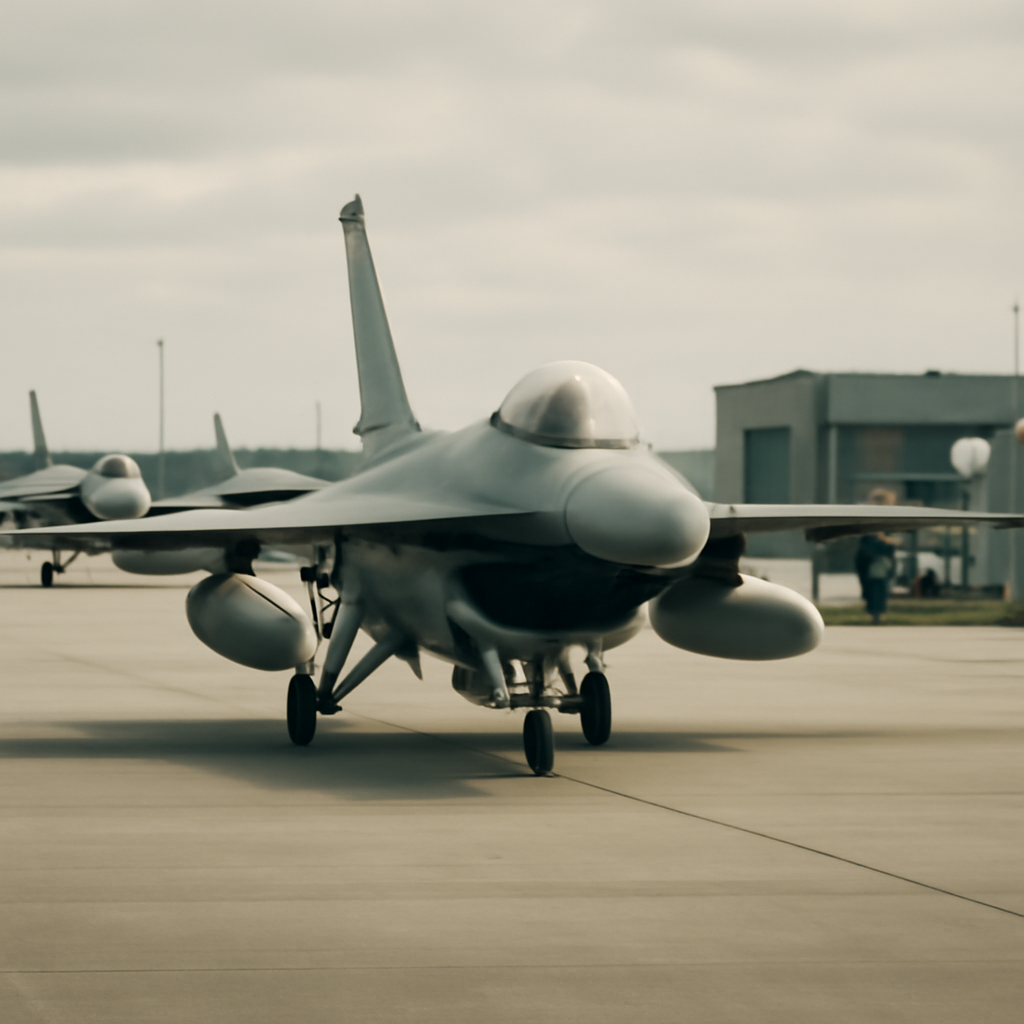
"Each sortie originates from an airfield. Every airfield is a node of vulnerability: if it can be persistently denied, the adversary’s air campaign is fundamentally disrupted at source," SACT suggested.
SACT, JATEC and ACT launch the Persistent Airfield Denial Innovation Challenge
The NATO-Ukraine Joint Analysis, Training and Education Centre (JATEC) and NATO Allied Command Transformation (ACT) have announced the Persistent Airfield Denial Innovation Challenge, a competition offering a 250,000 Euro award to companies or individuals who propose workable ways to prevent Russia from using its air bases. The announcement frames the effort as a response to what Headquarters Supreme Allied Commander Transformation (SACT) described as "one of the most consequential asymmetries" in the current conflict: Russian tactical aviation operating from rear-area bases beyond the reach of conventional Ukrainian strike assets.
Technical requirements: autonomy, persistence, EW- and GPS-resilience
SACT set demanding technical expectations. Solutions must be able to operate in GPS-denied and electronic-warfare (EW)-contested environments, across "all weather conditions and seasons," and demonstrate a credible path to rapid fielding. The solicitation is technically agnostic but specifies capabilities including sustained strikes deep into contested airspace, operation "without continuous human control," full autonomy, and the ability to deliver "sufficient mass and precision to suppress multiple aim points across an airfield simultaneously."
- Acceptable concepts include uncrewed aerial systems (any range class), autonomous or semi-autonomous munitions and loitering systems, swarming and mass-effect approaches, alternative delivery mechanisms, and hybrid combinations.
- SACT also seeks systems that require minimal training and incorporate AI-assisted target acquisition that "reduces reliance on expert judgment."
- Proposed systems should sit in the mid-to-upper tier of the military technology readiness level (TRL) scale, from "high fidelity" laboratory integration to prototypes near planned operational systems.

Audit-ready is a season. It shouldn't be.
Evidence in spreadsheets, controls drifting between audits, frameworks multiplying on flat headcount. Nubivance runs continuous compliance on Rapid7 Cyber GRC - SOC 2, HIPAA, ISO 27001, PCI, CMMC.
End the scrambleTimeline, prize, and selection process
The challenge imposes a compressed development clock: any solution that will take more than one year to field will not be considered. Submissions are due by July 20. Ten finalists will be announced on August 11 and invited to a pitch day on September 3, tentatively to be held in Poland.
Operational gap NATO and Ukraine aim to close
SACT and the Ukrainian Defense Ministry (MoD) characterize the problem bluntly: Russian tactical aviation continues to strike using guided aerial bombs, cruise missiles, and stand-off munitions from bases that are largely impervious to current Ukrainian strikes. The subcommand argues that existing "workarounds"—manned strike aviation, ground-based long-range fires (MLRS, ballistic missiles), and conventional single-unit loitering munitions—"have demonstrated limited effectiveness against defended airfield targets" because they "lack the mass-effect, persistence, and EW-resilience" needed to suppress multiple aim points across an airfield in a contested environment.
The Ukrainian MoD called for technologies that "will help to permanently limit the enemy’s use of aviation infrastructure: aircraft, runways, fuel and ammunition storage facilities, and ground support infrastructure," and invited Ukrainian miltech companies, startups, and engineering teams to participate.
What this means for Ukrainian miltech companies, NATO procurement, and Russian tactical aviation
- Ukrainian miltech companies and startups: They are explicitly invited to compete but face a steep bar—proposals must demonstrate rapid fielding potential and resilience in GPS- and EW-denied environments. The contest offers a route to scale through NATO channels if a concept matures.
- NATO procurement and fund managers: NATO has a potential conduit to move ideas toward operational use—reporting notes NATO has developed a half‑billion dollar fund to develop weapons for Ukraine—yet the challenge imposes tight timelines and high technical thresholds that will limit eligible candidates.
- Russian tactical aviation (as a strategic target): The program is built on the premise that persistent, massed suppression at the source—if achievable—would disrupt sortie generation from rear airfields. Whether the competition will produce capabilities sufficient to do that at scale remains a core question.
Even proponents concede uncertainty. The reporting notes that Ukraine has one of the world's most innovative wartime defense-technology ecosystems and has fielded drones and missiles under fire, but it has not yet achieved the kind of persistent, EW-resilient suppression SACT describes. Observers quoted in the source cite Ukraine's limited funds and "Ukraine’s inability to mass produce sophisticated weapons or sustain stable military supply chains," a constraint the Atlantic Council has described. The source warns that moving a winning design from prototype to the quantities required to alter air campaigns would be a "formidable endeavor."
The challenge is explicit about scope and speed: mid-to-upper TRL concepts, operational within a year, pitched publicly in September, and linked to NATO channels that could help scale a mature idea. The competing pressures—high technical bar, compressed timetable, and industrial-scale production requirements—leave the core question visible: can an idea turned up by July 20 grow fast enough, and be resilient enough, to make rear airbases less secure?