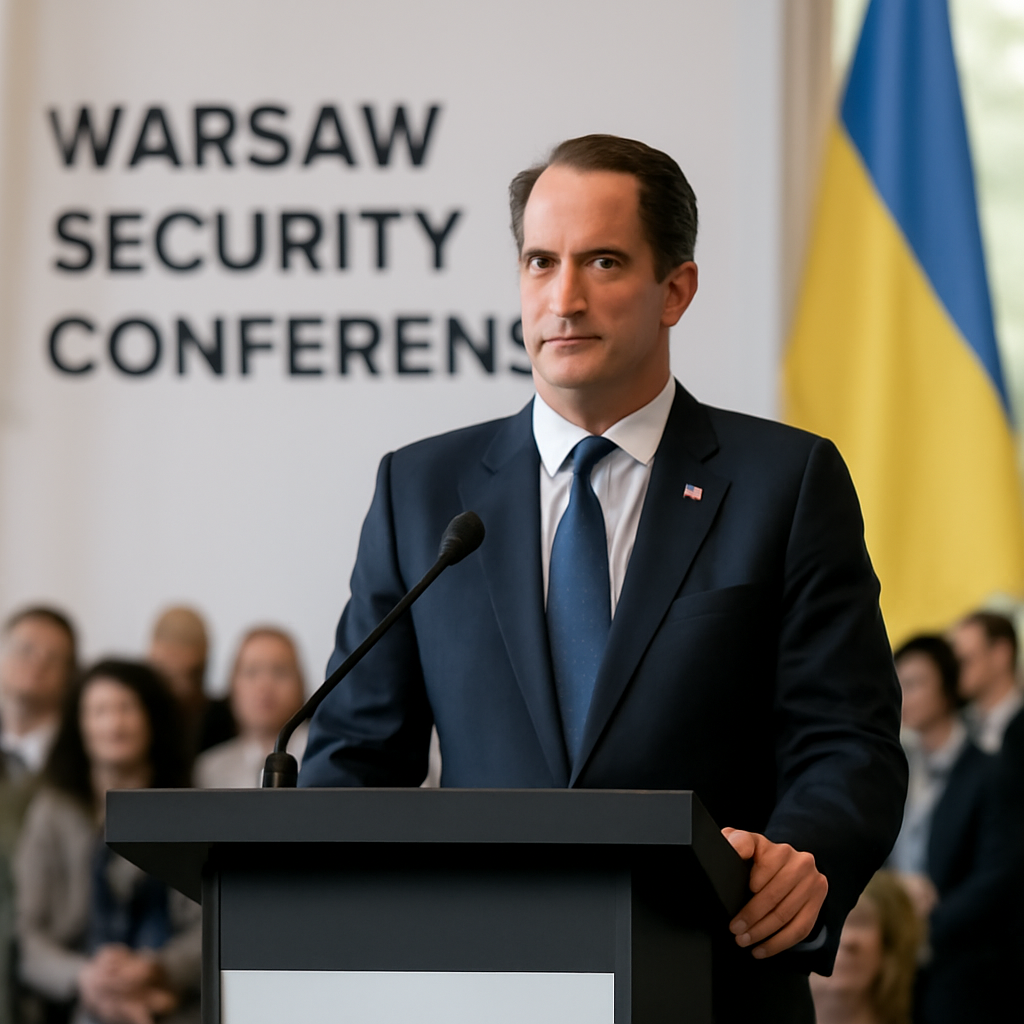
"It means that aid packages [to Ukraine] move not in nine months, but in nine days or nine weeks on the outside, and that the message [of support to Ukraine] is very different," Rep. Jim Himes said at the Warsaw Security Conference.
Rep. Jim Himes on a switch in House and Senate control
Speaking as the ranking member of the House Permanent Select Committee on Intelligence, Connecticut Rep. Jim Himes tied the speed and character of U.S. military aid to Ukraine directly to which party controls Congress. Himes argued that if Democrats win control of both the House of Representatives and the Senate in November’s midterm elections—and thereby the budget—President Donald Trump could be forced to negotiate with Democrats to fund his priorities. In that negotiation, Himes said, Democrats would "demand" the president adopt a "much more affirmative and consistent policy in support of Ukraine."
Himes framed the potential electoral outcome as broad and consequential: polling and prediction markets, he said, "suggest the midterms could deliver 'a fairly massive repudiation of the president,'" though he cautioned that the result would not be driven directly by U.S. policy toward Russia and Ukraine. He contrasted campaign promises and outcomes, quoting his assessment that, "In a remarkable political experiment," Trump said he would not go to war in the Middle East and would lower living costs, "And he did precisely the opposite of both those things."
NATO’s PURL mechanism and the role of U.S. procurement access
The NATO Prioritised Ukraine Requirements List (PURL) initiative is central to how European allies and partners fund purchases for Ukraine: NATO coordinates deliveries while allies and partners fund procurement of U.S.-sourced weapons and equipment. That structure, the reporting notes, depends on Washington making those U.S.-sourced weapons available for purchase. As a result, the pace and scale of European-funded military assistance via PURL can be affected by U.S. policy choices on what equipment is made available for sale or transfer.
Himes’ comments underscore that control of U.S. domestic levers—budgetary authority and procurement approvals—can materially affect how quickly allied funds convert into battlefield deliveries under NATO coordination.

Audit-ready is a season. It shouldn't be.
Evidence in spreadsheets, controls drifting between audits, frameworks multiplying on flat headcount. Nubivance runs continuous compliance on Rapid7 Cyber GRC - SOC 2, HIPAA, ISO 27001, PCI, CMMC.
End the scrambleReports of U.S. administration pressure, an energy ceasefire and diesel export decisions
Himes spoke in the context of reports that the Trump administration has threatened to stifle the procurement system supplying weapons to Ukraine in what those reports describe as an effort to pressure Kyiv to end deep strikes against Russian energy infrastructure. The source notes that on Sunday, U.S. President Donald Trump announced an energy ceasefire between Ukraine and Russia. The source also records that he has "received bipartisan criticism for temporarily lifting restrictions on Russian diesel exports."
The reporting frames those administration actions and reports as part of the political backdrop to Himes’ forecast about how a shift in congressional control could change both the tempo and the tenor of U.S. support for Ukraine.
Sen. Roger Wicker’s remarks and Gen. Alexus Grynkewich’s assessment
Also speaking in Warsaw, Mississippi Sen. Roger Wicker, chair of the Senate Committee on Armed Services, deferred to NATO Supreme Allied Commander Europe Gen. Alexus Grynkewich when addressing Ukraine and Iran. Wicker said Grynkewich "thinks we're up to the task with regard to helping Ukraine and finishing whatever the President [Trump] intends to do after the election in Iran," and added his own view that "the memorandum of understanding and stopping and starting [peace negotiations] was not a good idea with regard to Iran."
Wicker’s remarks link concurrent security questions—sustaining assistance to Ukraine and engagement on Iran—while signaling reliance on NATO military judgment for capacity assessments.
What this means for NATO allies, the Trump administration, and Congress
- NATO allies and partners: Under PURL, allies fund purchases of U.S.-sourced equipment and rely on Washington to make that equipment available. Changes in U.S. procurement policy could speed or constrain deliveries coordinated by NATO.
- The Trump administration: Reports cited in the source suggest the administration retains levers—procurement approvals and export decisions—that can affect the flow of externally funded weapons to Ukraine; recent public moves referenced include announcing an energy ceasefire and temporarily lifting restrictions on Russian diesel exports.
- Congress (if Democrats gain control): Himes foresees that Democratic control of both chambers and the budget would force negotiation over presidential priorities and could produce faster, more consistent military aid to Ukraine—measured, he said, in days or weeks rather than months.
The central tension in the record presented here is procedural as much as strategic: NATO can coordinate and allies can fund, but the availability of U.S.-sourced systems remains tethered to Washington’s approvals. Rep. Himes projects that a shift in congressional power would change how quickly and reliably that tether is loosened; the administration’s recent decisions and reported threats to procurement channels show how tightly the pace of aid can be controlled in practice. Whether the tempo of assistance will be driven by electoral outcomes, executive choices, or a mix of both is the practical question the Warsaw remarks leave squarely on the table.