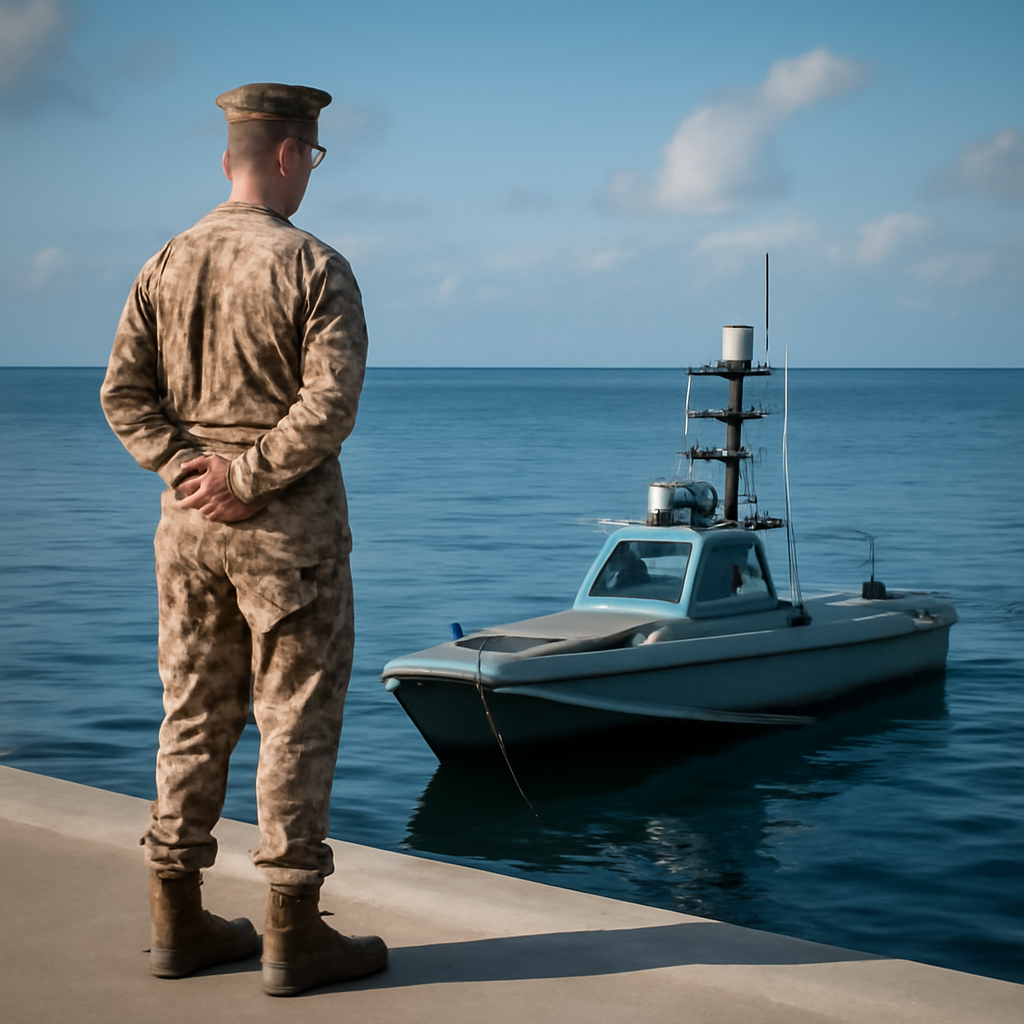
“You never want to send a Marine someplace you haven’t already sent a robot,” Col. Chris P. Niedziocha told TWZ, arguing that uncrewed surface vessels (USVs) should precede Marines into contested littoral zones.
Col. Chris P. Niedziocha makes the operational case for USVs
The officer who led the 31st Marine Expeditionary Unit (MEU) on its recent six‑month Middle East deployment and now directs the USMC Expeditionary Warfare School said the Marine Corps must incorporate sea drones organically. Niedziocha described an “explosion in robotics and autonomy” and said, “These systems are incredibly useful and capable,” adding plainly, “we’re not leaders. We’re fast followers in that regime.” His unit also employed Expeditionary Advanced Base Operations (EABO) in combat for the first time during the fight against Iran, running forward arming and refueling points (FARPs) and remote sensing locations — experience he said informs the need for USVs on future deployments.
Reconnaissance, hydrography and mine countermeasures
Niedziocha’s immediate operational priority for USVs is reconnaissance ahead of amphibious landings. He argued commanders need to “understand what’s waiting beneath the surface in the water column,” whether via side‑looking sonar or forward‑looking systems to confirm the absence of obstacles. The article cites NOAA to define hydrography as measuring “the shape and features of the shoreline; the characteristics of tides, currents, and waves; and the physical and chemical properties of the water itself,” and bathymetry as mapping depths and underwater terrain — functions he linked directly to mine detection and beach‑zone hazard identification.

This site is the portfolio.
OSINTSights runs on Cloudflare Workers, D1, R2, and Vectorize, with an AI pipeline on Hetzner ARM. Nubivance designed, built, and operates it. We do the same for clients.
See what we buildTests, programs and platforms the Marines are pursuing
The Marines are already testing systems to fill littoral gaps. The Program Manager Combat Support Systems (PM CSS) Explosive Hazard Defeat Team ran an evaluation “late last month at Camp Pendleton” of a commercial USV equipped with autonomous driving and payloads including sonar, Forward‑Looking Infrared (FLIR) cameras, Line‑of‑Sight communications, and Acoustic Communications (AComms). That effort was described as a response to a “littoral capability gap” and part of developing solutions to “enable increased standoff for Marines to detect, investigate and neutralize threats.”
PM CSS’s work ties into the Littoral Explosive Ordnance Neutralization (LEON) concept, a “system of systems” combining remotely operated vehicles, diver equipment, unmanned underwater vehicles (UUVs), USVs, and an Amphibious Unmanned Ground Vehicle to let EOD confirm and mark hazards from shallow water to the beach zone. Chief Warrant Officer 2 Alfredo Andrade, officer in charge of an EOD company, framed the goal as expanding endurance and reducing operator risk so “we have readily available combat power.”
Operational precedents: Ukraine, Houthi forces, and recent U.S. combat use
The Marines’ caution that they are “not leaders” in USV employment reflects battlefield practice elsewhere. The article notes the Houthis “pioneered the operational use of kamikaze USVs years ago,” and Ukraine has advanced sea‑drone capabilities — employing kamikaze boats, adding guns and rockets, launching missiles, and even using USVs to engage other USVs. In one clip cited, Ukraine’s Navy claimed a Sargan USV destroyed a Russian unmanned boat, described as “the first‑ever battle between unmanned surface vessels.”
U.S. forces have also used USVs in recent operations. During Operation Epic Fury, the U.S. employed USVs “for the first time in combat” as one‑way attack weapons against Iranian targets, to hunt for mines, and in a search and rescue to find the crew of an AH‑64 Apache downed by Iran, plus for broad‑area surveillance. CENTCOM tweeted that three Corsair unmanned surface vessels struck a submarine and ship maintenance facility at Bandar Abbas Naval Base on July 13, 2026 — the first recorded time American forces have used multiple one‑way attack surface drones in that way. The summer RIMPAC trials demonstrated launch and recovery of a Splash Industries Typhoon USV aboard USS Essex and an autonomous resupply mission in which a Typhoon delivered stores into a moving Navy ship.
What this means for PM CSS, the Navy, and Marines
- PM CSS and EOD planners: Expect continued emphasis on integrating USV payloads — sonar, FLIR, communications and acoustic links — into counter‑mine and LEON concepts, with live tests at Camp Pendleton and elsewhere informing requirements.
- The Navy and amphibious platforms (the so‑called “Gator Navy”): Amphibious assault ships’ well decks were highlighted as natural USV motherships, easing deployment and recovery — a logistical advantage the article suggests will push these ships into a central role in future USV operations.
- USMC force planners and expeditionary commanders: Niedziocha’s operational experience — FARPs, EABO and remote sensing during the recent deployment — frames an argument for organic USVs to increase standoff, reduce risk to Marines, and support beach‑zone hydrography and mine detection.
Taken together, the reporting sketches a service intent on catching up: Marines have operational reasons to want USVs, have run tests and solicitations such as an ALPV solicitation noted by the Department of War Innovation Unit on March 3, 2026, and have seen theater examples of what USVs can do. But Niedziocha’s plain language — “we’re not leaders. We’re fast followers” — and the article’s catalog of foreign and U.S. precedents underline that the road from demonstration to an organic, routine Marine USV capability remains active and contested.