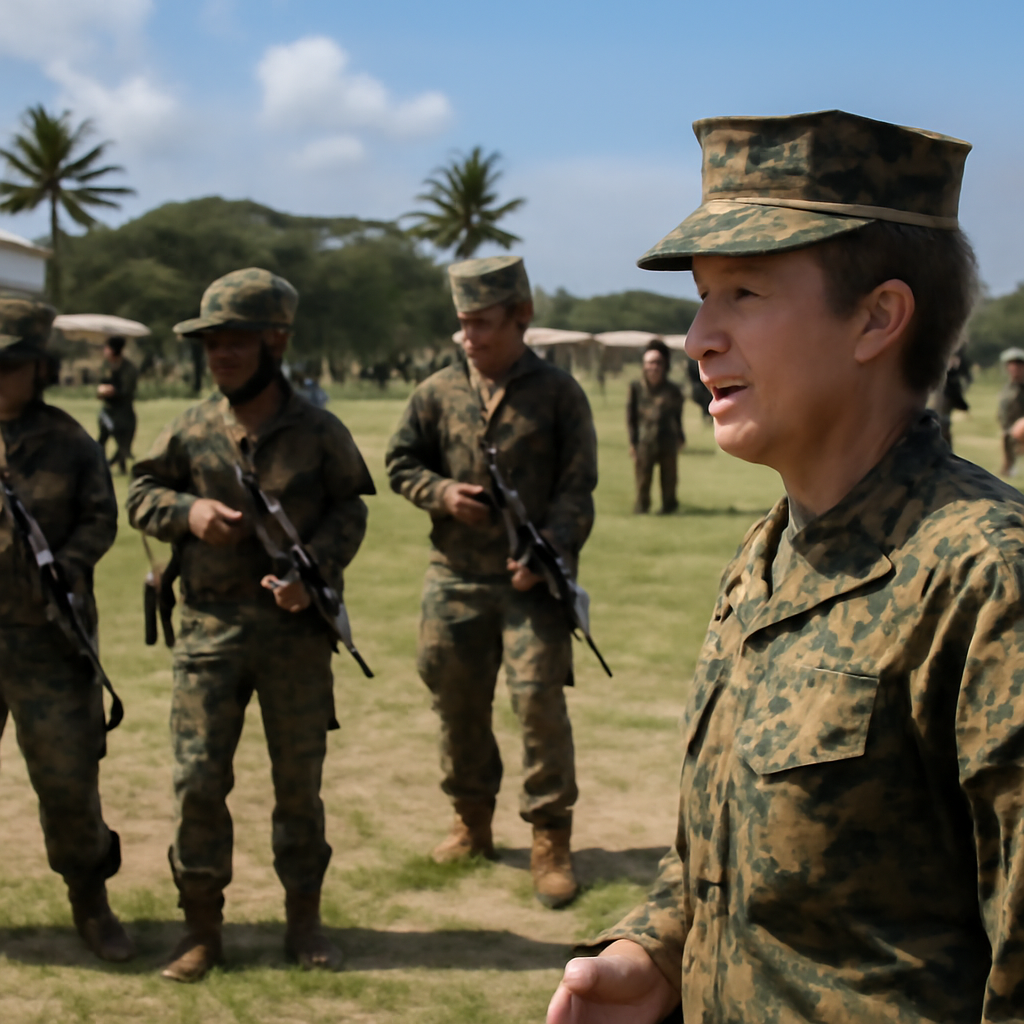
"This is all about alliances and partnerships, and when a crisis comes, you don’t want the first time working with someone to be when you’re facing a very determined adversary," Maj. Gen. Valerie Jackson told Defense One amid the staccato rifle shots of Mexican and South Korean marines training nearby.
Maj. Gen. Valerie Jackson on alliances and partnerships
Speaking on a live-fire range at Marine Corps Base Hawaii, Maj. Gen. Jackson framed the week’s exercises in stark operational terms: interoperability is not an abstract goal but a practical necessity. Her comment, delivered while multinational live-fire drills were underway, positioned the drills as rehearsal for real crises — a chance to ensure that partners arrive at future contingencies with matched skill sets and a shared understanding of the operational environment.
Live-fire drills in a volcanic crater and at Bellows
Marines fired rifles inside a volcanic crater and inside an urban training facility built to simulate deployments to Iraq. The live-fire exercises included shooting rifles, clearing rooms, and other tactical skills described in the reporting. The urban training took place at Marine Corps Training Area Bellows, where Marines practiced the kinds of close-quarters and complex-urban operations likely to appear in expeditionary deployments.

Audit-ready is a season. It shouldn't be.
Evidence in spreadsheets, controls drifting between audits, frameworks multiplying on flat headcount. Nubivance runs continuous compliance on Rapid7 Cyber GRC - SOC 2, HIPAA, ISO 27001, PCI, CMMC.
End the scramble2nd Battalion, 7th Marine Regiment and the 15th Marine Expeditionary Unit
The U.S. Marines involved are from 2nd Battalion, 7th Marine Regiment, the ground combat element of the 15th Marine Expeditionary Unit. Lt. Col. Colin Elsasser, commander of 2/7, described a broad training syllabus that ranges from jungle survival skills to methods for approaching "complex urban environments." Elsasser also said that, over the course of a week, his Marines will train on the "entire inventory of infantry weapons."
Col. Robb McDonald, commander of the 15th MEU, characterized the exercise as bilateral learning rather than a one-way transfer. "We see this as an opportunity to integrate and learn from each other," he said, and he called RIMPAC "a showcase to that interoperability that we’re able to achieve."
Mexican and South Korean marines alongside U.S. forces
The live-fire lanes and urban facilities were populated not only by U.S. Marines but by Mexican and South Korean marines training nearby. The proximate presence of those contingents underpinned Maj. Gen. Jackson’s emphasis on alliances: the sounds of rifle fire and the shared drills illustrated the practical mechanics of multinational integration — exercising the same tactics, weapons, and movement drills together rather than separately.
What this means for the 15th MEU, Mexican and South Korean marines, and operational planners
- 15th Marine Expeditionary Unit — The 15th MEU is using this week to field-test the 2/7’s readiness across a broad set of infantry skills, from jungle survival to urban close-quarters work, and to certify that its Marines can operate the "entire inventory of infantry weapons" under live-fire conditions.
- Mexican and South Korean marines — Training side-by-side gives these partners a chance to align tactics and procedures in the kinds of environments emphasized by the exercise: volcanic-range rifle lanes and urban facilities built to mirror deployment theaters. Close-proximity drills are an opportunity to identify and reconcile small differences in approach before they matter in crisis.
- Operational planners and commanders — For those responsible for combining forces in a contingency, the exercises are a practical answer to Maj. Gen. Jackson’s concern: they reduce the risk that the first joint planning and execution will occur under the pressure of combat, by allowing units to validate shared competency and an understanding of the operational environment in training.
Exercise Rim of the Pacific — this year bringing together 30 countries under the theme "partners: integrated and prepared" — provided the framework for these exchanges. For the 2/7 and the 15th MEU, the weeklong training roster and live-fire work are explicit steps toward that integration. As Maj. Gen. Jackson put it, the point is simple and operationally urgent: "When a crisis hits, you have to know that the person to your left and your right has the same level of competency and understanding of the operational environment."