Metropolitan Police Stunning facial tech proven effective — but to whom, and at what cost?
Metropolitan Police Stunning facial tech proven effective: the headline and the caveats
The Metropolitan Police Service (MPS) reports that hundreds of live facial recognition (LFR) deployments across London last year resulted in 962 arrests, a tally the force presents as evidence the technology is a powerful operational tool. The MPS’s new report — and the statistics it contains — have prompted both applause from supporters who say the system is helping catch suspects and concern from critics who warn about bias, privacy, and legal oversight.
What the report says, in plain terms
- The MPS carried out hundreds of LFR deployments during the period covered by the report and attributes 962 arrests to those operations.
- The force argues the technology has delivered operational benefits in identifying people wanted for serious offenses and returning vulnerable missing people to safety.
- The report acknowledges limits and says work continues to improve accuracy and governance frameworks.
Background: how live facial recognition fits into policing
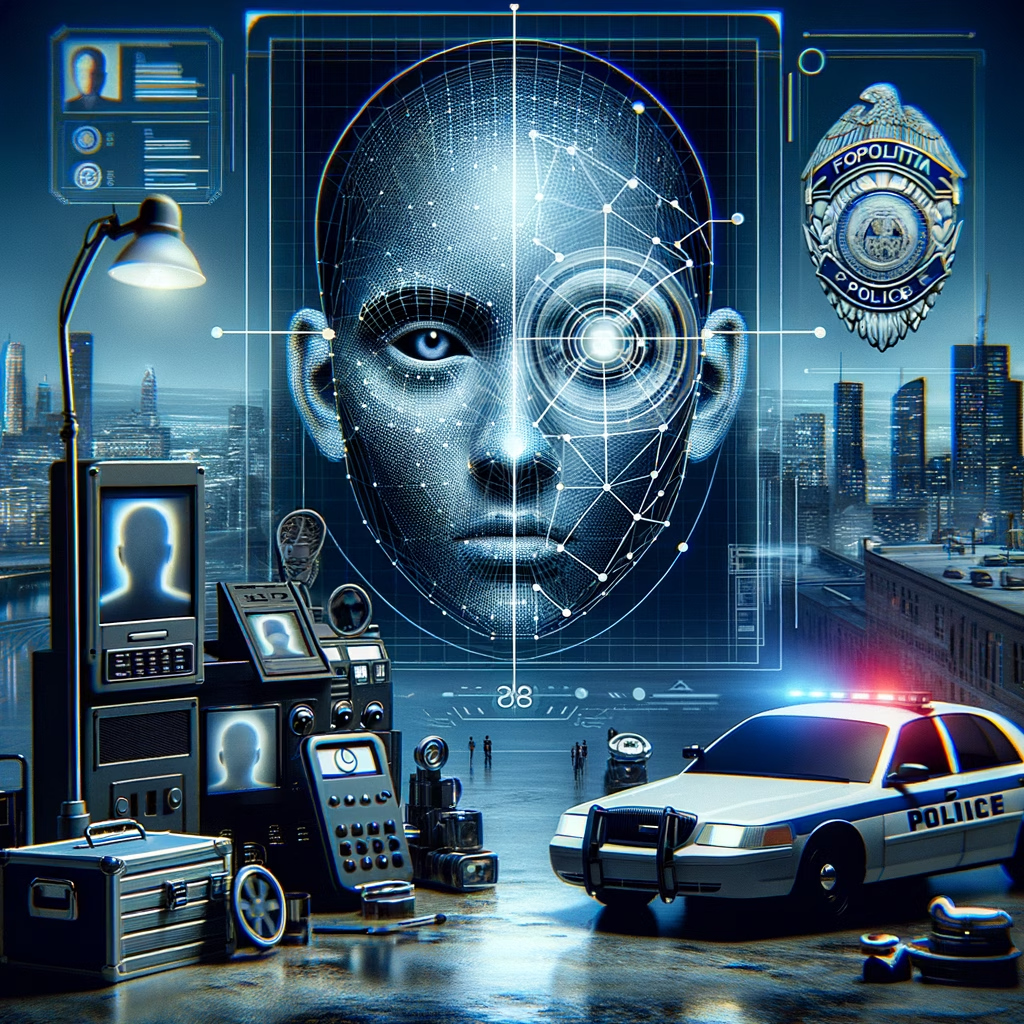
Facial recognition technology has moved from lab demonstrations into live public settings over the past decade. Live facial recognition systems capture images from CCTV or body-worn cameras, compare them against watchlists, and generate “matches” for officers to check. Proponents say LFR shortens the gap between suspect identification and arrest; opponents worry about false positives, disproportionate targeting of minority groups, and the collection of biometric data without clear consent.
Why the MPS figures matter
Numbers matter in public debates. A figure like 962 arrests is headline-grabbing: it suggests measurable impact. For frontline commanders, that’s a persuasive argument that a technology is delivering results. For civil liberties groups and some lawmakers, however, raw arrest counts are insufficient without transparent details about accuracy rates, the nature of the crimes, the demographic profile of those stopped, and the oversight applied to deployments.
Metropolitan Police Stunning facial tech proven effective — perspectives and tensions
Different stakeholders weigh the findings through different lenses.
- Technologists: Many engineers and data scientists point out that a system’s utility depends on both precision (how many matches are correct) and recall (how many true targets the system finds). They urge publication of confusion matrices, false-positive rates, and test results across diverse population samples to evaluate bias and reliability.
- Policymakers and oversight bodies: Regulators want assurances that use complies with law and human-rights obligations. That means clear documentation of policies, thresholds for generating alerts, retention and deletion practices for biometric data, and external audits.
- Communities and civil-liberties advocates: Groups such as Liberty and Big Brother Watch (who have been active in the U.K. debate) focus on disproportionate impacts and the chilling effects LFR may have on free assembly and privacy.
- Frontline officers and victims: Officers often emphasize practical benefits — finding vulnerable missing people or swiftly arresting alleged offenders — while families and victims may welcome faster resolutions but still express concern about the implications for wider society.
Key technical and ethical questions that remain
Even supporters concede there are unresolved issues that mean the MPS’s success claim should be viewed in context:
- Bias and differential accuracy: Independent studies have repeatedly found that commercial facial recognition systems can perform worse on women, younger people, and certain ethnic groups unless training datasets are broad and balanced.
- False positives and consequences: Even a low false-positive rate can produce many incorrect alerts in a city-scale deployment. The human decision to act on a match matters, which is why governance and officer training are crucial.
- Transparency and independent audit: Without third-party audits and public data about deployments, the public cannot fully assess whether the benefits claimed outweigh the harms.
- Legal and social limits: Courts and legislatures are increasingly interested in placing clearer limits on biometric surveillance. Public trust requires not just legality but perceived legitimacy.
How this might change policing and public life
If LFR continues to be adopted and shown operationally effective, we may see several shifts:
- Faster suspect identification across urban networks, changing how investigations are prioritized.
- Richer data-driven policing models that combine facial matches with other signals — license-plate reads, social-media scraping, and predictive analytics.
- Stronger calls for statutory frameworks that set standards for accuracy, oversight, and redress.
But there is an opposite risk: if LFR deployments are perceived as biased or inadequately controlled, public backlash could force abrupt restrictions that hamper useful applications and erode trust in technology-assisted policing.

Audit-ready is a season. It shouldn't be.
Evidence in spreadsheets, controls drifting between audits, frameworks multiplying on flat headcount. Nubivance runs continuous compliance on Rapid7 Cyber GRC - SOC 2, HIPAA, ISO 27001, PCI, CMMC.
End the scrambleMetropolitan Police Stunning facial tech proven effective — the final appraisal
The MPS’s report presents a clear operational case: hundreds of deployments, nearly a thousand arrests. Those numbers deserve scrutiny and contextualization, not only applause or condemnation. The data indicate that LFR can contribute to outcomes that matter to policing — arrests, recoveries, disruption of crime — but they do not settle deeper questions about fairness, transparency, and long-term social consequences.
For citizens and policymakers, the debate should therefore focus on measurable safeguards: independent audits of accuracy and bias, publicly available deployment logs, strict limits on retention, and meaningful routes for challenge and redress. Without those, the technology’s effectiveness risks being overshadowed by erosion of trust.
In the end, the question is less whether facial recognition can work than whether a democratic society can make it work without sacrificing principles it claims to uphold. If the technology is to remain a tool for public safety, how will we ensure it serves everyone equitably — and who will hold it to account?
Source: https://go.theregister.com/feed/www.theregister.com/2025/11/03/metropolitan_police_hails_facial_recognition/