"So, a key thing that’s changed for us is where historically we’ve always focused on operating the assets and [providing] the products," LeoLabs CEO Tony Frazier told Breaking Defense on Monday, explaining why the company is now offering its newest mobile radar directly to governments as well as customers.
Tony Frazier on a new, hybrid sales strategy
Speaking on the margins of the Advanced Maui Optical Space Surveillance Technologies (AMOS) conference in Maui, Frazier said LeoLabs will make Scout‑S available in multiple ways: as a commercial service operated by the company with priority customer access; as a contractor‑owned and operated system funded by a government; or as a government‑owned and operated system. That shift responds, he said, to increased demand from US allies for "sovereign" military space capabilities.
Scout‑S: what the mobile radar can do and where it has appeared
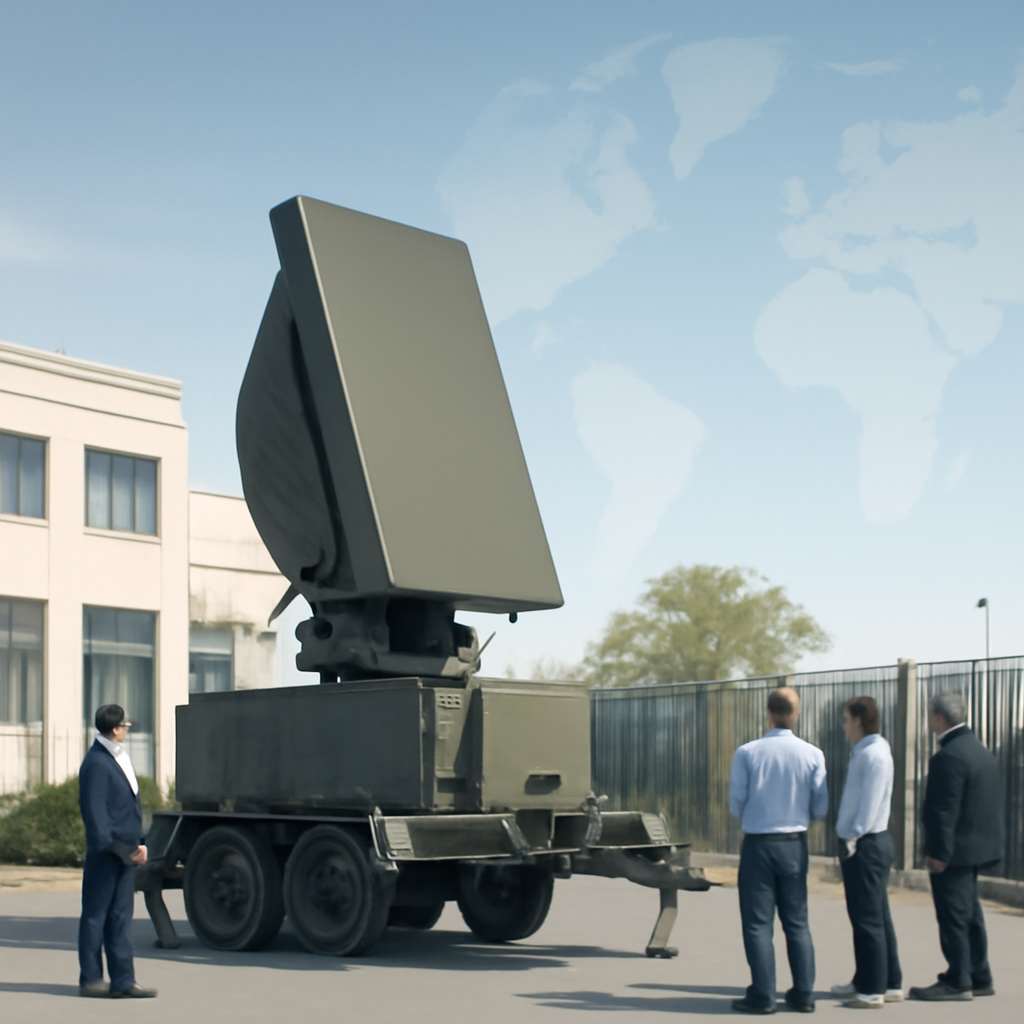
Scout‑S is a containerized radar system that debuted in late June during US Indo‑Pacific Command’s multinational Valiant Shield exercise. Its multiple S‑band antennas can detect and, crucially, constantly track over time multiple space objects in orbits from very low Earth orbit (VLEO) at about 180 kilometers up to roughly 1,000 kilometers, Frazier said. The company noted the relevance of that upper range: "(Not incidentally, many of China’s growing fleet of intelligence, surveillance and reconnaissance (ISR) satellites now operate at some 900‑1,000 kilometers in altitude.)"

Audit-ready is a season. It shouldn't be.
Evidence in spreadsheets, controls drifting between audits, frameworks multiplying on flat headcount. Nubivance runs continuous compliance on Rapid7 Cyber GRC - SOC 2, HIPAA, ISO 27001, PCI, CMMC.
End the scrambleFilling gaps in a global tracking network of 12 larger radar sites
LeoLabs already operates a network of 12 larger radar sites around the globe. Chief operating officer and co‑founder Dan Ceperley said the firm will integrate multiple Scout‑S radars to "fill the gaps" in that network and thereby improve space situational awareness services currently provided to customers, including the US Space Force. "We’ve got the most commercial radars of any company in the world, but it still leaves a lot of the world uncovered," Ceperley said, adding that, "depending on the satellite orbit, it can go hours before it’s observed. We’ve got to cut that down."
Allied demand, production plans, and procurement options
Company officials said LeoLabs is in talks with over a dozen allied countries about Scout‑S, and at least one of those governments has expressed interest in buying multiple units. Officials declined to disclose a price per unit. On production, Frazier said LeoLabs intends to produce Scout‑S in the "single digits" next year, with a goal of scaling up to "dozens" per year thereafter.
What this means for the US Space Force, foreign militaries, and suppliers
- US Space Force: As a named customer for LeoLabs' current services, the US Space Force stands to receive denser, more persistent tracking coverage if Scout‑S units are integrated into the company's network and operated as service assets.
- Foreign militaries (allied governments): Governments seeking sovereign capabilities now have three concrete procurement pathways — commercial service access, contractor‑owned/operated systems paid for by governments, or government‑owned/operated Scout‑S units — and at least one ally has already signaled interest in purchasing multiple units.
- Suppliers and LeoLabs' production planners: The stated plan to build only "single digits" of Scout‑S next year, then scale to "dozens" annually, frames a near‑term ramp of manufacturing and deployment that will constrain how quickly allied customers can move from interest to operational, sovereign capability.
LeoLabs' move reframes its product from a purely service layer to a set of discrete, government‑operable systems as well. The company cites both customer demand for sovereignty and a technical need to reduce long observation gaps for maneuverable satellites — moving from "periodic observations to persistent custody," in Frazier’s words. The near term will test whether allied procurement decisions and LeoLabs' manufacturing ramp can align to turn interest from "over a dozen" governments into deployed, persistent tracking nodes.