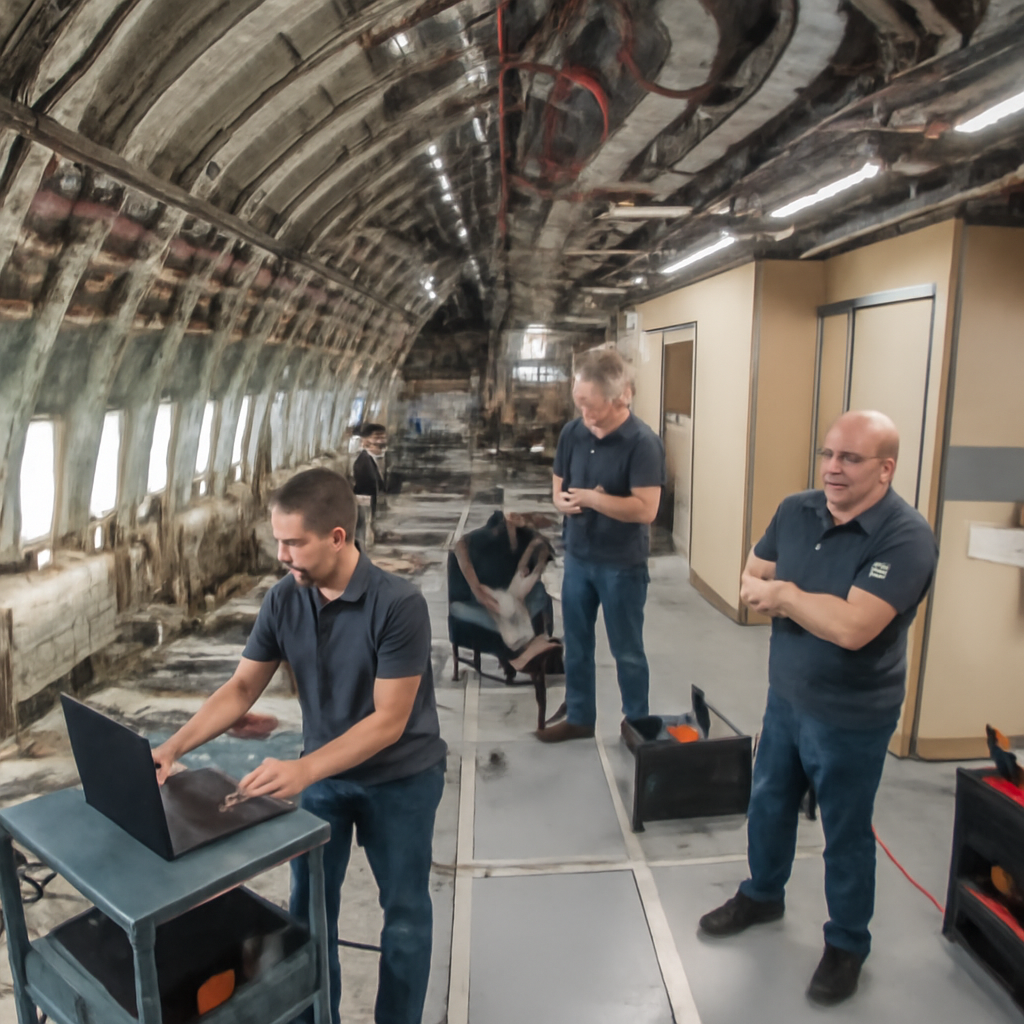
L3Harris converted a Qatari‑gifted Boeing 747‑8i into the VC‑25B bridge jet in a 10‑month period, deploying pre‑staged employees on a 24/7, three‑shift schedule to meet a tight delivery objective tied to the country’s Independence Day observance.
L3Harris’s rapid conversion: scale, authorities, and method
Jason Lambert, president of Intelligence, Surveillance and Reconnaissance (ISR) at L3Harris, told TWZ the company “worked in conjunction with the Air Force to deliver the first VC‑25B” and described why his firm was chosen. L3Harris positions itself as “the world’s largest non‑OEM integrator of aircraft,” taking existing commercial or military platforms and “missionize[ing] and outfit[ting] them for specific uses.”
The company said it marshalled a large, cleared workforce inside ISR—2,600 engineers within a total workforce of 7,600, and some 5,600 personnel with security clearances—along with an ODA (Organization Designation Authorization) of about 100 people to accelerate certification of modifications rather than certifying an aircraft from scratch. That mix of manpower and delegated FAA authority was central to the compressed schedule.
Security vetting, classified work, and what was withheld
Because the aircraft originally belonged to another government, L3Harris and U.S. government experts performed intensive cybersecurity and electronic‑threat work. Lambert described the process as “electronic scrubbing” and said “a team of experts from the U.S. government, in terms of cyber security, did an immense amount of work…in conjunction with the L3Harris team, to ensure that this aircraft was fully safe.”
Several technical questions—specifics about hardening against electromagnetic pulse (EMP), the presence of missile‑defeat systems, and which survivability systems were fitted—were deferred to the U.S. Air Force. Lambert said survivability “was absolutely thought of,” but declined to discuss particular systems because that material is classified or under Air Force purview.

Audit-ready is a season. It shouldn't be.
Evidence in spreadsheets, controls drifting between audits, frameworks multiplying on flat headcount. Nubivance runs continuous compliance on Rapid7 Cyber GRC - SOC 2, HIPAA, ISO 27001, PCI, CMMC.
End the scrambleTraining, sustainment, and the practical mods added
L3Harris did more than install systems: it built operational infrastructure. The company leased an Atlas Air 747 and purchased a Lufthansa 747‑8i to give the Presidential Airlift Group hands‑on flight training with the new platform. A one‑to‑one interior mockup was erected on the Joint Base Andrews hangar floor for crew practice before flight.
On the aircraft itself, much of the Qatar‑installed interior “monuments” were retained to avoid schedule risk—Lambert said hard walls, bulkheads and the like were kept—while fit and finish elements (leather, wood veneers) were modified in areas to make them “fitting for the U.S. president.” The jet retains 10 restrooms, the presidential seal in select locations, an upgraded communications suite tied to L3Harris’s role as prime contractor for the Senior Leader Communication System, and a self‑deploying air stair for remote embarkation.
L3Harris also said it built sustainment plans—spares, engineering support and training—not just for this aircraft, but “to support the entire VC‑25B fleet.”
Paint, public profile, and operational signals
Paint and livery were high‑profile elements. Lambert said teams tested paint sequencing on a scrap fuselage and on a C‑32A (a 757) before applying the red, white, gold and navy scheme to the 747‑8i; the navy coat was applied last to preserve finish. He said the president personally signed off on details including the tail flag treatment. The hangar used at Joint Base Andrews was “custom‑built for the VC‑25B because of the size of these planes.”
The aircraft performed touch‑and‑go practice flights at Andrews on June 22, 2026; the conversion was publicly unveiled at Joint Base Andrews on June 19, 2026 when President Donald Trump toured and spoke about the jet.
What this means for the Air Force, the Presidential Airlift Group, and L3Harris
- For the Air Force and procurement leaders: the bridge jet responds to multi‑year delays and cost growth on the original Boeing VC‑25B program—Lambert noted that the Boeing program “has been delayed significantly by years, and its budget overrun by billions.” The interim aircraft addresses near‑term availability pressure while the two Boeing‑modified VC‑25Bs remain in work.
- For the Presidential Airlift Group and White House planners: the conversion included training assets and a mockup so crews could begin operating the larger 747‑8i; Lambert said the president intends to use the aircraft for international travel and referenced an upcoming flight to Turkey. Operational decisions about where the jet can deploy, and which missions it will perform long term, remain matters for the Air Force and White House planning groups.
- For L3Harris and defense acquisition managers: the project was presented as proof that government and industry aligned to meet an urgent need can compress historically slow timelines. L3Harris framed the effort—formerly an unacknowledged special access program—as a demonstration of its missionization and rapid‑integration capability and said it will continue to sustain the bridge aircraft while the full VC‑25B fleet is completed.
The converted 747‑8i is an interim, highly visible solution: delivered earlier than planned ahead of the July 4, 2026 target, it carries upgraded communications and a refitted interior but leaves several survivability and capability details in the hands of the U.S. Air Force to disclose. The bridge fills an immediate availability gap while the longer‑term Boeing VC‑25B program continues.