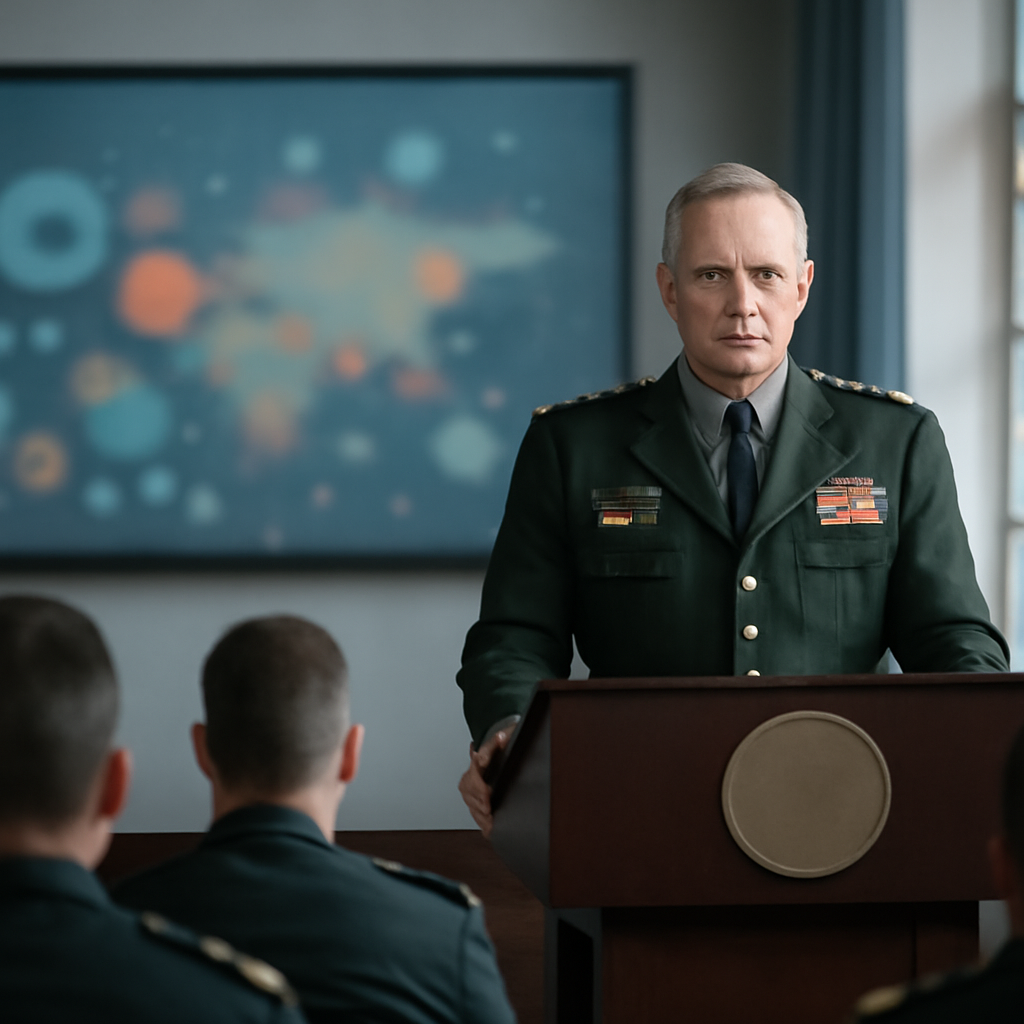
"Information moves so fast that leader decision times have compressed from weeks down to days down to seconds," Air Force Gen. Dan Caine, chairman of the Joint Chiefs of Staff, told attendees at the Air & Space Forces Air, Space and Cyber Conference. His keynote drew a straight line from that compression to concrete, recent events: an Apache helicopter crew rescued after a downing in the Gulf of Oman and new, AI-enabled tactics on the battlefields of Ukraine.
Gen. Dan Caine’s framing of AI and decision speed
In a keynote address reported by TWZ, Gen. Caine argued that artificial intelligence and advancing cyber capabilities are “no factor is accelerating change as fast as artificial intelligence and advancing cyber capabilities.” He summarized the advantage in blunt terms: “In the future fight, advantage will go to the side who can see first, who can understand first, decide first, and act first, and along the way, be a learning organization.”
He reinforced the immediacy of the change: “AI is here now, and it’s already changing the way militaries see, sense, decide, and act across the joint force.” The chairman used two operational examples to show both the promise and the peril of that shift.
The June 8 Apache rescue in CENTCOM’s area of responsibility
Caine described an incident on June 8 in which two U.S. Army AH-64 Apache crew members were recovered after their helicopter was shot down by an Iranian drone near the coast of Oman. The rescue, he said, drew on “the totality of the joint force” and marked a milestone: it “was required to use enabled unmanned vessels to participate in the rescue of downed U.S. service members for the first time ever.”
TWZ’s prior reporting, cited by the chairman, named the system involved as a U.S. Navy Corsair unmanned surface vessel — the Corsair USV (Saronic) — deployed by U.S. CENTRAL COMMAND to support the rapid, responsive search and rescue effort.

Audit-ready is a season. It shouldn't be.
Evidence in spreadsheets, controls drifting between audits, frameworks multiplying on flat headcount. Nubivance runs continuous compliance on Rapid7 Cyber GRC - SOC 2, HIPAA, ISO 27001, PCI, CMMC.
End the scrambleTask Force 59, unmanned maritime networks, and the maritime picture
Gen. Caine credited the rescue’s success not to senior command fiat but to operational work over years by CENTCOM’s Task Force 59. He called Task Force 59 “CENTCOM’s forward-leaning unmanned joint maritime unit” and said its personnel “spent the last several years testing, integrating, and operationalizing unmanned systems and AI in one of the most demanding and kinetic environments on Earth right now.”
Describing the human side of technical work, Caine said: “What made this possible was a bunch of entrepreneurial sailors and members of the joint force on watch floors, at piers, managing networks of unmanned systems across thousands of miles of water, and using AI to turn massive amounts of data into a crisp, clear, perfect maritime picture that allowed us to go grab those two soldiers in the water.”
AI-enabled drones on the Ukrainian front and the changing cost of lethality
The chairman’s second example shifted from sea to land. Caine described “first-person view drones operating in heavily contested EMI [electromagnetic interference] environments,” some “now using AI-enabled computer vision to continue to drive towards targets, even when there’s no GPS or the links are cut.” He framed this as a tactical revolution: affordable precision delivered to small units through software and autonomy at the tactical edge.
To underscore the human consequence, Caine offered a stark metric: “In certain locations on the front line of troops right now, the life expectancy of a new Russian recruit arriving on the front lines is as little as 20 to 30 minutes.” He concluded that “The price of lethal exchange is decreasing day over day,” a trend he said will force rethinking of close air support and force posture.
What this means for Task Force 59, CENTCOM, and the 2.8‑million member joint force
- Task Force 59 and CENTCOM: Their recent operational work — integrating unmanned surface vessels like the Corsair USV and AI-enabled data fusion — will be watched as a model for how to make unmanned systems part of joint personnel recovery and maritime operations.
- The joint force and young service members: Caine tied capability development to readiness for a “2.8-million member all volunteer joint force,” stressing the need to “give the young members ... the tools that they need before they need them.” The message to commanders is to accelerate fielding and training for contested electromagnetic and autonomous-threat environments.
- Military technologists and operators: The examples emphasize two operational priorities — building a reliable maritime picture from distributed unmanned sensors and hardening autonomy and computer vision to operate when GPS and links are denied.
Gen. Caine’s examples — a first-known personnel recovery with an unmanned surface vessel and AI-driven small-unit effects on a distant front — are more than technical anecdotes. They are a framing device: information and autonomy are compressing decision cycles and lowering the cost of lethal action. The chairman’s closing pitch was both pragmatic and urgent: the joint force must “prepare the joint force to win in this kind of conflict” by assuming formations “will be hunted by autonomous systems, jammed across the spectrum, and tracked in real time,” and by generating lethality at scale with an “agile, optimized, high-low mix of combat capabilities.”
The concrete test he left in the room was operational and immediate: can the systems and the people described — from Task Force 59 watch floors to sailors at piers managing unmanned networks — be given the tools and doctrines to operate “before they need them”? The June rescue suggests they can; his broader argument is that adversaries will not wait for that to happen.