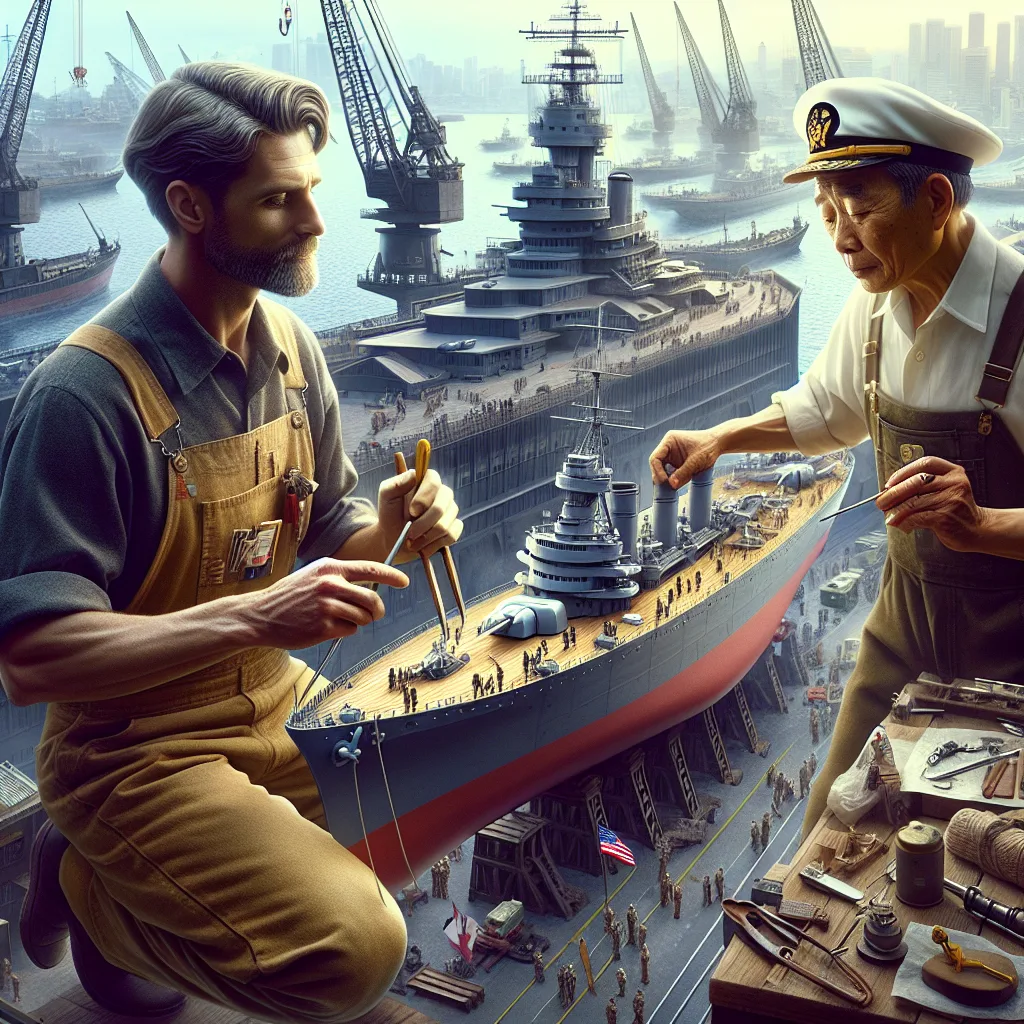
Historic Naval Collaboration: Japanese Shipyard Completes Unprecedented Overhaul of US Navy Vessel
The USS Miguel Keith (ESB-5), the U.S. Navy’s expeditionary mobile base, has returned to operational readiness following a groundbreaking five-month Regular Overhaul (ROH) at Mitsubishi Heavy Industries’ facilities in Yokohama, Japan. The $12 million project, which concluded on April 15, marks a historic first for a Japanese shipyard executing an overhaul of this scale on a U.S. Navy vessel.
In an era defined by multifaceted security challenges and complex international relationships, the cooperation between U.S. defense operations and a Japanese shipbuilder is significant. Not only does the project exemplify the deep-seated alliance between the two nations, but it also signals a shift toward leveraging global industrial expertise to support military readiness. Mitsubishi Heavy Industries (MHI) – a company with a storied history in high-tech manufacturing and engineering – has successfully met the rigorous standards required by the U.S. Navy, reinforcing trust in international defense partnerships.
The overhaul involved extensive maintenance and repair work on the USS Miguel Keith, an expeditionary platform designed for versatile maritime missions. As a mobile base, the vessel is integral to the Navy’s ability to project presence, support humanitarian efforts, and adapt swiftly to emerging threats. The project’s completion at a Japanese facility underscores not only the technical prowess of MHI but also a pragmatic commitment to innovation in naval engineering.
Historically, U.S. Navy maintenance and overhaul work has been predominantly carried out by domestic facilities. However, as the global defense architecture evolves, partnerships across borders are increasingly vital. This milestone in Yokohama is a testament to the growing willingness among allied nations to pool resources, share technological advancements, and address common security challenges through cooperative ventures. The decision to award a contract of this magnitude to MHI reflects both confidence in the shipyard’s capabilities and a broader strategic alignment between the United States and Japan.
While the financial scope of the project is modest in the larger context of U.S. defense spending, its strategic implications ripple far beyond the balance sheets. The seamless execution of such a sophisticated overhaul invites scrutiny and admiration alike. It speaks to meticulous planning, adherence to rigorous quality standards, and an unyielding attention to operational detail—qualities essential to sustaining a competitive edge in modern naval operations.
Defence Blog, the outlet that first reported on the overhaul, provides an informative window into the intricate process behind the transformation. An in-depth article, complete with visual documentation, outlines the phased stages of the ROH and highlights the collaborative efforts between technicians, engineers, and project managers from both the U.S. and Japan. The comprehensive report delves into specifics such as hull renovation, system upgrades, and structural repairs—all pivotal in returning the USS Miguel Keith to full capability.
Beyond technical details, the project also carries a symbolic weight. In an age where trust and transparency are central to global defense cooperation, successful collaborations such as this are instructive. They underscore a continuum of shared values and mutual benefit that can only fortify the geopolitical bond between nations. The strategic interest here is less about replacing domestic capabilities than it is about enriching them through complementary expertise across allied borders.
Experts have noted that leveraging the capabilities of a seasoned Japanese shipyard can drive efficiencies not only in cost but also in operational readiness. According to defense analysts at the International Institute for Strategic Studies, the move can be seen as part of a broader trend: the diversification of military logistics and maintenance operations to partner nations with proven competencies in advanced maritime engineering.
- Technical Achievement: The successful overhaul of the USS Miguel Keith illustrates masterful integration of advanced repair techniques, rigorous adherence to U.S. military specifications, and the effectiveness of cross-national engineering collaboration.
- Strategic Implications: Expanding the sphere of maintenance and logistical support beyond domestic borders enhances operational flexibility. In a dynamic security environment, this capacity to adapt is a critical asset.
- Economic Considerations: The $12 million project is a significant investment, reflecting meticulous resource allocation aimed at sustaining the Navy’s expeditionary readiness while simultaneously bolstering the capabilities of allied industrial sectors.
From a logistical perspective, the overhaul of the expeditionary mobile base is more than a routine maintenance operation—it’s an exercise in international synergy. The U.S. Navy has historically depended on a network of domestic shipyards and repair facilities, but evolving operational requirements dictate that modern maintenance practices embrace transnational competencies. Mitsubishi Heavy Industries, with decades of experience in both commercial and defense sectors, is an exemplar within this domain.
Critically, the project stands as an illustrative case of the U.S.-Japan security alliance. Both nations have deep-rooted strategic interests in regional stability, particularly in the Asia-Pacific, where maritime domains are of immense geopolitical importance. As global maritime routes become ever more significant for trade, military logistics, and power projection, robust maintenance capabilities are indispensable. The collaboration seen here could presage a new phase of broader military-industrial partnerships, where expertise is shared to overcome complex technical challenges.
While policymakers and military strategists praise the bridge built by this exchange, operational commanders on the ground view it through a pragmatic lens. They consider this success a critical step towards ensuring that U.S. naval assets remain mission-ready in a rapidly changing strategic landscape. The decision to outsource such work to a trusted Japanese firm reflects a long-standing commitment to maximizing the effectiveness of U.S. naval operations by diversifying maintenance resources.
Looking ahead, defense analysts suggest that this project might serve as a blueprint for future transnational maintenance contracts. With the increasing frequency of extended operations in hostile or logistically challenging conditions, the capacity to remotely execute detailed overhauls could become crucial. This shift is not without its challenges, particularly concerning issues of security, intellectual property, transparency, and quality control. However, early indicators suggest that with robust bilateral frameworks and clear contractual guidelines, these challenges are surmountable.
In the wake of the overhaul’s completion, both U.S. Navy officials and representatives from Mitsubishi Heavy Industries have acknowledged that the collaboration is as much a technical success as it is a diplomatic one. While official statements remain measured, the completed ROH is a tangible sign that nations can effectively combine strengths to address mutual defense imperatives.
As the USS Miguel Keith gears up for its next phase of service, questions remain about how this model of defense cooperation might evolve. Will more U.S. Navy vessels undergo similar international overhauls? And can such partnerships be scaled without compromising the meticulous quality the military demands? History has shown that innovation often arises under conditions of necessity, and the current partnership serves as a reminder that alliances built on trust and technical expertise are essential in today’s complex security environment.
Ultimately, the restored expeditionary mobile base is more than just a repaired ship—it is a symbol of resilient cooperation. As global threats continue to compel nations to rethink traditional paradigms of defense and logistics, the collaboration between the United States and Japan in this instance stands as a beacon. It poses a thoughtful challenge for future operations: how can nations further interweave their industrial and military capabilities to maintain a technological and strategic edge in unsteady times?



