“We will deepen our concrete and realistic consideration,” Prime Minister Takaichi Sanae told parliament on October 14, 2026, putting into words a debate Tokyo has rehearsed for nearly seven decades.
From a 1958 Kawasaki sketch to a 2026 policy rethink
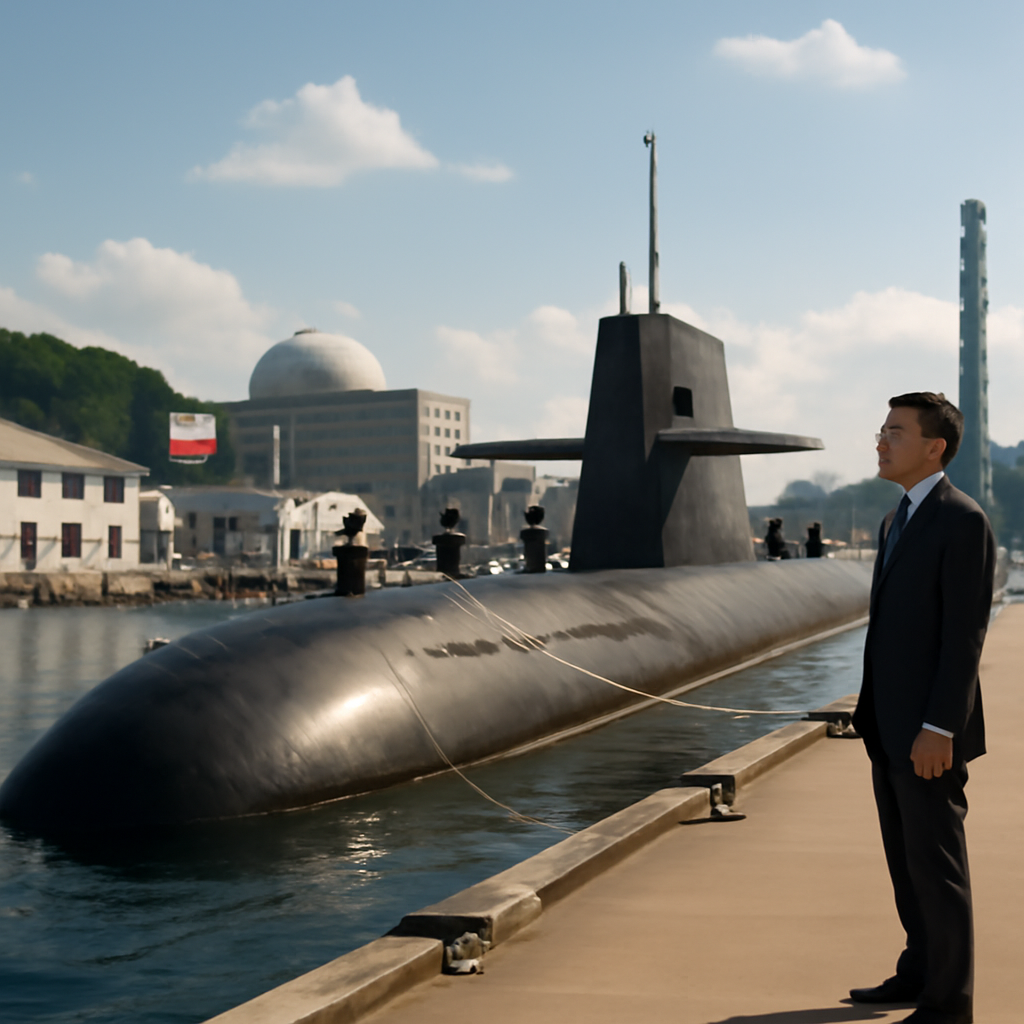
The record shows Japan first formally examined nuclear propulsion in May 1958, less than four years after the USS Nautilus entered service. A preliminary design document bearing the name Kawasaki Heavy Industries described a nuclear propulsion system for a 2,500-ton submarine and concluded the concept was technically feasible, while noting Japan could not independently manufacture its reactor and would need extensive U.S. technology. That document only entered public debate in February 1974, when Japan Socialist Party lawmaker Narazaki Yanosuke questioned the government in parliament. Kawasaki and government officials maintained the paper represented an individual engineer’s work rather than an official corporate project, a claim never conclusively resolved in the public record.
Legal and institutional roadblocks: the 1964–65 turning point
By June 1964, a government-industry advisory group judged nuclear-powered submarines the most effective way to counter foreign nuclear submarines’ superior underwater speed and endurance. But the next year closed one institutional door. In April 1965, then-Science and Technology Agency chief Aichi Kiichi stated that using nuclear propulsion aboard Self-Defense Forces vessels was impermissible under Japan’s Atomic Energy Basic Act because nuclear propulsion had not become generally established for civilian maritime use. At that same hearing, then-Defense Agency chief Koizumi Junya declared that Japan had no intention of building nuclear-powered submarines “at the present stage.” The Takaichi Cabinet formally reaffirmed that long-standing legal interpretation in a written response to parliament on November 14, 2025.

This site is the portfolio.
OSINTSights runs on Cloudflare Workers, D1, R2, and Vectorize, with an AI pipeline on Hetzner ARM. Nubivance designed, built, and operates it. We do the same for clients.
See what we buildRepeated, quiet returns to the idea: 1986 and 2004 episodes
The question resurfaced again in later decades. In 1986 the Mainichi Shimbun reported that the Maritime Self-Defense Force had informally approached the U.S. Navy about acquiring nuclear-powered attack submarines, reflecting naval officers’ judgments that conventional submarines could no longer match U.S. nuclear submarines in speed and endurance. A 2011 investigative report by the Sankei Shimbun found that Defense Agency officials had privately considered developing nuclear-powered submarines domestically or acquiring them from the United States while preparing Japan’s 2004 defense guidelines, but ultimately abandoned the idea as premature. Across episodes, the same themes recur: perceived operational advantages, technological dependencies, legal limits, costs, and public concern—shaped in part by the 1974 radiation leak aboard the experimental nuclear-powered ship Mutsu.
Technical trade-offs: VLS, endurance, batteries, and nuclear power
Contemporary design pressures are changing the calculus. Japan is studying a next-generation submarine equipped with vertical launch systems (VLS) for long-range missiles; integrating VLS may require a larger hull. Advanced sonar systems and unmanned underwater vehicles (UUVs) would increase electrical power demands. Conventional submarines remain constrained by finite battery capacity and therefore by the electrical energy available while submerged. Nuclear propulsion would allow submarines to remain submerged for extended periods and to sustain higher underwater speeds—qualities useful for monitoring Chinese naval movements and supporting deterrence.
But the source stresses that VLS does not necessarily require a nuclear plant: South Korea already operates conventionally powered submarines equipped with such systems. Nuclear propulsion is not a panacea. It brings major financial and technical burdens and creates new requirements for nuclear safeguards, specialized crew training and maintenance infrastructure. Conventional boats can retain acoustic advantages in certain conditions, and the decision therefore hinges on a detailed, multi-dimensional assessment rather than on a single capability metric.
What this means for Japan, the United States, and South Korea
- Japan: Tokyo must resolve legal constraints under the Atomic Energy Basic Act, accept the political and public-relations implications of nuclear operations at sea, and build nuclear safeguards, specialized crew training programs and maintenance facilities. One expert at a September government advisory meeting warned reactor development and crew training would take a decade or more; others argued it was too early to decide. The source argues that a defined timetable, clear responsibilities and a rigorous assessment are required—because studying the problem indefinitely would repeat a familiar pattern.
- The United States: U.S. technology was identified as essential in the earliest (1958) engineering work, and Japan has previously approached the U.S. Navy (reported in 1986). Any move toward nuclear propulsion would therefore intersect with U.S. industrial and naval capabilities and with bilateral technology questions already evident in the historical record.
- South Korea: Seoul already fields conventionally powered submarines with VLS and is pursuing its own acquisition plans. That fact demonstrates operational alternatives to nuclear propulsion and frames Japan’s choice within a regional competition over submarine capabilities.
Prime Minister Takaichi’s instruction to “deepen our concrete and realistic consideration,” and Defense Minister Koizumi Shinjiro’s insistence that “no options should be ruled out,” bring this long-running debate back to the top of Tokyo’s agenda as it revises three national security documents by the end of 2026. Nearly seven decades after the first documented study, the test for Tokyo is whether it will transform open-ended study into a timetable and accountable decisions—or simply add another chapter to a history of persistent consideration without acquisition. Deciding not to acquire nuclear propulsion after a rigorous assessment would itself be a policy decision; postponing that assessment would only extend the pattern.