“With five times the tracking capability of the SPY-1, it [the AN/SPY-7(V)1] counters lofted trajectories and simultaneous multiple ballistic missile threats,” a machine translation of Japan’s 2026 defense white paper states — a succinct claim that explains why the first of two Aegis System Equipped Vessels (ASEV) under construction looks, by any measure, enormous.
AN/SPY-7(V)1 radar and the mast that carries it
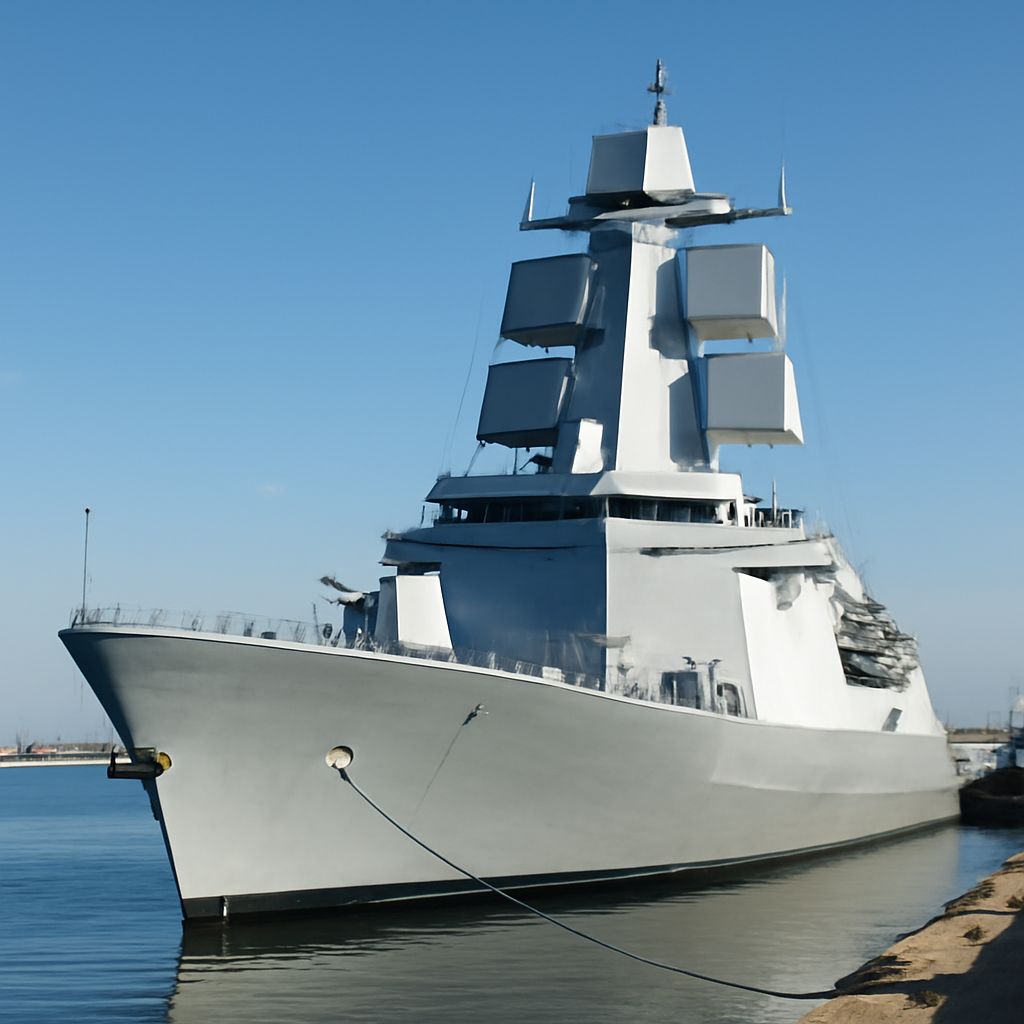
The ASEV’s defining visual feature is a very large integrated mast that will carry four rectangular AN/SPY-7(V)1 active electronically‑scanned arrays. Each array is reported to be roughly 14 feet tall, placing them in the same general size category as arrays used on other modern long‑range naval radars. The centralized, elevated mast departs from array placements on existing Japanese destroyers and U.S. Arleigh Burke destroyers, offering an unobstructed line‑of‑sight to the horizon — a configuration the Japanese Ministry of Defense says is central to the ship’s missile‑defense role.
Ship dimensions, construction progress, and schedule at MHI Nagasaki
The ASEVs are cruiser‑sized: about 620 feet long, with a beam near 82 feet and a standard displacement of roughly 12,000 tons. For immediate context, Japan’s current largest surface combatants, the Maya class destroyers, measure just over 557 feet in length, have a beam near 73 feet, and displace about 8,200 tons standard. The first ASEV was laid down at Mitsubishi Heavy Industries’ (MHI) Nagasaki shipyard in July 2025; the second was laid down in February 2026 at Japan Marine United’s Isogo yard in Yokohama. The Ministry of Defense is aiming to have the first ship in service before the end of Japan’s 2027 Fiscal Year (April 2027–March 2028), with the second following in the 2028 fiscal cycle that extends into 2029.

The cyber insurance questionnaire just landed. Now what?
SOC 2, HIPAA, insurance renewals - someone has to own security strategy. Nubivance provides fractional CISO leadership without the full-time salary.
Get a security leadWeapons fit today and upgrades planned through 2032
On entry to service the ASEVs are expected to mount a mix of Standard Missile variants — SM‑3 for exo‑atmospheric, midcourse interception and SM‑6 for terminal and multi‑mission use — and future Glide Phase Interceptors (GPI) that Japan is co‑developing for glide‑phase hypersonic threats. Armament will be distributed in two Vertical Launch System (VLS) arrays, one forward and one aft, for a total of 128 VLS cells per ship. By comparison, Maya class and U.S. Arleigh Burke destroyers have 96 VLS cells, and U.S. Ticonderoga cruisers have 122.
Japan’s defense white paper sets out a path for additional capabilities: Tomahawk cruise missiles and an extended‑range version of the Type 12 anti‑ship missile are slated for inclusion around the 2032 timeframe. Models and renderings also show a five‑inch gun on the bow, two Phalanx CIWS mounts, and automatic cannons for point defense. The white paper further signals plans to integrate high‑energy laser directed‑energy weapons to counter swarms of drones, and leaves open the possibility for high‑power microwave systems and other future upgrades.
Cooperative Engagement Capability and the ASEV’s role in networked defense
The ASEVs will operate the Aegis Combat System and, per the Ministry of Defense, will have Cooperative Engagement Capability (CEC) to enable remote engagement and guidance against targets tracked by other vessels. That networking, combined with the AN/SPY‑7(V)1’s stated tracking performance and the ships’ long‑range intercept weapons, is the core of Tokyo’s “stand‑off defense” approach described in the 2026 white paper.
What this means for the Japan Maritime Self‑Defense Force, Mitsubishi Heavy Industries, and regional actors
- Japan Maritime Self‑Defense Force: The ASEVs are designed to expand long‑range air and missile defense bubbles around Japan’s home islands and outlying territories, including defenses against ballistic, cruise, hypersonic missiles and long‑range attack drones. But with only two hulls planned initially, they will be high‑value, low‑density assets that must be deployed deliberately and protected as priority targets.
- Mitsubishi Heavy Industries and shipbuilders: Visible progress at MHI’s Nagasaki yard — notably the newly installed main mast — indicates construction momentum; the article notes MHI appears on track to deliver the first ship within the next year or two from the date of reporting.
- Regional actors and deterrence: The white paper frames the ASEVs as additions to deterrence against threats posed by China, Russia and North Korea, whose missile arsenals the paper says are expanding while cooperation among them grows. The ASEVs’ missile‑defense and eventual long‑strike capabilities (including Tomahawk) extend Japan’s reach and defensive posture.
The ASEV program stitches together a large radar architecture, a heavy VLS loadout and a road map for future directed‑energy and long‑range strike systems into a platform meant first to protect Japanese airspace and territory at range. The tradeoffs are clear on the page: unmatched sensor and interceptor capacity concentrated in two hulls that will be both strategic assets and, by design, conspicuous targets. Japan’s timetable — first in service before the close of FY2027, a second hull to follow in the subsequent fiscal cycle, and Tomahawk and other strike additions planned around 2032 — sets a sequence of capability milestones that will define how, where and when these “monster” ships will factor into regional security calculations.
Source: TWZ — Japan’s First Dedicated Missile Defense Warship Is A Monster