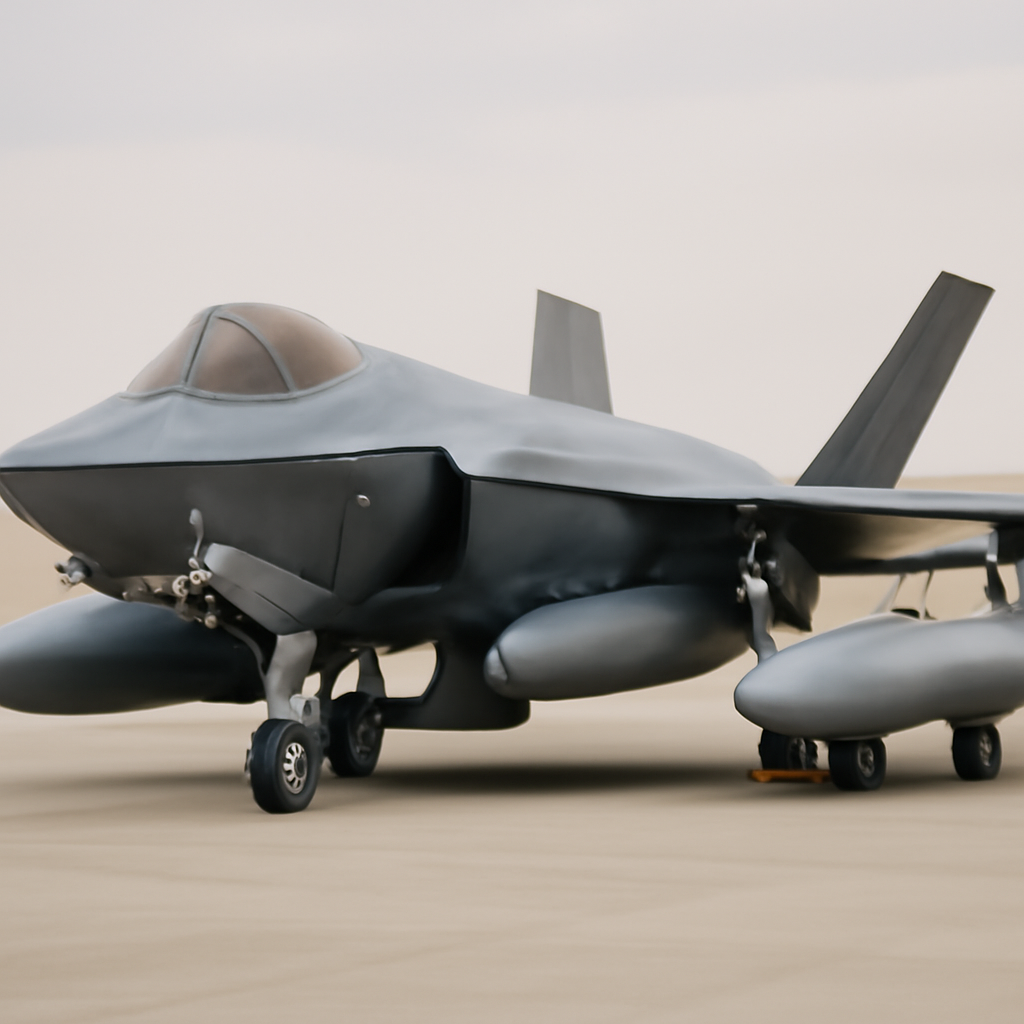
$34 million and a Cyclone logo: the Israeli Ministry of Defense confirmed today that Elbit Systems’ Cyclone subsidiary will develop and integrate external fuel tanks for the F-35I Adir, a move designed to extend range and reduce reliance on aerial refueling.
Elbit Systems’ Cyclone wins the contract
The Israeli Ministry of Defense has signed a contract with Cyclone, a wholly owned subsidiary of Elbit Systems, to develop and integrate an extended-range capability for the F-35 “Adir” fighter aircraft, the company said. Elbit described the deal as “valued at over $34 million” and added that the tanks will be based on an existing Cyclone design originally developed for the F-16.
Drop tanks or conformal tanks: the design choices
The announcement refers to an F-16 heritage design, and that has led observers to widely take the upgrade to mean external drop tanks. The source notes it remains possible, although improbable, that the modification could be conformal, flush-mounted fuel tanks — a design that would change the airframe shape and complicate low-observable clearance. The article notes Israel’s experience operating F‑15s and F‑16s with conformal tanks and that Aviation Week reported Israeli Aerospace Industries (IAI) and Cyclone previously worked on both a conformal design and a 600‑gallon drop tank for the F-35I.

The cyber insurance questionnaire just landed. Now what?
SOC 2, HIPAA, insurance renewals - someone has to own security strategy. Nubivance provides fractional CISO leadership without the full-time salary.
Get a security leadTactical reasoning: reduce tanker dependence and extend reach
Elbit explicitly framed the capability as one that will “extend the aircraft’s operational range, reduce reliance on aerial refueling, and enhance operational flexibility across long-range missions.” The reported driver is operational experience: Israeli F-35Is saw extensive action striking targets in Iran during campaigns over the past two years, operating at a tempo that tested the ability to provide refueling support. The Israeli Air Force currently operates a fleet of only around seven aging Boeing 707 tankers; the overreliance on these tankers has previously produced speculation that the Israeli Air Force relied on U.S. Air Force refueling support, a claim the Pentagon denied.
Stealth, jettison tactics and precedents
Any external fuel carriage will degrade the F-35I’s low-observable characteristics, the source stresses, but the Israeli Air Force is judging that tradeoff acceptable to increase long-range strike capability. If drop tanks are used, they are likely to be jettisonable — possibly together with their pylons — allowing crews to discard them before penetrating dense air-defense zones or when under threat to regain agility and reduce radar signature. The piece draws parallels to new faceted, low-drag tanks developed for the U.S. Air Force F-22 Raptor, which are also jettisonable and intended to help cover vast operational distances.
Engineering history: past F‑35 tank studies and Israeli signals
Integrating tanks on stealthy fighters has a long engineering record. Lockheed Martin previously studied two 600‑gallon drop tanks for the F-35 as part of a range-extension study, after earlier work on 480‑ and 460‑gallon designs; the 480‑gallon design was abandoned for aerodynamic and stores separation issues, and the 460‑gallon design was not ultimately pursued because drag eroded the range benefits. In 2021 Lockheed Martin confirmed it was working with an unnamed foreign buyer on tens of millions of dollars in engineering support for an F‑35 modification; separate 2022 reports suggested Israel had developed a way to extend Adir range potentially without aerial refueling. More recently, Israeli Ambassador to the United States Yechiel Leiter said in mid-February: “We developed fuel tanks that extend the aircraft’s range without compromising stealth.”
How the Israeli Air Force, Elbit/Cyclone, and the Pentagon will respond
- Israeli Air Force: The force that already flies the F‑35I in long-range operations — including strikes on Iranian targets and the campaign labeled Operation Lion’s Roar — gains an option to reduce dependence on its aging tanker fleet and to boost sortie reach and tempo. The service is also modernizing tankers: the first KC-46 has begun flight trials this month.
- Elbit Systems / Cyclone: Cyclone will carry out development and integration work tied to an F‑16‑heritage tank design, now contracted at over $34 million. The firm will face the engineering task of fitting tanks to an Israeli‑specific F‑35I, a variant already fitted with unique electronic‑warfare systems and weapons.
- The Pentagon: U.S. authorities have in recent years re-examined external fuel options for the F‑35. In 2025 the Pentagon confirmed it will explore the feasibility of all forms of external fuel tanks, including underwing tanks, for all three F‑35 variants — a parallel track that could affect interoperability and commonality considerations.
Israel’s announcement makes explicit a decision long signaled in public reports and official hints: range extension for the Adir is a priority driven by recent operational demands. Whether the program produces jettisonable drop tanks, stealth‑shaped conformals, or a hybrid solution, the practical effect will be to give crews greater mission flexibility at the cost of some low‑observable performance. The coming months of development and flight testing by Cyclone will determine how much range is added, how the tanks affect survivability in contested airspace, and how often the Israeli Air Force opts to fly with them attached.
https://www.twz.com/air/israels-f-35s-are-getting-external-fuel-tanks



