"Later, the military discovered launches occurring from distances of up to 15 kilometers (nine miles)." The finding, reported in recent coverage, has forced Israeli forces to experiment with low‑tech and improvised protections for vehicles facing a rising tide of first‑person view (FPV) drone strikes from Lebanon.
What the video shows: netting draped like a soccer goal
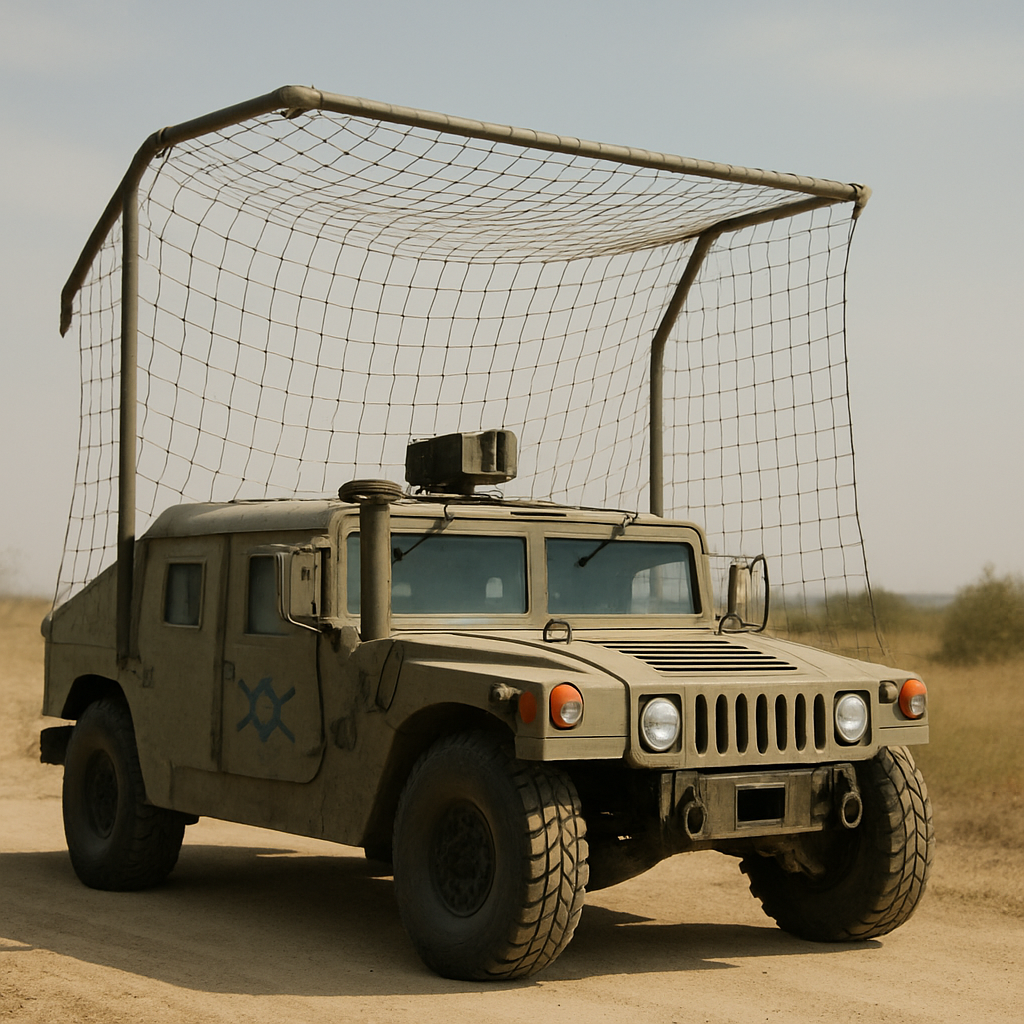
A social‑media video circulated April 29 shows an Israeli combat vehicle fitted with anti‑drone netting: nylon or mesh metal nets draped from metal arms extending out and above the vehicle, described in the footage as looking “like a soccer goal.” Other clips shared over the same period show a folded anti‑drone net installed on a Humvee and additional footage of FPV drone strikes against vehicles including two Merkava Mk.4 tanks, a D9 armored bulldozer, and what appears to be a Namer heavy IFV.
Why netting is being tried: fiber‑optic FPV drones and the limits of jamming
Hezbollah has increasingly used fiber‑optic‑guided FPV drones against Israeli forces during the nearly two‑month conflict, a trend that prompted the Defense Ministry’s Directorate of Defense Research and Development to issue a public call for counter‑drone solutions on April 11. Fiber‑optic guidance reduces vulnerability to electronic warfare and can negate some line‑of‑sight radio limits, which the military initially underestimated — later discovering launches at distances up to 15 kilometers. Netting is a passive attempt to catch or deflect one‑way attack drones so that they disable or detonate away from occupants.

This site is the portfolio.
OSINTSights runs on Cloudflare Workers, D1, R2, and Vectorize, with an AI pipeline on Hetzner ARM. Nubivance designed, built, and operates it. We do the same for clients.
See what we buildIDF assessments and field improvisation
A high‑ranking IDF official recently returned from Lebanon described the netting seen in video as “more like an experimental concept rather than something that is already operational in the field.” Forces on the ground are reportedly using improvised fixes—fishing nets, camouflage nets, even soccer nets—along with drills to engage drones with small arms. The official added he had not personally seen the specific net system in use and relayed that the IDF’s ground forces research and development team concluded, “this solution is highly problematic. It allows the lower parts of the vehicle to remain exposed, areas that the net doesn’t cover. The likely next step for the adversary would be to detonate the drone at a distance from the net, causing shrapnel to disperse toward the forces.”
How senior commanders view the threat
Israeli military journalist Doron Kadosh reported that the issue dominated discussion at a senior command forum at Ramat David. The commander of the 282nd Artillery Brigade, Col. G., told fellow commanders: “The drone threat is a significant operational challenge that we’re dealing with. We need to think about how to organize better against this threat.” Kadosh summarized the field briefings as boiling down to: “Stay alert, and if you spot a drone—shoot at it.” Commanders and unit leaders fighting in Lebanon expressed frustration about the few available tools to counter the FPV strikes; some units have improvised nets over positions, houses, and windows to prevent drones from hitting key targets.
What this means for IDF commanders, frontline troops, and Defence R&D
- IDF commanders: Expect continued experimentation with passive measures such as netting and a push to organize unit‑level tactics around limited, improvised responses; the Defense Ministry’s public call for "innovative and mature technologies" signals a request for scalable solutions beyond improvised nets.
- Frontline troops: Netting and small‑arms drills are being used as immediate protective measures, but commanders warn these provide partial coverage—open‑top vehicles and lower vehicle sections remain vulnerable if a trapped drone detonates.
- Defense R&D and vehicle programs: Active protection systems (APS) are being adapted for hard‑kill counter‑drone roles and represent a hopeful, but costly, route for armored platforms; lighter vehicles lacking APS capabilities remain an acute shortfall.
Video of FPV strikes, the first fatal FPV strike reported in the current fighting and the Defense Ministry’s April 11 solicitation for solutions underline a simple reality: improvised nets buy time and publicity, but they do not yet solve an evolving technical problem. The military has documented increasing engagement ranges, commanders are openly frustrated, and a public search for technological mitigations is underway. Expect more visible experiments on vehicles in the near term, and a steady focus inside the Defense Ministry on converting that experimentation into field‑ready systems.
Original story: https://www.twz.com/news-features/israel-now-using-netting-to-protect-combat-vehicles-against-scourge-of-hezbollah-drones