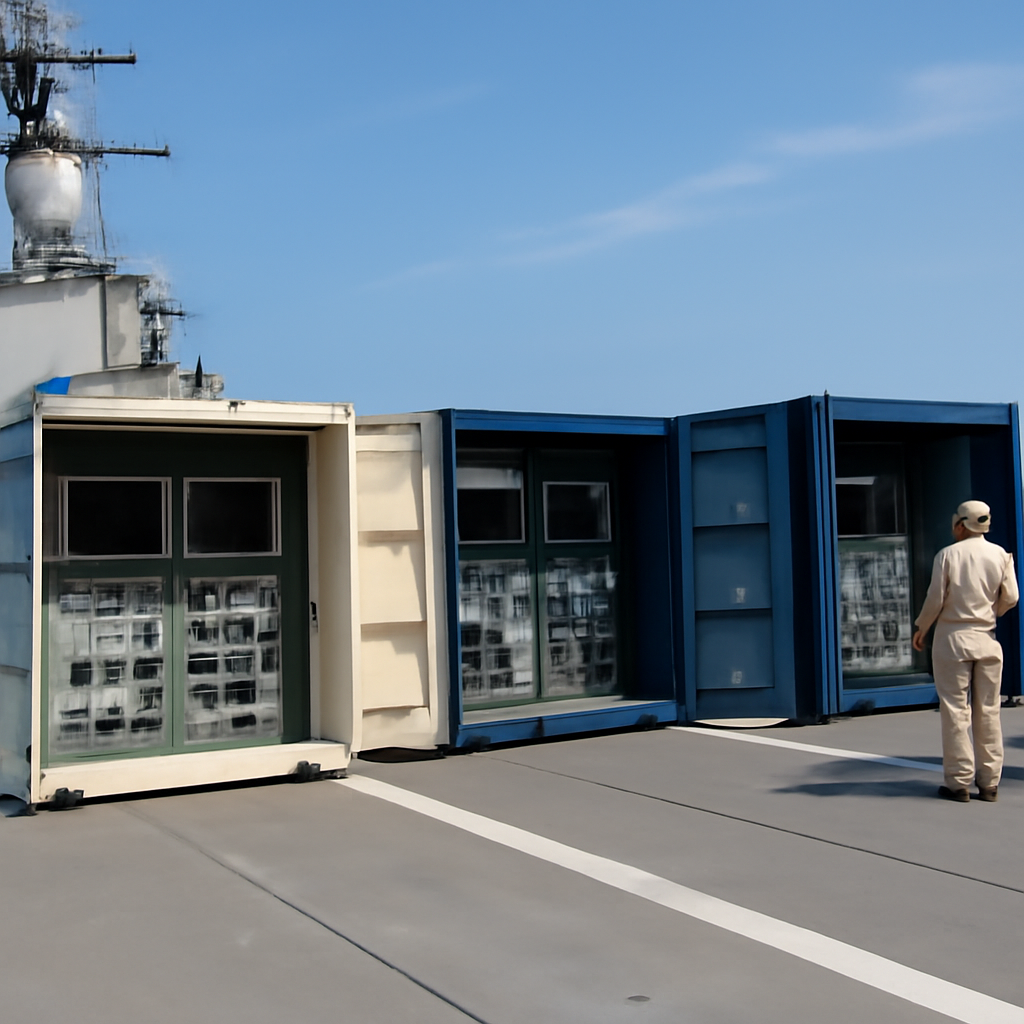
"The solution enables rapid deployment, shortens operational timelines, reduces costs and supports continuous modernization in response to emerging threats and evolving mission," IAI said in announcing its new naval concept on May 20.
Diamond: a containerized architecture for frigates and small vessels
Israel Aerospace Industries (IAI) unveiled "Diamond" as a modular, containerized approach to naval combat capabilities. The company described the technology as a "distributed warfare solution that expands the power of modern frigates" and said it will give ships "greater firepower, operational flexibility and rapid response." In IAI’s presentation, the hardware is housed in standardized shipping-container footprints that can be placed on a ship’s deck to add new capabilities without full shipboard integration.
Plug-and-play systems and rapid reconfiguration
IAI emphasises a plug-and-play design. "The modular systems all come in a standard container footprint and can be deployed, replaced or reconfigured within hours based on operational needs," the company said. That modularity is offered as a way to shorten timelines: crews or logisticians could swap containerized modules onto available deck space rather than undertake long, costly integration programs.

Audit-ready is a season. It shouldn't be.
Evidence in spreadsheets, controls drifting between audits, frameworks multiplying on flat headcount. Nubivance runs continuous compliance on Rapid7 Cyber GRC - SOC 2, HIPAA, ISO 27001, PCI, CMMC.
End the scrambleNetworked groupings: mother ships and satellite vessels
Because modern warships frequently lack excess deck capacity, IAI pairs containerized modules with a distributed, networked force structure. The Diamond concept envisions small, simple vessels acting as satellite or "wing" ships that carry the containers and link back to a command-and-control mother ship. IAI presents this as a way to provide group-level defensive and offensive capabilities in a disaggregated model, enabling forces to be "configured quickly for mission requirements."
Demonstrated payloads: interceptors, loitering munitions, sensors and missiles
IAI’s announcement video showed a variety of containerized payloads. Examples included missile interceptor pallets, loitering munitions (the company highlighted systems similar to its Harop), and sensor masts. IAI listed systems that can be integrated into Diamond's plug-and-play architecture: "loitering munitions such as Harop, Harpy and Mini-Harpy, Blue Spear cruise missiles, LORA ballistic missiles, the BARAK MX family of advanced air defense interceptors, Counter-UAS capabilities and more."
One sequence in the video depicts loitering munitions launching from a container and striking mobile surface-to-air missile (SAM) launchers positioned on a hill overlooking a waterway. The footage notes a resemblance to the operational challenges in the Strait of Hormuz and shows SAM systems that "appear similar to those used by Iran."
IAI's rationale: adaptive, networked force structures
Guy Barlev, IAI’s Executive Vice President and General Manager of its Space Missiles and Space Group, framed Diamond as a response to changing naval priorities. Barlev said modern naval warfare is shifting to "adaptive, networked force structures," moving away from concentration on large platforms. He argued Diamond lets navies "expand combat capacity, survivability and mission endurance without relying on costly fleet expansion programs."
What this means for navies, procurement leaders, and potential adversaries
- Navies: Diamond offers a way to augment existing frigates and task groups quickly by adding containerized payloads and using small satellite vessels to extend capability. Navies will need to consider command-and-control links and logistical flows to support rapid swaps and reconfiguration.
- Procurement leaders: The pitch centers on cost reduction through modularity and avoidance of deep platform integration. Procurement officials will face decisions about investing in containerized payloads, mother-ship C2 upgrades, or procuring small vessels to act as satellite platforms.
- Potential adversaries: The IAI video illustrates scenarios where loitering munitions and interceptors, launched from dispersed platforms, target coastal or land-based air defenses and deny enemy systems freedom of action in constrained waterways resembling the Strait of Hormuz.
Diamond packages operational ideas — modular containers, networked small vessels, and a mother-ship command node — into a single concept aimed at giving forces quicker, cheaper pathways to new capabilities. IAI positions this as a response to the limits of expanding fleets through traditional shipbuilding; the company proposes instead a distributed, reconfigurable force built from standardized building blocks. Whether navies adopt that model will turn on how they weigh the tradeoffs among rapid reconfigurability, the demands of networking and C2, and the specific threats they face in littoral and chokepoint environments.