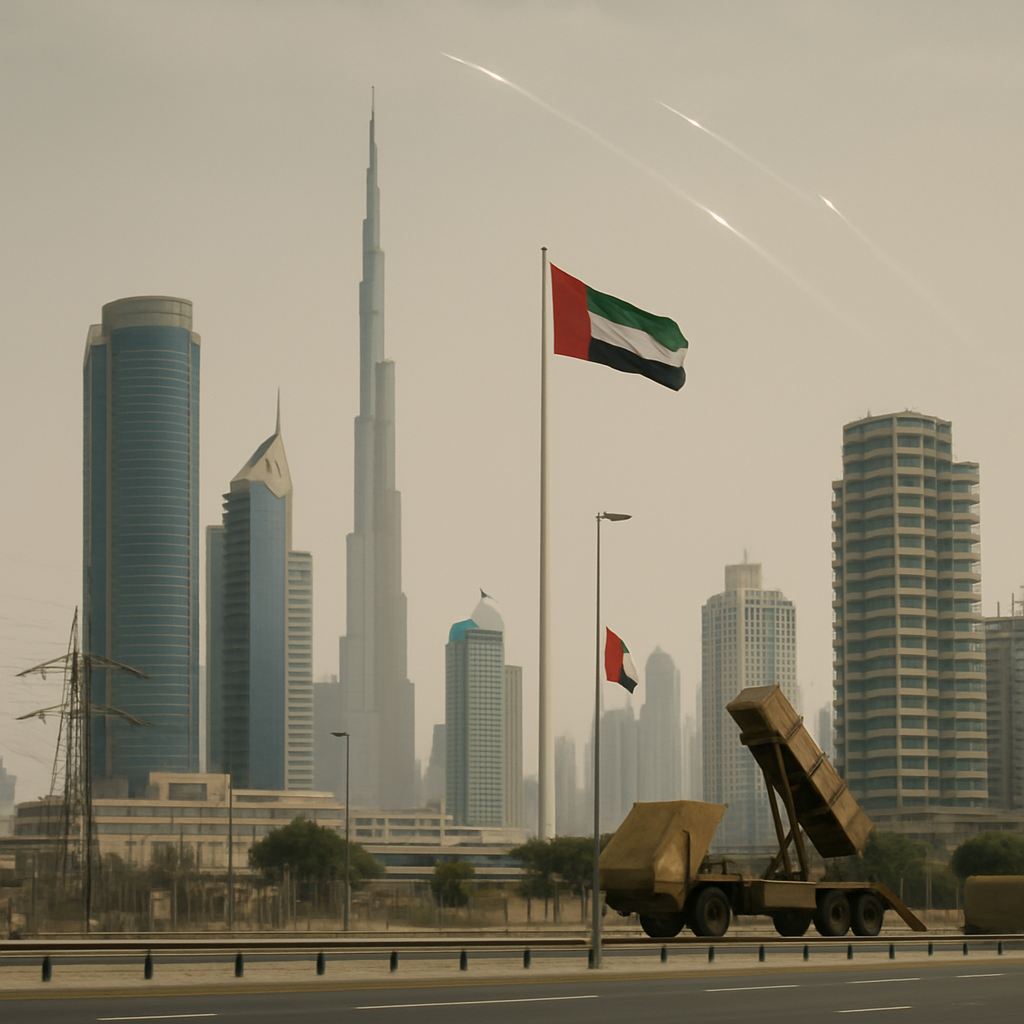
"The UAE’s air defenses are currently dealing with missile and drone attacks originating from Iran,” the UAE Defense Ministry stated on X, as air-defense systems reportedly engaged ballistic missiles, cruise missiles, and drones over scattered areas of the country.
UAE Defense Ministry: intercepts and immediate claims
On Tuesday the UAE said Iranian missiles and drones struck toward Emirati territory, and that the “sounds heard in scattered areas of the country are the result of the UAE’s air defense systems intercepting ballistic missiles, cruise missiles, and drones,” the Ministry of Defense wrote on X. The extent of damage remained unclear in the available reporting, and the IRGC subsequently denied carrying out any missile or drone operations against the UAE, saying such reports were “categorically denied and ... entirely devoid of truth.”
IRGC warnings and the Persian Gulf Strait Authority permit system
The Islamic Revolutionary Guard Corps (IRGC) issued fresh threats to shipping, warning that “the only safe route for crossing the Strait of Hormuz is the corridor previously announced by Iran and any deviation of vessels to other routes is unsafe and will face decisive action from the IRGC Navy.” Later the IRGC announced a new “mechanism for exercising sovereignty over the Strait of Hormuz,” saying ships would receive an email from info@PGSA.ir (Persian Gulf Strait Authority) informing them of transit regulations and providing a transit permit, a move reported via Iran’s Press TV.

Audit-ready is a season. It shouldn't be.
Evidence in spreadsheets, controls drifting between audits, frameworks multiplying on flat headcount. Nubivance runs continuous compliance on Rapid7 Cyber GRC - SOC 2, HIPAA, ISO 27001, PCI, CMMC.
End the scrambleProject Freedom, U.S. military actions, and statements from Washington
Project Freedom — described in the reporting as an operation to enable commercial ships to safely transit the Strait — has seen U.S. forces take direct action. U.S. Army AH-64 Apache and U.S. Navy MH-60 Seahawk helicopters destroyed six small Iranian boats that were threatening commercial ships, and NBC News reported two U.S. commercial ships that transited on Monday carried U.S. military security teams aboard. Joint Chiefs chair Gen. Dan Caine said Iran had fired at commercial vessels nine times, seized two container ships, and attacked U.S. forces more than ten times since the ceasefire, but characterized the incidents as “below the threshold of restarting major combat operations.”
U.S. War Secretary Pete Hegseth told reporters “No, the ceasefire is not over” and framed Project Freedom as “a separate and distinct project” that the U.S. expected churn at the outset. Secretary of State Marco Rubio called Project Freedom “not an offensive operation” and said “there’s no shooting unless we’re shot at first.” In a late-evening update, President Trump announced on Truth Social that Project Freedom would be paused pending negotiations and that a blockade would “remain in full force and effect” while talks continued.
International responses: a proposed U.N. resolution, the IMO, and partners weighing involvement
The United States, together with Bahrain, Saudi Arabia, the UAE, Kuwait, and Qatar, drafted a U.N. Security Council resolution aimed at defending freedom of navigation in the Strait of Hormuz, according to a media release cited in the reporting. The draft calls on Iran to cease attacks, mining, and tolling, and would demand Iran disclose the number and locations of sea mines and cooperate in their removal while supporting the establishment of a humanitarian corridor.
The International Maritime Organization (IMO) said it welcomed attention to “the plight of innocent seafarers,” warned that naval escorts were “not a sustainable long-term solution,” and said it stands ready to roll out an evacuation plan once it is safe to do so — a step that requires “clear safety guarantees from all parties involved.” South Korea said it was reviewing the U.S. proposal and considering whether to join Project Freedom, and Pakistani officials mediating stalled peace talks urged restraint as tensions rose.
Maritime environment: attacks, electronic interference, and navigational constraints
Maritime-security monitors reported continuing hazards. The United Kingdom Maritime Trade Operations (UKMTO) reported a cargo vessel struck by an unknown projectile, with environmental impact unknown. The maritime intelligence firm Windward reported a surge in vessels switching off AIS and a “return of critical GPS jamming” following attacks on Fujairah’s port. Bloomberg columnist Javier Blas noted the U.S. Navy’s suggested southern route appears deep enough for the largest oil supertankers but is narrow and bordered by obstacles including shallow reefs, underscoring navigational constraints for escorted transits.
What this means for commercial mariners, the U.S. Navy, and Iran–UAE relations
- Commercial mariners: The reported rise in AIS shutdowns and GPS jamming, plus UKMTO and IRGC warnings, will force ship operators to weigh route choice, convoy/escort options, and whether to accept transit permits from Iran’s announced mechanism.
- The U.S. Navy and Project Freedom partners: The presence of multiple U.S. warships in the Arabian Gulf and reported military security teams aboard commercial vessels indicate a willingness to protect transits; the announced pause of Project Freedom pending negotiations, however, changes operational timelines and alliance commitments.
- UAE–Iran relations and regional diplomacy: Conflicting claims — the UAE saying it was attacked and the IRGC denying responsibility — coupled with the IRGC’s new permit system, place bilateral trust under strain and make diplomatic verification and de-escalation central to preventing renewed major combat operations.
The facts on the table are stark and contested: air-defense intercepts over the UAE, contested claims about who fired, a new IRGC permit mechanism for the Strait, multiple recent attacks on commercial shipping, and a U.S. decision to pause Project Freedom while talks continue. Whether those talks produce a binding, verifiable cessation of hostile acts — and whether parties will accept independent verification of mine-laying, attacks, and navigational safety — are the immediate questions that the region faces next.