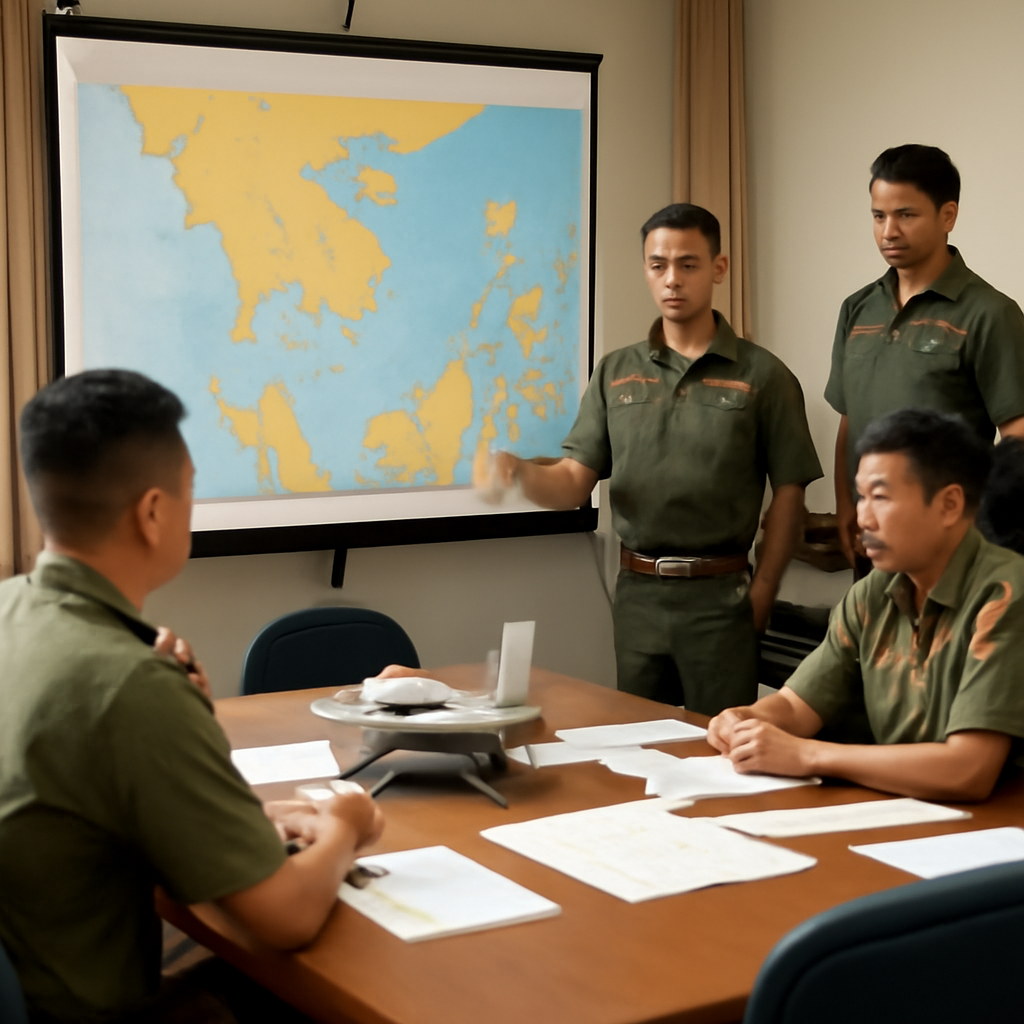
"A thousand friends are too few, one enemy is too many."
Prabowo Subianto’s strategic balance: bebas aktif in practice
President Prabowo Subianto has articulated Indonesia’s long-standing foreign-policy principle of "bebas aktif" — to remain free, active, and avoid permanent alignment — with that proverb. The policy is visible not only in Jakarta’s diplomatic moves but in its recent, unusually wide-ranging search for combat aircraft. In October 2025, Indonesia publicly announced plans to acquire at least 42 Chinese-made J-10C fighters, and months later was reported to be in advanced talks with Pakistan over more than 40 JF-17s. The practical status of those possible acquisitions remains unclear, but the announcements mark a concrete shift: Chinese-origin combat aircraft now play a serious role in Indonesia’s modernization planning.
Multiple suppliers: Rafales, KAAN, the F-15EX drop, and Chinese options
Jakarta’s air-force shopping spans Europe, the United States, Türkiye, China, and Pakistan. Indonesia is already receiving French Rafales and has agreed to acquire Turkish KAAN fighters over the longer term; a proposed F-15EX program with Boeing has fallen away. Against that backdrop, J-10C and JF-17 options indicate a deliberate diversification strategy — a form of hedging intended to modernize an ageing force without binding Indonesia to a single supplier.

Audit-ready is a season. It shouldn't be.
Evidence in spreadsheets, controls drifting between audits, frameworks multiplying on flat headcount. Nubivance runs continuous compliance on Rapid7 Cyber GRC - SOC 2, HIPAA, ISO 27001, PCI, CMMC.
End the scrambleOperational realities: maintenance, logistics, and secure links
Fighters are complex systems, and the source highlights the full logistics tail required to field them: maintenance, engine support, armaments, simulators, mission planning, electronic-warfare libraries, and training systems. Adding Chinese and Turkish aircraft to an existing mix of Russian, American, French, and Korean-origin equipment would create a proliferation of disparate combat systems. The report stresses concrete bottlenecks — spare parts, technicians, weapons stocks, and secure data links — that must be solved to keep aircraft combat-ready during a prolonged crisis.
Interoperability is also political. Indonesia conducts many exercises on sophisticated Western aircraft and networks. Some Western allies might be less willing to share electronic signatures, mission information, or communications equipment if Jakarta operates Chinese aircraft. That possibility would force Indonesia to consider compartmentalizing its Air Force: Western-oriented systems for interoperability with partners, Chinese-origin systems for other missions, and a national overlay intended to bridge them without exposing sensitive systems.
Economic and diplomatic interdependence with China
Jakarta’s outreach to Beijing extends well beyond defense procurement. Chinese capital underlies Indonesia’s nickel-processing boom and EV supply-chain plans; Chinese companies dominate nickel-refining capacity. A CATL-backed project in Indonesia spans mining, processing, EV battery manufacturing, and battery recycling. China also financed and constructed the Jakarta–Bandung high-speed railway. Parallel to deep economic links, Jakarta has broadened security engagement with Beijing: the two agreed to resume joint military training, and in April 2025 Indonesia became the first recipient of China’s new “2+2” dialogue format that brings together foreign and defense ministers — a mechanism Beijing described as the first of its kind it had created with another nation. At sea, Jakarta disputes the legal basis of Beijing’s expansive South China Sea claims around the Natuna Islands but has chosen to manage the issue peacefully rather than let it define the bilateral relationship.
What this means for Jakarta, the Philippines, and Vietnam
- Jakarta: Diversification brings bargaining power and reduces the risk that a single supplier could hold the Air Force hostage. But the source warns there is a tipping point: too many suppliers can yield redundant infrastructure, smaller spare-parts pools, and less efficient economies of scale, meaning fewer mission-ready planes despite a longer procurement list.
- The Philippines: With repeated maritime incursions by China a source of frustration, Manila is likely to read an Indonesian purchase through a security lens — worrying about whether Jakarta would confront China in defense of a partner and whether sensitive mission data could be shared if Indonesian forces operate Chinese planes.
- Vietnam: Hanoi, committed to strategic autonomy and known to operate equipment from multiple suppliers, would probably issue a subtler critique — wary that deepening defense-industrial ties with Beijing elsewhere could reduce leverage over maritime disputes.
The central calculation for Jakarta is therefore not merely technical: it is political messaging. The report argues that buying Chinese fighters need not be decisive if Indonesia can clearly articulate each platform’s role, define how many different combat systems it can sustain, and show how those aircraft will integrate into a common command-and-control system. Otherwise, the risk is gradual erosion of confidence among ASEAN partners who must decide whether Jakarta is a reliable security partner in a crisis.
Prabowo’s proverb may be a comfortable diplomatic maxim, but an effective air force requires disciplined choices about sustainment, integration, and clarity of purpose. The immediate question left by Jakarta’s announcements is straightforward and consequential: can Indonesia turn a long shopping list into a single coordinated system that can train, communicate, and fight simultaneously?