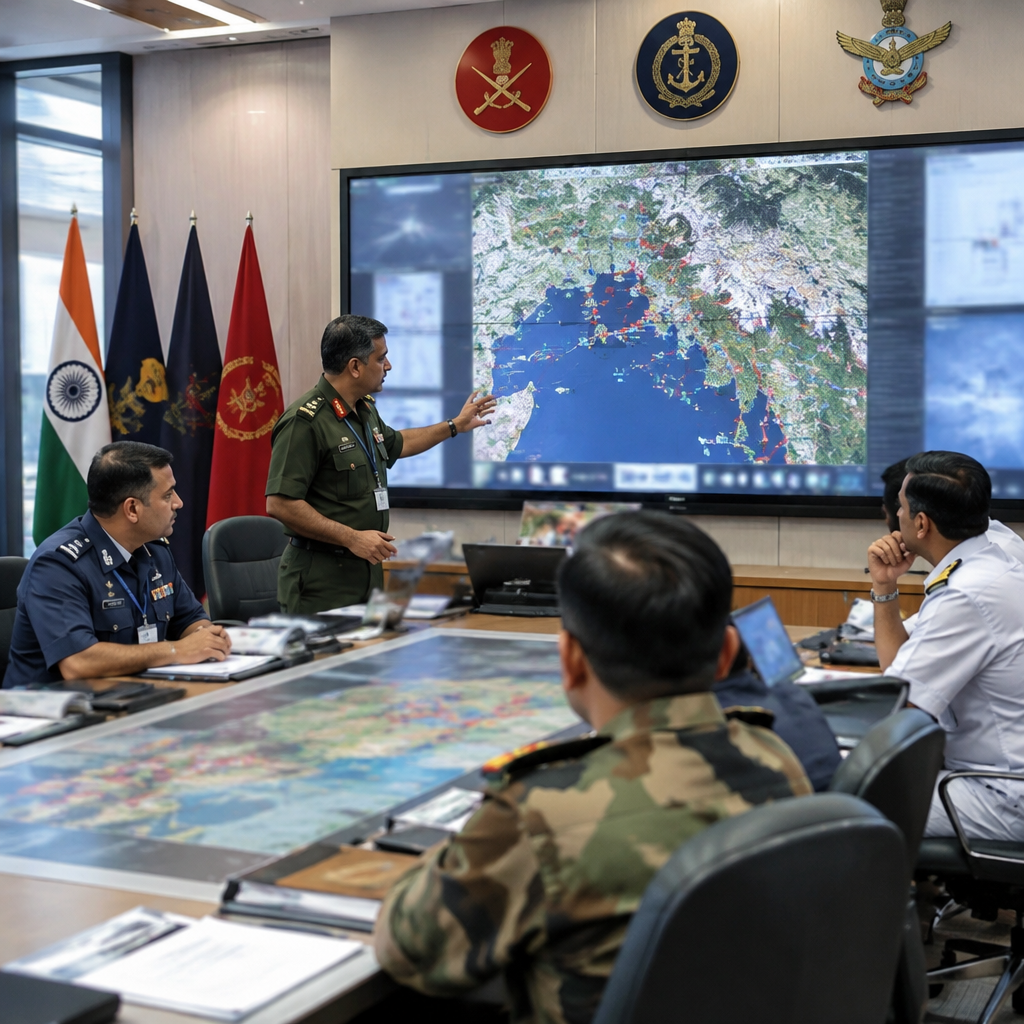
India operates 17 single-service operational commands — seven each for the Army and the Air Force, and three for the Navy — a configuration that sits at the heart of a long-running debate over military theaterization.
The present architecture: single-service commands and a handful of joint experiments
Today’s force structure divides operational authority across three separate service command systems, with the Andaman and Nicobar Command (ANC), created in 2001 in the aftermath of the Kargil conflict, standing as India’s only longstanding tri-service operational command. The Strategic Forces Command is separately tasked with managing the country’s nuclear arsenal. Advocates of theaterization argue these three independent command structures complicate planning, create duplication, and slow operational responses; critics counter that a move to permanent geographic theaters would pose fresh trade-offs.
Why the Indian Air Force resists permanent division of air assets
Outgoing Air Chief Marshal A.P. Singh has argued that fighter aircraft must not be permanently divided across geographical commands and has advocated centralized control and decentralized execution. The Air Force’s core contention, as set out in recent public debate, is practical: speed, range, aerial refuelling and precision-strike capability allow air power to be concentrated where it is most needed. From the IAF perspective, air assets are an independent strategic capability that requires flexibility to operate across theaters, rather than being parceled out permanently to multiple geographic commanders.

Audit-ready is a season. It shouldn't be.
Evidence in spreadsheets, controls drifting between audits, frameworks multiplying on flat headcount. Nubivance runs continuous compliance on Rapid7 Cyber GRC - SOC 2, HIPAA, ISO 27001, PCI, CMMC.
End the scrambleHow proponents frame theaterization and the counterexamples
Proposals most frequently discussed envision northern and western theater commands oriented toward China and Pakistan respectively, alongside a maritime theater command. Proponents say theaterization institutionalizes tri-service coordination — turning the ad hoc cooperation that can emerge in a crisis into a permanent arrangement where a joint theater commander exercises operational authority over assigned Army, Navy and Air Force assets. They point to institutional steps already taken — the creation of the Chief of Defense Staff and the Department of Military Affairs in 2019, and the Inter-Services Organizations (Command, Control and Discipline) Act, 2023 — as providing momentum for deeper reform.
Operation Sindoor and the argument for existing structures
Operation Sindoor, the May 2025 military operation, is offered as a concrete reference point. The operation demonstrated the importance of coordinating different capabilities, but it was carried out under a joint architecture involving the Chief of Defense Staff and the three service chiefs rather than under a permanent geographical theater command. That reality fuels a pointed question: if effective tri-service coordination was possible under the existing senior-leader-driven arrangements during a major 2025 confrontation, what additional advantages would full theaterization provide? Proponents answer that theaterization removes dependence on working relationships between individual commanders and makes the joint approach permanent; opponents say the costs in flexibility and the practical difficulties of assigning scarce air assets may outweigh those gains.
Political leadership, resource constraints, and the path forward
Former Navy chief Admiral Arun Prakash has appealed that the services must settle their differences over theaterization before a serious security crisis exposes limitations in the current command structure. The debate exposes a broader governance question: theaterization requires redistributing authority across institutions that have long preferred operational autonomy, and the source material argues that where consensus remains elusive, political leadership must provide direction, set timelines, and take responsibility for the final organizational framework. Observers cited in the discussion also note India’s geographical vulnerabilities and resource constraints mean the country cannot simply copy foreign models; the U.S. model of unified combatant commands is referenced as one example that separates operational command from service responsibilities, but the material stresses India needs home-grown, phased solutions that reconcile the interests of all three services.
What this means for the Army, the Navy, the IAF, and India’s Indo‑Pacific partners
- Army: Will seek assured access to air power in support of ground operations and therefore will push for arrangements that guarantee close air support and prioritized air allocations for land campaigns.
- Navy: Will press for a maritime theater command or equivalent arrangements that ensure integrated sea control and maritime-domain coordination across services.
- Indian Air Force (IAF): Will continue to argue for centralized management of principal air combat assets to preserve the flexibility to concentrate air power across theaters as conflict demands.
- Indo-Pacific partners: The source material notes that those who seek a regional balance of power will watch the outcome closely; a military able to run a two-front contingency under unified command is described as a steadier partner for such countries.
The debate is less about whether tri-service coordination is desirable — that is largely accepted — and more about how authority and scarce capabilities should be distributed in a fight. Institutional steps taken since 2019 have nudged India in the direction of theaterization, but differences remain stark and practical. Unless political leadership moves from facilitation to firm direction, the argument risks becoming an unresolved structural standoff: an enduring debate with tangible consequences for operational readiness and for how outside partners assess India’s strategic reliability.
Original story: https://thediplomat.com/2026/11/indias-theater-commands-a-never-ending-debate/