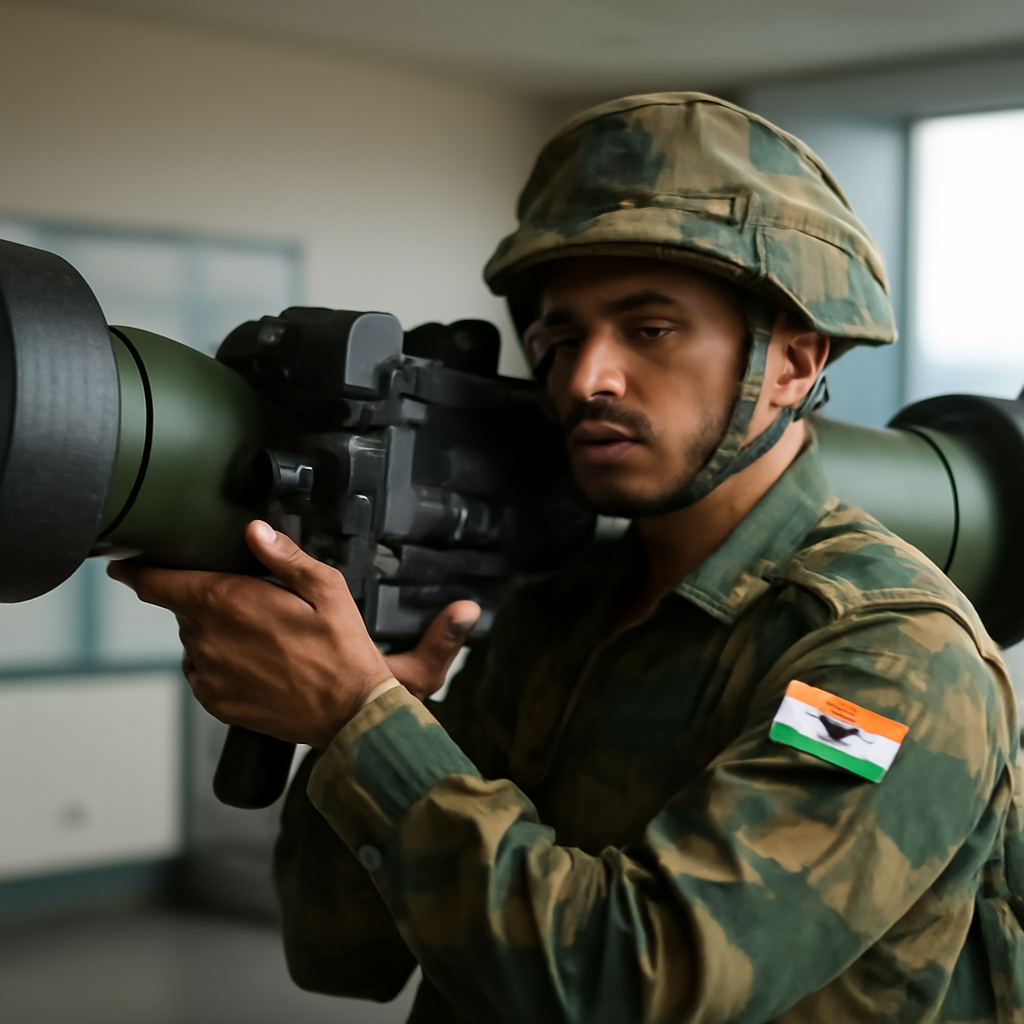
“BIG news! India plans to buy the battle-tested Javelin anti-tank system,” U.S. Ambassador to India Sergio Gor announced on X on August 28, adding that the move opens the door to “co-production possibilities.”
The sale on paper: what was signed and what the U.S. notification shows
The Indian Army signed a letter of offer and acceptance (LOA) for the Javelin through the U.S. foreign military sales (FMS) route, a purchase that traces back to a U.S. Defense Security Cooperation Agency notification in November 2025. That notification put precise numbers on the first lot: 100 Javelin rounds and 25 launch units at an estimated cost of $45.7 million. The specifics of the LOA beyond that notification have not been publicly released.
Lockheed, TASL and the push for local assembly
Lockheed Martin announced a memorandum of understanding between Tata Advanced Systems Limited (TASL) and the Javelin Joint Venture (JJV)—a Raytheon‑Lockheed partnership—for “co-production of the Javelin All Up Round (AUR) in India.” Lockheed said the MoU will explore a final assembly and integration facility and component production capabilities in India. Those discussions build on TASL’s existing industrial ties: the company already manufactures assemblies and components under agreements with Boeing and Lockheed, ranging from Apache fuselages and C-130J structures to vertical fins for 737 aircraft, according to the source.

This site is the portfolio.
OSINTSights runs on Cloudflare Workers, D1, R2, and Vectorize, with an AI pipeline on Hetzner ARM. Nubivance designed, built, and operates it. We do the same for clients.
See what we buildThe long arc: why India still needs thousands of ATGMs
The Javelin purchase is a piecemeal step against a very large requirement. The Indian Army’s overall need, as stated in the reporting, is for more than 40,000 missiles to equip some 382 infantry battalions and 44 mechanized regiments. The search for a modern, fire-and-forget anti-tank guided missile (ATGM) began in the early 2000s to replace Konkurs and Milan systems. Indigenous work by the Defense Research and Development Organization (DRDO) was delayed, producing a procurement process that stretched across decades.
The Spike episode: procurement loops, cancellations and emergency buys
The Javelin was not India’s only option. In 2009 the Defense Acquisition Council gave initial approval to procure Rafael’s Spike ATGM—over 8,000 missiles and 300 launchers with transfer-of-technology for domestic manufacture—in a deal valued at $500 million. The contract was formally approved in October 2014, but negotiations looped over cost and technology transfer. Rafael set up a joint venture with Kalyani Group in 2016 with Bharat Dynamics Limited as system integrator, only for the deal to be cancelled in January 2018 and then revived at the end of 2018 for 170 launchers, 4,500 missiles and 15 simulators. Those revived plans dragged on and faltered when validation trials raised performance questions.
In contrast, emergency procurement became the route to deliver capability quickly. After the Balakot air strike in February 2019 and the subsequent security environment, the Army procured Spike‑LR missiles under emergency sanction: an order for 12 launchers and about 250 missiles, repeated in 2020 following the standoff in Ladakh. The 2019 emergency spending was capped at 3 billion Indian rupees—about $42 million, per the reporting—and the Spike‑LR is a 4th‑generation missile with a range up to 4 kilometers. Despite these buys, the reporting stresses that only one new-generation ATGM has been inducted in the period covered.
Testing, age‑graded lots and operational pressure: 2024–2025
The Javelin has been trialed in India before. The Indian Army first encountered the system in 2009 during the bilateral exercise Yudh Abhyas. It was tested again in 2024 alongside Stryker infantry combat vehicles, but performance was described as “sub-optimal” because the lot supplied for trials was dated. The reporting also cites Operation Sindoor in 2025 as having “reinforced the deficiencies” that prompted the emergency procurements and accelerated interest in off-the-shelf purchases and potential co-production.
What this means for the Indian Army, TASL, and the DRDO
- The Indian Army: Will obtain a limited number of Javelins to fill immediate gaps, but the larger requirement—more than 40,000 missiles—remains unfilled because the acquisition was routed through Emergency Procurement, which limits quantities.
- TASL and U.S. partners: Gain a potential foothold in final assembly and component production for the Javelin AUR in India, extending TASL’s role as a supplier in U.S. defense supply chains and advancing the “co-production possibilities” flagged by the ambassador.
- DRDO and procurement authorities: Face continued pressure to accelerate indigenous development; the source notes DRDO’s ATGM work “has made progress” but timelines remain long, while other co-development efforts—such as domestic license manufacture programs cited in the reporting—have been “stuck for several years.”
The Javelin deal is both symbolic and practical: symbolic of deepening U.S.-India defense ties, practical as an emergency fix for an urgent battlefield need. As the source frames it, this acquisition “is likely the first of many” steps to bridge a capability gap that has been debated for more than a decade. Whether those steps remain small and episodic under emergency authorities, or scale into substantive co-production and long-term supply is the specific question the facts leave squarely on the table.