"An important milestone in Indian defence R&D," Defence Minister Rajnath Singh said of the trial.
Integrated Test Range on Dr. APJ Abdul Kalam Island: the 23 July trial
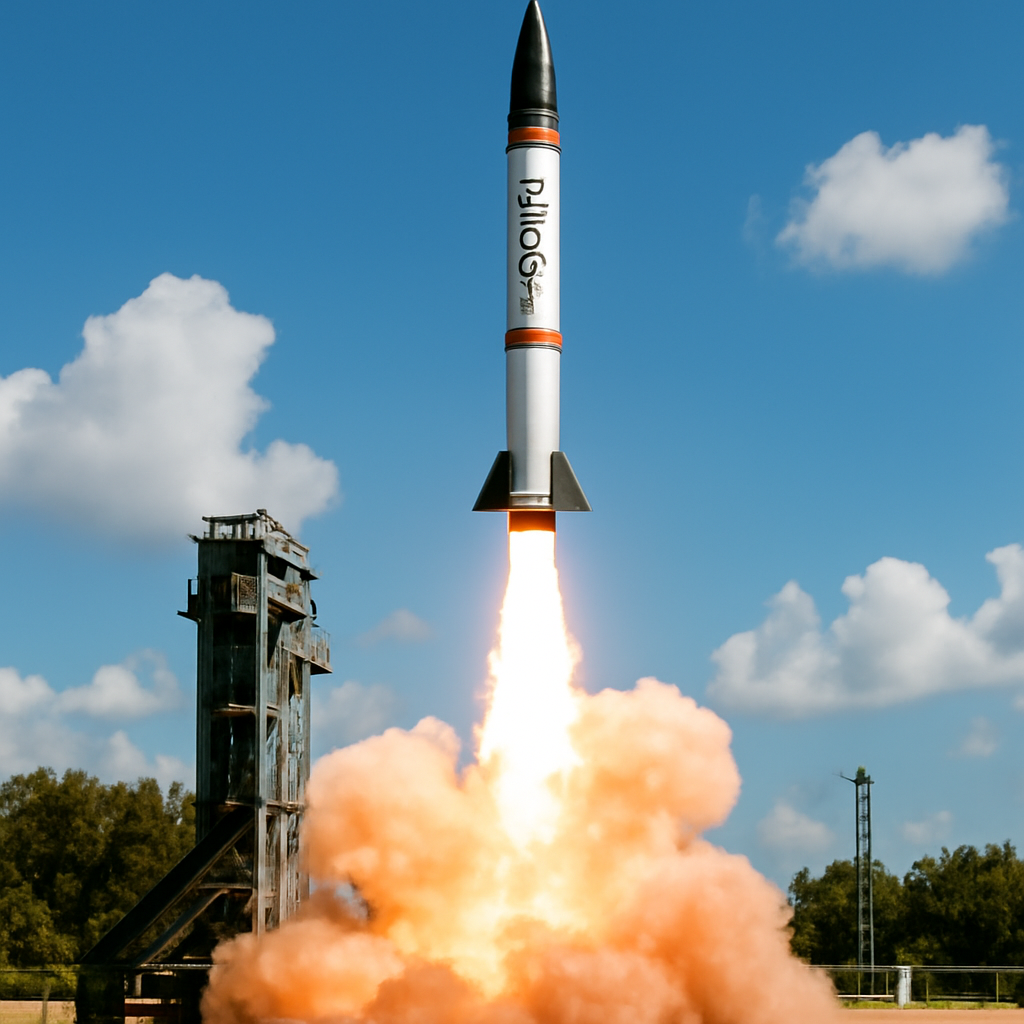
India’s Defence Research and Development Organisation (DRDO) conducted the maiden flight test of Project Kusha on 23 July 2026 at the Integrated Test Range on Dr. APJ Abdul Kalam Island, off the Odisha coast, successfully intercepting a simulated aerial target. The Ministry of Defence confirmed the trial validated integration between the missile, its radar, launcher, and command‑and‑control systems as a single functioning unit. The Defence Secretary and DRDO Chairman Rajesh Kumar Singh monitored the launch from the test range.
Project Kusha's M1, M2, and M3 interceptors and the development timeline
Project Kusha is structured as a three‑tier interceptor family sharing a common design. The variants are the M1 (roughly 150 kilometres), the M2 (about 250 kilometres), and the M3 (350 to 400 kilometres). The 23 July trial is understood to have tested the shortest‑range M1 variant. DRDO has scheduled M2 and M3 flight trials for 2027 and 2028 respectively, ahead of a targeted operational induction window between 2028 and 2030.
The Cabinet Committee on Security approved the program in May 2022. The Ministry of Defence issued an Acceptance of Necessity in September 2023 for five Indian Air Force squadrons at a sanctioned cost of US$2.26 billion (₹21,700 crore).

Audit-ready is a season. It shouldn't be.
Evidence in spreadsheets, controls drifting between audits, frameworks multiplying on flat headcount. Nubivance runs continuous compliance on Rapid7 Cyber GRC - SOC 2, HIPAA, ISO 27001, PCI, CMMC.
End the scrambleIntegrated Air Command and Control System: where Kusha fits with Akash, Barak‑8, and S‑400
DRDO and the Ministry of Defence have framed Kusha as a domestic long‑range layer to sit between India’s medium‑range systems and the S‑400 Triumf. According to ministry framing, Kusha fills the capability gap between Akash and Barak‑8—systems that cover roughly 7 to 80 kilometres—and the Russian‑supplied S‑400, which reaches out to 400 kilometres and already equips the Indian Air Force.
Rather than replacing the S‑400, the program is intended to reduce reliance on a single foreign‑supplied long‑range system by adding an indigenously produced tier with comparable reach. The system will be integrated through the Integrated Air Command and Control System alongside Akash, Barak‑8, and existing S‑400 squadrons. Defence commentary has tied Kusha’s development to lessons drawn from Operation Sindoor, the May 2025 conflict with Pakistan, during which India’s layered air defence network, including S‑400 squadrons, saw combat use.
Bharat Electronics Limited, Bharat Dynamics Limited, and procurement scale
Bharat Electronics Limited (BEL) is expected to serve as the primary systems integrator for Project Kusha, while Bharat Dynamics Limited (BDL) is positioned for missile production. Reporting has suggested a potential follow‑on order approaching US$4.16 billion (₹40,000 crore) beyond the initial sanctioned procurement.
DRDO has outlined ambitions beyond the initial five IAF squadrons, noting plans for up to ten Indian Air Force squadrons and a future naval variant of the system.
What this means for the Indian Air Force, DRDO, and the defence industry
- Indian Air Force: The MoD’s Acceptance of Necessity for five squadrons sets an initial procurement baseline; induction timing is targeted between 2028 and 2030 and will depend on the results of M2 and M3 trials scheduled in 2027 and 2028.
- DRDO and the Ministry of Defence: The test validates a combined‑systems approach—missile, radar, launcher, and command‑and‑control—which the ministry and DRDO have presented as a strand of the Atmanirbhar Bharat indigenization push to reduce dependence on imported long‑range air‑defence systems.
- Defence industry (BEL and BDL): BEL is slated as primary systems integrator and stands to lead integration work if follow‑on orders materialize; BDL is positioned for production, with reporting indicating a possible industrial role if the program scales toward the quoted US$4.16 billion figure and a naval variant.
The maiden M1 trial on 23 July confirmed basic interceptor functionality and system integration. The program’s next technical milestones are the M2 and M3 flight trials in 2027 and 2028; operational induction aims for 2028–2030, and procurement commitments beyond the five initial squadrons would raise the program’s industrial and budgetary stakes. The defence minister framed the test as a significant step in creating an indigenous long‑range capability, and the coming trials and procurement decisions will determine whether Project Kusha becomes a sustained domestic alternative to existing foreign‑supplied long‑range systems.
Original reporting: https://quwa.org/india-defence-news/india-conducts-maiden-flight-test-of-indigenous-kusha-long-range-air-defence-missile/