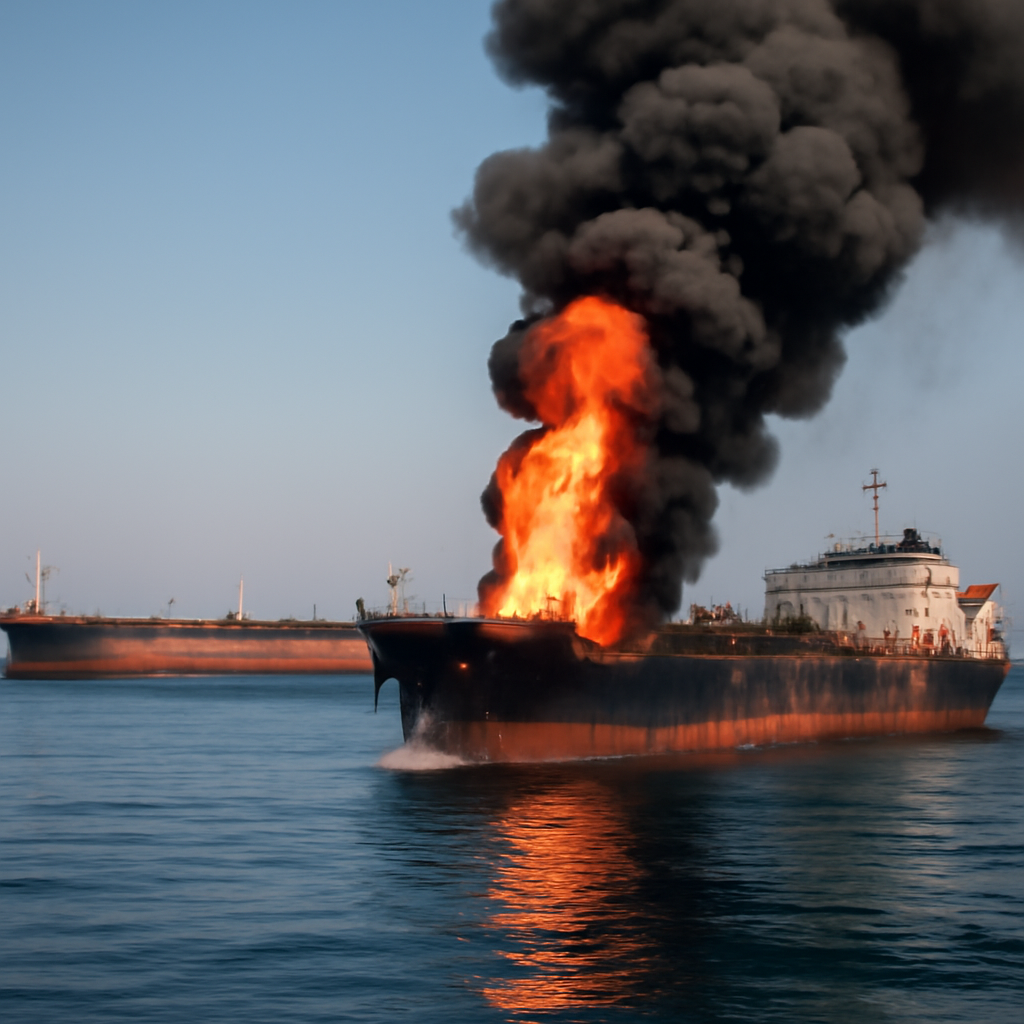
"The Yemeni armed forces have carried out a significant military operation targeting two Saudi oil tankers that violated the ban imposed by the armed forces in the Red Sea," the Houthis claimed on Telegram, saying the strikes "involved a number of ballistic and cruise missiles, as well as drones" and "caused a large fire on both vessels."
Houthi claim, UKMTO confirmation, and Saudi report
The Houthi statement asserted two Saudi oil tankers were hit and that the strikes forced "10 ships" to retreat; TWZ cannot independently verify that claim. The United Kingdom’s Maritime Trade Operations (UKMTO) confirmed an incident in the same area: a master of an oil tanker reported being struck by an "unknown projectile" 70 nautical miles southwest of Al Shuqaiq, Saudi Arabia, causing a fire that the crew were fighting. UKMTO noted "no reported casualties and no environmental impact" and advised vessels to transit with caution and report suspicious activity.
Saudi state SPA later published an official source from the Transport General Authority (TGA) saying the vessel Encelia, "belonging to a Saudi company," was targeted while sailing in the Red Sea and suffered a fire at the bow; SPA reported the safety of all crew members and that authorities had taken measures to secure the vessel and protect the marine environment.
U.S. military action and CENTCOM updates
The incident occurred amid a sustained U.S. campaign of strikes on Iranian military targets. CENTCOM announced at 7:17 p.m. EDT on July 22 that U.S. forces had begun launching more strikes "to further degrade Iran’s ability to threaten civilian mariners and commercial vessels transiting regional waters." By 11:01 p.m. EDT, CENTCOM said it had concluded a 12th consecutive night of attacks at 10:30 p.m. ET, striking "maritime capabilities, missile and drone storage facilities, coastal surveillance sites, and air defense assets." CENTCOM also stated it had "redirected nine commercial vessels and disabled one to prevent ships from entering or departing Iranian ports" as it resumed a blockade against Iran at sea.

This site is the portfolio.
OSINTSights runs on Cloudflare Workers, D1, R2, and Vectorize, with an AI pipeline on Hetzner ARM. Nubivance designed, built, and operates it. We do the same for clients.
See what we buildWarnings, weapons movements, and regional engagements
The U.S. Navy’s Joint Maritime Information Center (JMIC) had warned a day earlier that the Houthis had moved weapons near Bab al-Mandeb and that recent Houthi statements indicated readiness to target shipping, "specifically Saudi-affiliated," if directed. JMIC cited regional reporting that "Iran has instructed the Houthis to stand ready to close the Red Sea oil route should the United States strike Iranian power infrastructure," and that missiles and drones were positioned near Bab al-Mandeb.
Separately, President Donald Trump publicly stated he would target Iranian bridges or power plants "including those located next to, or in, the Capital City of Tehran" whenever Iran fired on a ship transiting the Strait of Hormuz; Iranian outlets connected to the IRGC responded with reciprocal threats to American interests in the region. Jordanian military officials reported that air defenses detected six missiles from Iranian territory, intercepted four, and that the other two fell in remote uninhabited areas without casualties. Iranian media also posted video claiming a direct drone hit on Aqaba; TWZ cannot independently verify that material.
Energy and shipping implications: Bab al-Mandeb meets Strait of Hormuz
Analysts and traders flagged the risk of dual chokepoint disruption. Kpler reported a sharp decline in traffic on July 21: Strait of Hormuz crossings fell 31% day-on-day to nine vessels, while Bab al-Mandeb crossings dropped 34% to 29 vessels; Kpler also noted four confirmed vessel U-turns near the Gulf of Aden. TWZ emphasized that a Houthi blockade of Bab al-Mandeb would compound the regional energy squeeze already produced by the Iranian closure of the Strait of Hormuz and renewed U.S. blockade measures.
The source reported that Saudi Arabia has diverted "millions of barrels of oil per day" through pipelines to its Yanbu port on the Red Sea to mitigate Persian Gulf hostilities — a re-routing that illustrates how strained supply lines are becoming and why keeping Bab al-Mandeb open is now a critical global energy concern.
What this means for the Saudi TGA, U.S. forces/CENTCOM, and maritime operators
- Saudi Transport General Authority (TGA): TGA has already publicly engaged after the Encelia report, securing the vessel and emphasizing crew safety and marine environmental protection; it will be expected to continue coordination with naval authorities and implement port and transit advisories reported by SPA.
- U.S. forces / CENTCOM: CENTCOM has expanded strikes against Iranian military maritime capabilities and asserted operational measures at sea — redirecting nine commercial vessels and disabling one — which signals continued kinetic and maritime interdiction activity tied to protecting commercial transit.
- Maritime operators and insurers: UKMTO cautioned ships to transit with care and report suspicious activity; Kpler’s data showing vessel U-turns and sharp traffic declines underscores operational confidence erosion that can reshape routing decisions, increase freight costs, and sustain higher risk premiums for energy shipments.
The sequence in this report — Houthi claims of strikes in the Red Sea, UKMTO and Saudi confirmations of damage to a vessel, and broader U.S. operations against Iranian maritime capabilities — ties local attacks to a wider regional spiral. With Bab al-Mandeb now an active front while the Strait of Hormuz remains contested, the movement of oil through alternative routes such as Yanbu and decisions made by CENTCOM and commercial carriers will determine whether short-term disruption hardens into a deeper energy crisis. The questions left on the immediate table are narrow and consequential: can maritime transit be protected sufficiently to prevent sustained detours, and how will continued strikes and counter-threats alter shipping patterns and the security posture of regional ports?