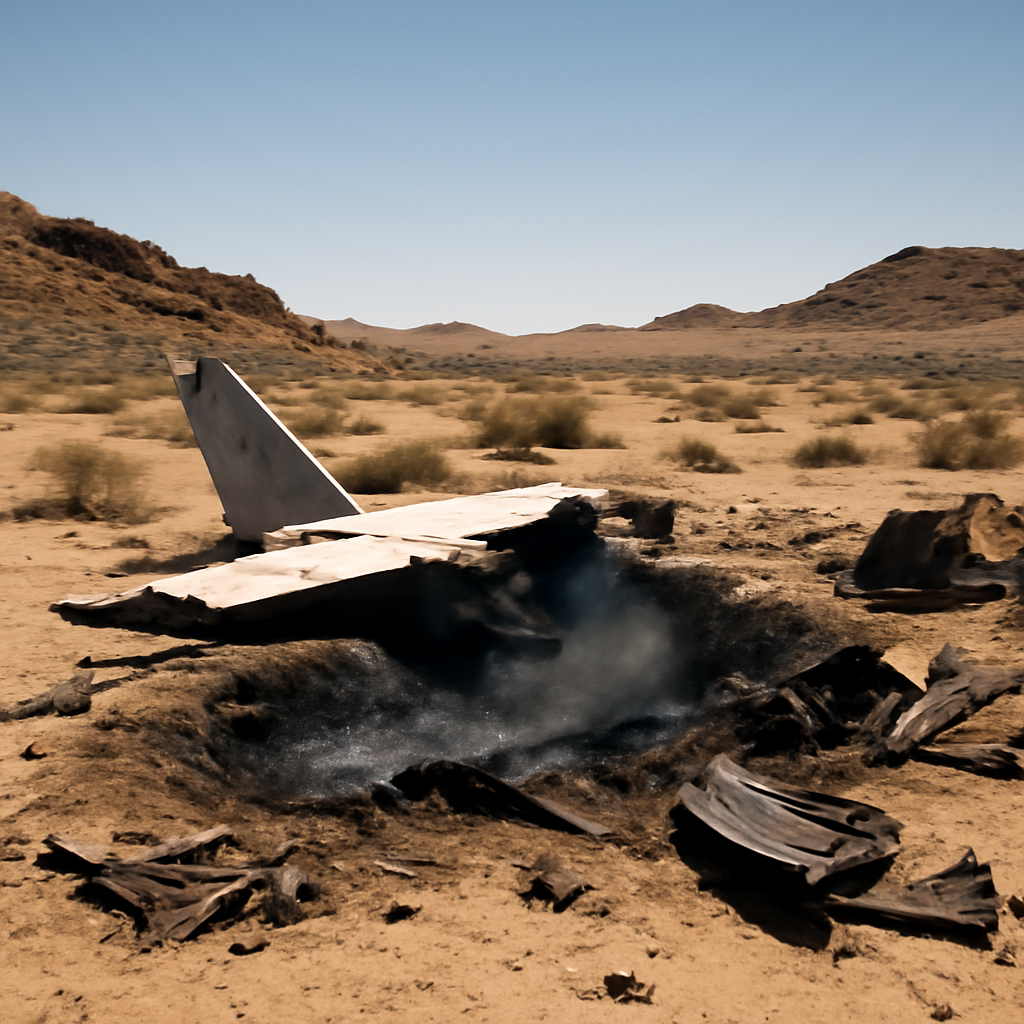
Tail number 5539 — an F-15 assigned to the Royal Saudi Air Force’s 55th Squadron at King Khalid Air Base — appears in imagery released by Yemen’s Houthi movement that the group says shows a downed Saudi Eagle over Marib governorate.
Ansar Allah's imagery and the claim
Yemen’s Houthi movement, Ansar Allah, released photos and video that it says document the destruction of a Royal Saudi Air Force F-15 over Marib. The material includes ground photos of wreckage and footage described as onboard recordings from a Houthi surface-to-air missile (SAM) system. Brig. Gen. Yahya Saree, the Houthi military spokesman, told media the aircraft was engaged by a locally manufactured surface-to-air missile, but he did not identify the weapon by model.
Reuters reported the Houthis’ claim but noted it had not been independently verified. Saudi Arabia had not publicly acknowledged the loss at the time of reporting. The fate of the aircraft’s two crew members is likewise unclear from the published material.
The aircraft: F-15SA, tail 5539
Observers of the imagery identify the jet as an F-15SA — the most advanced F-15 variant operated by the Royal Saudi Air Force — and specifically point to tail number 5539. TWZ reports that tail 5539 is understood to be among the locally upgraded F-15SR fleet (earlier F-15S aircraft modernized to a similar standard). The Royal Saudi Air Force received 84 new-build F-15SA aircraft; an additional 68 earlier F-15S airframes were upgraded locally to the F-15SR configuration.

Audit-ready is a season. It shouldn't be.
Evidence in spreadsheets, controls drifting between audits, frameworks multiplying on flat headcount. Nubivance runs continuous compliance on Rapid7 Cyber GRC - SOC 2, HIPAA, ISO 27001, PCI, CMMC.
End the scrambleHouthi air-defense systems and tactics
TWZ’s reporting and the released material underscore the continuing threat from Houthi air defenses in Yemen. The Houthi network combines mobile SAM launchers, repurposed air-to-air missiles such as infrared-guided R-73s and R-27s, and Iranian-derived systems including the Saqr/358. Visuals in Houthi-controlled media show Thaqib-1 missiles (repurposed R-73s) deployed in front of Thaqib-2s (repurposed R-27s), with other missile types staged behind them.
Of particular note is the Houthis’ use of passive infrared sensors for detection, tracking, and missile cueing. Unlike conventional fire-control radars, those passive sensors do not produce the kind of electronic emissions that would warn modern aircraft via electronic-warfare systems. TWZ notes that this combination of mobility, concealment, passive detection, and unconventional missile employment has repeatedly posed a difficult problem even for highly capable combat aircraft.
Marib fighting and the wider escalation
The reported shootdown comes amid a marked intensification of fighting after a period of relative calm following a 2022 truce. TWZ reports Houthi forces making significant advances against Saudi-backed Yemeni government positions, including around Marib and Taiz; the Houthis have also stepped up missile and drone attacks on southern Saudi Arabia, targeting military and energy infrastructure.
The Houthis have additionally declared the Bab el-Mandeb closed to Saudi oil traffic and have launched attacks reported against the Red Sea port of Yanbu and the southern airbase at Khamis Mushait, according to Reuters. Riyadh has reported intercepting Houthi drones, and there were earlier Saudi accounts of air defenses destroying a Houthi drone south of Mecca — a claim Ansar Allah denies. TWZ also reported the discovery of remnants of a Chinese-made short-range ballistic missile (DF-15A) in Yemen during the current fighting.
TWZ relays the Houthi account that, after the downing, Houthi air defenses engaged formations of Saudi F-15s and Eurofighter Typhoons seeking the wreckage and that those aircraft withdrew; that portion of the claim has not been independently verified.
What this means for the Royal Saudi Air Force, U.S. officials, and shipping
- Royal Saudi Air Force: The imagery and claim underline the operational challenge Houthi air defenses pose to Saudi strike and support operations over Yemen, particularly given the reported use of passive infrared detection and repurposed missiles that complicate aircraft warning systems.
- U.S. officials and forces: TWZ notes that Houthi systems have previously threatened U.S. crewed and uncrewed aircraft, including repeated demonstrations of the ability to down MQ-9 Reaper drones and past near-engagements with U.S. F-35s. Separately, U.S. officials met Houthi representatives in Oman recently; the Houthis told those U.S. officials they did not intend to attack American vessels and said they remained committed to a 2025 ceasefire with the United States unless the United States intervened on behalf of Saudi Arabia — a request the Houthis said the United States denied.
- Commercial shipping and Saudi oil traffic: The Houthis’ declaration closing the Bab el-Mandeb to Saudi oil traffic and their missile and drone campaign aimed at Red Sea transit routes have direct implications for the kingdom’s ability to move oil through that corridor.
For now, the publicly available record establishes that Ansar Allah claims responsibility and has published imagery of a destroyed Saudi F-15 that appears to bear tail number 5539. Key unanswered and verifiable details — the precise weapon used, how the aircraft was detected and tracked, and the status of its crew — remain to be independently confirmed as analysts and officials examine the released material.