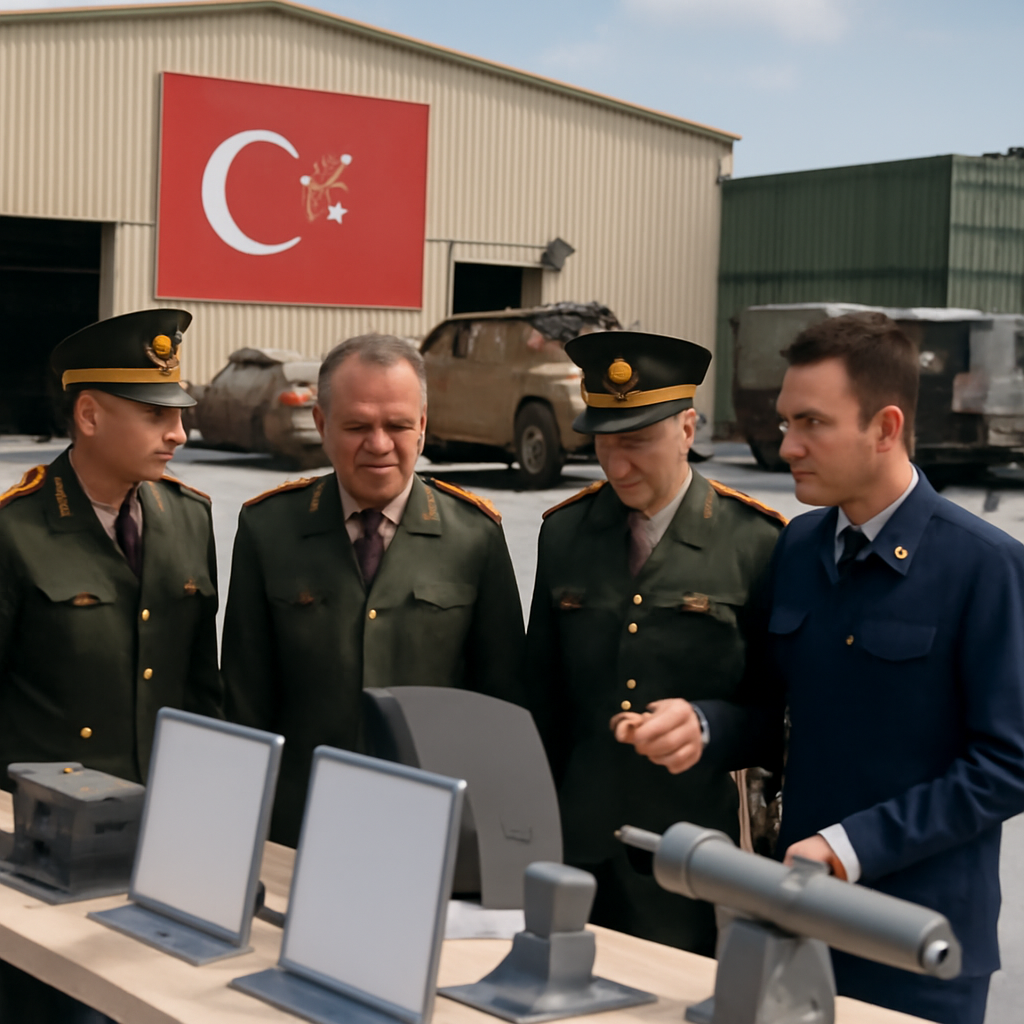
"Yes, we have some requests from the governments after recent developments," Murat Kurtulus, deputy general manager of missile production giant Roketsan, told Breaking Defense.
Roketsan's Cirit and Alka draw Gulf inquiries
Officials at Roketsan reported concrete requests from Gulf states for two relatively new systems: the Cirit missile and the Alka directed-energy weapon. The company described Cirit as a light-weight, laser-guided counter-UAS missile with a 5 km (3 mile) range that can be launched from mobile land-based vehicles and billed as a cost-effective alternative to traditional air defense systems. Alka, Roketsan said, is a directed-energy system that uses electromagnetic and laser technology at very close range; the firm described it as "very effective" for protecting critical infrastructure similar to targets hit in recent Iranian attacks.
MKE's Tolga platform and a fivefold jump in interest
Ersin Kandur, regional manager for the Middle East and Africa at state-owned MKE (MAKİNE ve KİMYA ENDÜSTRİSİ), told Breaking Defense that his firm has seen "increasing demand" from Gulf states and quantified the change: "five times more" interest than before the conflict. Kandur highlighted Tolga, a layered short-range air defense system that combines an electronic-warfare "soft" kill option with a 35MM cannon and laser-guided interceptors for a hard kill. He said Tolga is "specifically designed against drones, small, medium, [and] micro drones" and stressed that the conflict demonstrated how important close-range systems are to protecting critical infrastructure such as military bases, air bases, naval bases and oil production sites.

Audit-ready is a season. It shouldn't be.
Evidence in spreadsheets, controls drifting between audits, frameworks multiplying on flat headcount. Nubivance runs continuous compliance on Rapid7 Cyber GRC - SOC 2, HIPAA, ISO 27001, PCI, CMMC.
End the scrambleLocalization and technology transfer as a sales strategy
Both Turkish executives framed technology transfer and localization as central selling points in the Gulf market. Kurtulus said Roketsan is "very open to make such collaborations with the other countries" and welcomed developing local infrastructure. Kandur outlined a turnkey approach, saying MKE delivers production machinery and equipment, technical manufacturing data packages, training, and technical assistance so customers "are able to produce the product by themselves." He added that when MKE offers the transfer of technology, "the Intellectual Property (IP) resulting from technology transfer will belong to the exporting country and not to MKE."
Context from Saha expo and Efes 2026
The interest surfaced publicly on the sidelines of Turkey’s annual Efes 2026 military drill. Roketsan unveiled Cirit at the Saha defense expo in May, and MKE announced it is planning to expand its export base after receiving a $1.5 billion investment at Saha. Breaking Defense disclosed that it accepted travel and accommodation from a combination of the Turkish Ministry of Defense and Turkish defense firms Havelsan, Aselsan, Roketsan, MKE and Asfat to cover the exercise.
What this means for Gulf procurement agencies, Roketsan and MKE, and critical infrastructure operators
- Gulf procurement agencies: They are reportedly initiating or increasing requests for short-range and counter-UAS capabilities — specifically Cirit, Alka, and Tolga — and appear to value offers that include local production lines and technology transfer.
- Roketsan and MKE: Both firms are positioning recent products and turnkey transfer packages to capture accelerated demand; Roketsan emphasized collaborative partnerships, while MKE stressed its experience establishing production lines and the transfer terms for IP.
- Critical infrastructure operators in the Gulf (military bases, air/naval bases, oil production sites): The Turkish firms and their customers view close-range defenses and counter-drone measures as essential to protecting facilities similar to those targeted by Iranian systems, making deployment and localization priorities.
The post-attack environment has translated into identifiable commercial momentum for specific Turkish short-range and counter-drone systems, paired with a clear emphasis on localization as part of procurement deals. The precise outcomes — which Gulf states will proceed with purchases, the scale of any localized production, and how quickly systems such as Cirit, Alka or Tolga are fielded — remain to be determined, but the vendors involved have signaled readiness to move from demonstration to transfer.