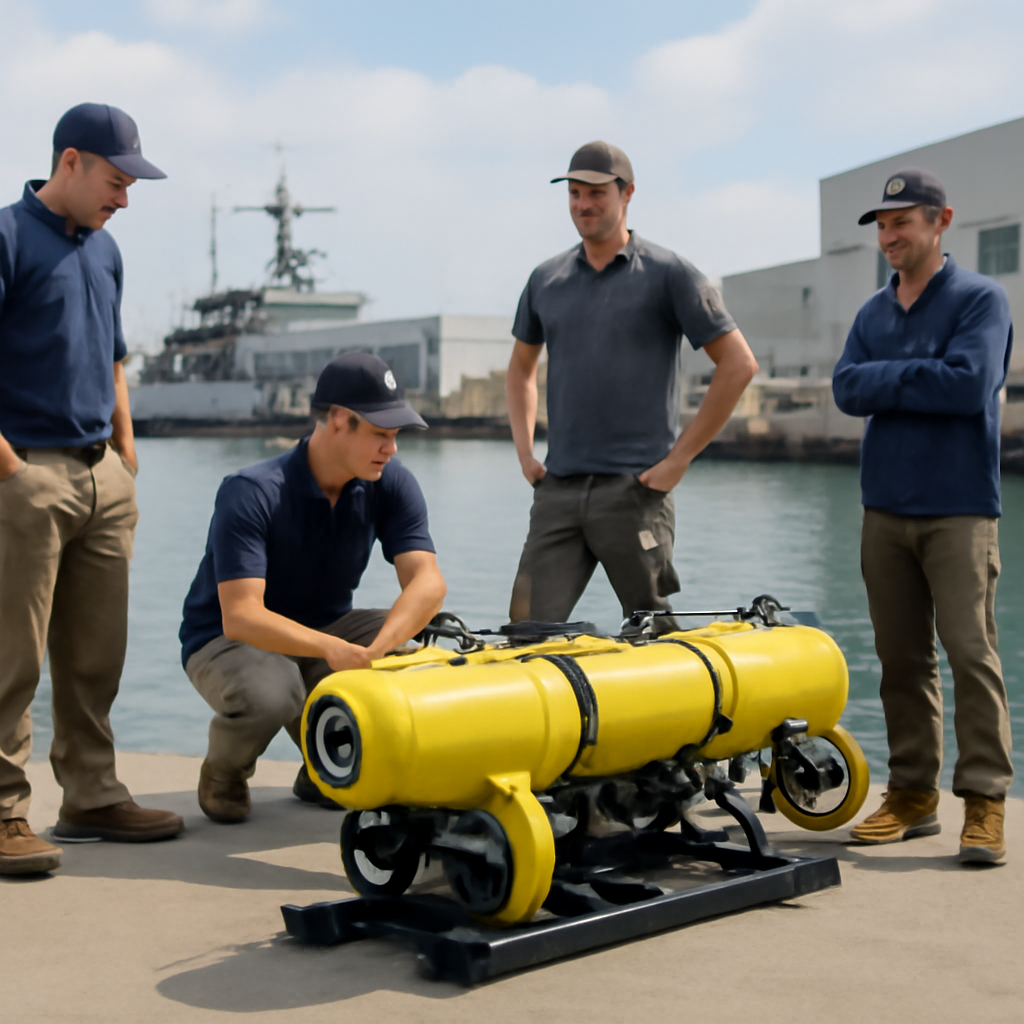
"ISE’s underwater technologies will further strengthen our position as a global provider of comprehensive, integrated maritime solutions," Elbit President and CEO Bezhalel Machlis said in the company statement announcing the deal.
Elbit Systems acquires International Submarine Engineering
Israel’s Elbit Systems announced the acquisition of International Submarine Engineering (ISE), a Vancouver-based company “specializing in advanced autonomous underwater and remotely operated systems for the maritime domain.” ISE, founded in 1974, has worked on underwater robotics and has “delivered over 250 underwater vehicles to customers in more than 20 countries worldwide,” the announcement said. Elbit framed the purchase as an expansion of its maritime portfolio into underwater autonomous systems; the company said the transaction was completed for a purchase price that is “not material to Elbit Systems,” but did not disclose the cost.
ISE’s underwater vehicles and operational focus
Elbit described ISE’s capabilities as strengthening the company’s offerings in underwater intelligence, surveillance and reconnaissance (ISR), mine countermeasures and anti-submarine warfare. The Canadian firm’s product set — autonomous underwater vehicles (AUVs) and remotely operated vehicles — brings underwater robotics into Elbit’s broader set of naval offerings, according to the company statement. That explicit linking of ISE’s systems to ISR, mine clearance and anti-submarine missions signals the practical roles Elbit intends for the technology.

This site is the portfolio.
OSINTSights runs on Cloudflare Workers, D1, R2, and Vectorize, with an AI pipeline on Hetzner ARM. Nubivance designed, built, and operates it. We do the same for clients.
See what we buildIntegration with Seagull USV and a multi-domain autonomous ecosystem
Saar Koursh, Elbit’s senior vice president and general manager of Elbit Naval Systems, told Breaking Defense the addition of autonomous underwater capabilities “complements Elbit’s existing Seagull unmanned surface vessel (USV).” He said the acquisition will enable Elbit to provide “naval forces with a complete multi-domain autonomous ecosystem, integrating UAVs, USVs and AUVs into a single mission framework.”
Elbit’s maritime systems already include “integrated command-and-control (C2) suites, electro-optical and sonar systems, communications and electronic warfare technologies,” the company said. Koursh highlighted that customers would be able to deploy coordinated air, surface and underwater autonomous assets as part of “one end-to-end operational solution,” while still being offered standalone systems tailored to specific needs.
Seagull USVs, prior demonstrations, and operational claims
Elbit has developed 12-meter and 20-meter versions of its Seagull USV, and said those platforms have been outfitted for mine clearance and anti-submarine warfare capabilities. The company cited previous public demonstrations and operational activity: in 2022, Seagull was sent to U.S. Central Command’s Digital Horizon event in the Persian Gulf to showcase unmanned systems, and in 2025 Elbit stated that “dozens of its USVs are in service worldwide with additional currently under production.” The firm has also shared videos showcasing USVs conducting scanning and strikes at sea.
Industrial posture: finances, production lines, and partnerships
The acquisition comes amid a period of strong financial performance for Elbit. In its second-quarter financial report, released in August, the company reported revenues of $2.3 billion and a record order backlog of $32 billion. Elbit has been extending its naval work beyond Canada: in February it and Germany’s ThyssenKrupp Marine Systems (TKMS) inaugurated a new production line in Israel for submarine components, and in May they signed a memorandum of understanding for a “strategic framework agreement to explore opportunities for cooperation in the development, integration and commercialization of advanced naval defense solutions.”
What this means for technologists, policymakers, and procurement leaders
- Technologists and security teams: will be tasked with integrating AUV and ROV capabilities into existing C2, electro-optical, sonar, communications and electronic warfare suites to realize the “single mission framework” Elbit describes.
- Policymakers and regulators: will see another example of cross-border naval industrial activity — an Israeli firm acquiring a Canadian underwater-systems company while also deepening ties with Germany’s TKMS — and the concrete expansion of capabilities in mine countermeasures and anti-submarine warfare.
- Procurement leaders and naval forces: gain access to both coordinated multi-domain autonomous options and standalone underwater platforms, with prior Elbit deployments and demonstrations cited as evidence of operational use.
The acquisition folded ISE’s underwater robotics into a supplier already stressing integrated command-and-control, sensors and electronic warfare. Elbit positions the move as completing a multi-domain puzzle — air, surface and subsurface autonomy under a single mission framework — but the company disclosed neither the purchase price nor a timetable for system integration and fielding. What remains clear from the facts released is that Elbit intends to couple ISE’s underwater vehicles with its existing USVs, UAVs and naval systems and to market those combined capabilities to customers worldwide.