On 08 July 2026, Ukraine and Germany signed an implementation agreement to jointly produce the BARS, a jet-powered long-range strike weapon Ukraine has used to target deep inside Russia, including Moscow.
Signing in Ankara and who signed the deal
The agreement was signed on the sidelines of the NATO summit in Ankara by Ukrainian Foreign Minister Andrii Sybiha and German Defence Minister Boris Pistorius. According to Sybiha, "the agreement resulted from work carried out by the two countries’ respective defence ministries under Germany’s 'Build with Ukraine' initiative." Germany will finance production through the first phase of the project, and the deal specifies that every unit built under the agreement will go to Ukraine’s Defence Forces.
Technical profile of the BARS family
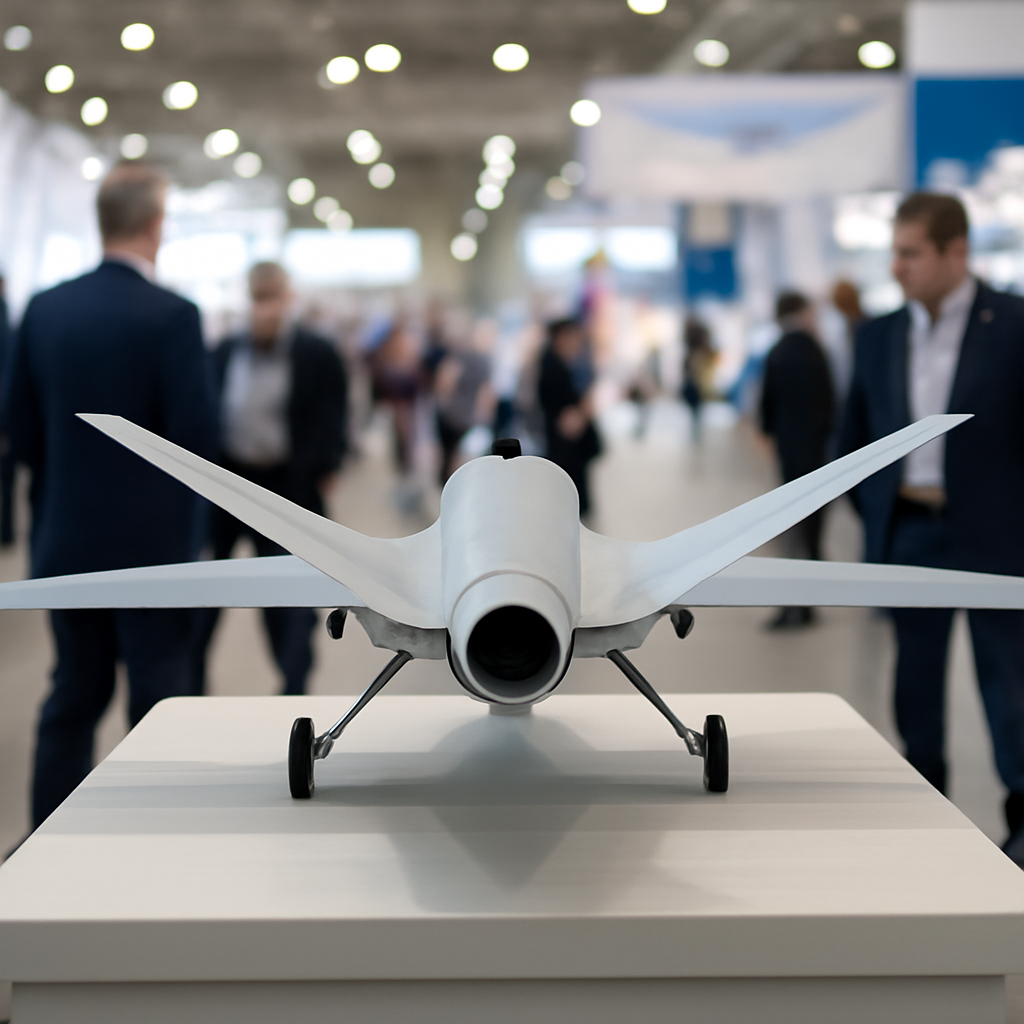
The BARS designation covers a family of weapons Ukraine officially classifies as "missile-drones" but which the source describes as a jet-powered one-way attack (OWA) loitering munition. Key published specifications include a wingspan of roughly 2 m, a biplane tail, and a miniature turbojet engine mounted above the fuselage at the tail. BARS is rail-launched from the ground with the support of a solid-fuel rocket-assisted take-off (RATO) motor.
Range figures vary by variant: the baseline BARS reportedly offers 700–800 km, while the manufacturer — unnamed and withheld for operational security — stated a variant can reach up to 1,000 km. The family has a cruise speed of 400–450 km/hour and a top speed of 620 km/hour.

This site is the portfolio.
OSINTSights runs on Cloudflare Workers, D1, R2, and Vectorize, with an AI pipeline on Hetzner ARM. Nubivance designed, built, and operates it. We do the same for clients.
See what we buildVariants, payloads and the manufacturer's public disclosures
At Eurosatory 2026 in Paris, Ukraine showcased the 'Bars RS' variant. A manufacturer representative said the Bars RS can carry a 22 kg warhead and has a maximum take-off weight (MTOW) of 135 kg with a 95-litre fuel tank. The same representative also described a heavier variant with an MTOW of up to 220 kg and warhead options of 60 kg and 105 kg. The manufacturer has publicly stated the BARS family has accumulated around 7,000 launches across testing and combat use to date.
The first public display of the airframe occurred in December 2025, when the Museum of the Russian-Ukrainian War at Ukraine’s National Defence University put one on view. The manufacturer itself remains undisclosed.
Production scale, modular design, and cost-driven choices
The BARS leverages a composite fuselage assembled from a minimum number of parts to reduce costs and enable scale. That design choice, together with an externally mounted turbojet, supports modularity: the engine can be sourced from different vendors as available. Observers reported that by December 2025 production and deployment had reached scale, including launch salvos of 100 rounds in a single event.
The source notes that the BARS’ externally mounted turbojet is a feature increasingly seen in low-cost cruise missile (LCCM) designs and that similar core design attributes are being adopted elsewhere, including in MBDA’s Crossbow. The reporting also cites interest and proposals in Pakistan for jet-powered OWA loitering munitions that echo the BARS approach, and it notes that a private company with limited resources could replicate a similar, simpler design.
Germany’s Build with Ukraine initiative and prior commitments
Germany launched the "Build with Ukraine" initiative in December 2025 and allocated roughly €2 billion for 2026. The initiative subsidizes Ukrainian weapons manufacturing whether production occurs inside Ukraine or at plants built on German soil. Berlin had earlier, in May 2025, agreed to finance the purchase of BARS rounds alongside Liutyi strike drones and other Ukrainian-made long-range strike weapons under a package worth roughly €400 million. The new co-production agreement integrates German producers into Ukraine’s wartime supply chain, according to the reporting.
The Build with Ukraine program has already produced joint ventures: in February 2026, Germany’s Quantum Systems and Ukraine’s Frontline Robotics formed a joint venture outside Munich to build the Linza logistics drone. That example is cited in the source as precedent for integrating German industry with Ukrainian producers under the initiative.
What this means for Ukraine's Defence Forces, German producers, and private munition makers
- Ukraine's Defence Forces: They are designated as the recipient of every unit built under the agreement, which, combined with prior procurement and the claimed production scale, suggests increased access to long-range, jet-powered strike effects for use in operations.
- German defence producers: The agreement embeds German producers into Ukraine’s supply chain and ties German financing — at least for the first phase — directly to production. Companies already participating in Build with Ukraine joint ventures, such as Quantum Systems, provide a template for how German firms could be involved.
- Private munition makers and new entrants: The BARS blueprint — an externally mounted turbojet, composite fuselage, and minimized part count — is presented in the source as relatively simple and scalable, lowering the barrier for smaller or resource-limited companies to design similar jet-powered OWAs.
The implementation agreement formalizes an industrial partnership built on a design that the source describes as affordable, modular and already field-proven in large numbers. It links Berlin’s financing and industrial capacity to a weapon family that the manufacturer says has logged thousands of launches and multiple variants with differing payloads and ranges. How production is organised on the ground, how quickly outputs reach the Ukrainian forces, and which German producers are integrated next are the immediate practical questions left by the pact.
https://quwa.org/europe/defence-news-eu/germany-to-co-produce-ukraines-bars-missile-drone/