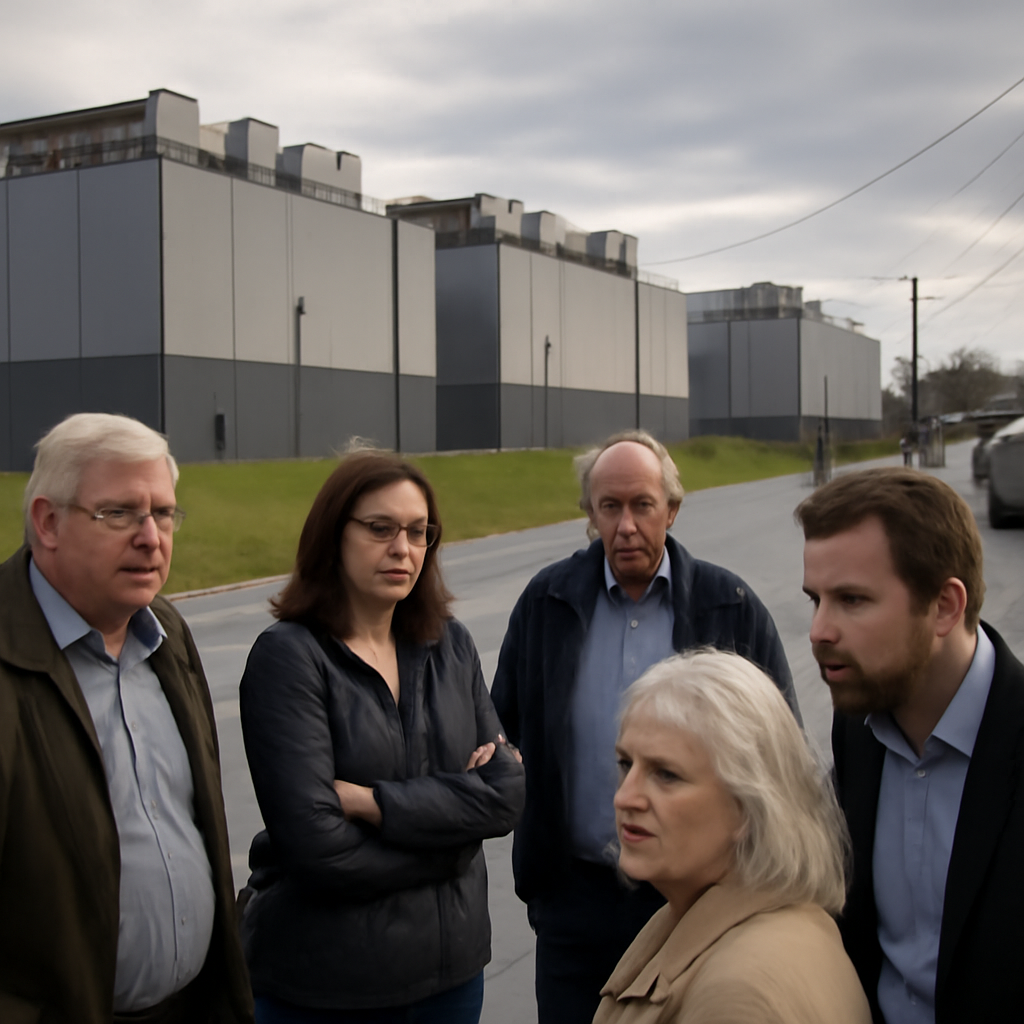
“There is a staggering three-quarters of a trillion dollars being spent on data center infrastructure by US companies this year alone.” That single figure, lifted from the essay, frames a debate that stretches from small-town zoning boards to the halls of federal power: are data centers the right target for public resistance to AI, or a convenient distraction from a deeper concentration of wealth and political influence?
Three-quarters of a trillion dollars and the bigger prize
The essay warns that the headline number—roughly $750 billion in U.S. data center spending this year—must be kept in perspective. The market for enterprise software, the authors note, is about twice that size. More important, data center construction is only one input into what AI companies are actually trying to capture: whole slices of economic value across multiple industries. The essay lists successes in customer service and consumer sales, and warns of looming targets including enterprise software development, creative design, management and legal services, and even professions such as teaching and medicine as part of the companies’ expansive vision.
Saline township, Michigan — how capital punches through local opposition
Local opposition has sometimes slowed or stopped early-stage proposals, but well-resourced projects can prevail. The essay cites a concrete example: an OpenAI- and Oracle-backed facility in Saline township, Michigan, where local officials voted to reject the project, but developers sued the town of 3,000 and forced a settlement that allowed construction to move forward. At the same time, the essay says, the Trump administration has signaled willingness to advance AI infrastructure by overriding state objections and even using federal lands—demonstrating federal levers that can be used to bypass local resistance.

The cyber insurance questionnaire just landed. Now what?
SOC 2, HIPAA, insurance renewals - someone has to own security strategy. Nubivance provides fractional CISO leadership without the full-time salary.
Get a security leadLocal concerns — land use, energy, jobs, and carbon
Opposition to data centers, the authors write, rests on legitimate local grievances: misallocation of scarce land where housing is at a premium; pressure on already higher energy prices; and localized environmental impacts. Unlike many industrial facilities, data centers “produce very few jobs,” the essay notes, intensifying the perception of an inequitable bargain in lower-income communities where opposition has been fiercest. On the global scale, the piece warns, the carbon footprint of AI could grow unsustainably if usage accelerates.
Technical trends that could shift the calculus: Z.ai, open weights, and on-device AI
The essay does not assume data-center growth is permanent. It points to technical developments that could reduce demand for centralized computing: leading Chinese labs such as Z.ai are working on making frontier-class models smaller and cheaper to run; AI power users have become adept at miniaturizing open weight models to run locally; and Apple and Google “both support infrastructure stacks for running AI models directly on mobile phones.” Taken together, these innovations could reduce reliance on massive centralized facilities, the authors suggest, making the current data-center surge resemble past infrastructure bubbles such as the early-2000s fiber-optic expansion.
What this means for local communities, state regulators, and AI companies
- Local communities: Continue to press zoning, environmental, and housing arguments—land-use pressures, energy impacts, and the jobs mismatch are concrete, local issues where civic action has traction.
- State regulators and policymakers: The essay urges states to regulate AI and to reject irresponsible uses. It recommends policy tools including taxation of AI computation so the public captures some profit and companies internalize energy and environmental costs, plus Citizens United–proof measures such as public financing and state regulation to limit corporate political influence.
- AI companies and investors: Capital-rich projects can overcome local defeats, the essay stresses, and companies are using political framing to defend rapid infrastructure expansion. The authors argue that both product marketing (the rhetoric of “safety” or national dominance) and deep pockets shape outcomes more than local cost–benefit debates.
The essay argues that opposing data centers should be only the start. Its broader prescription calls for active state regulation, taxation of computation, and a global movement for “Public AI” — models and infrastructure developed under public control with incentives aimed at public benefit rather than private profit. Underpinning those recommendations is a stark normative claim repeated in the piece: the concentration of power and wealth in trillion-dollar AI companies and their financiers is the greatest existential risk society faces today, and must be confronted by limiting corporate power and political influence.
Whether data centers remain the most visible front in this fight, or fade as models move on-device, the central issue the essay leaves for voters, regulators and civic organizers is clear: contesting local projects matters, but the authors want attention pointed higher—to taxation, public governance of AI, and structural limits on corporate political power.