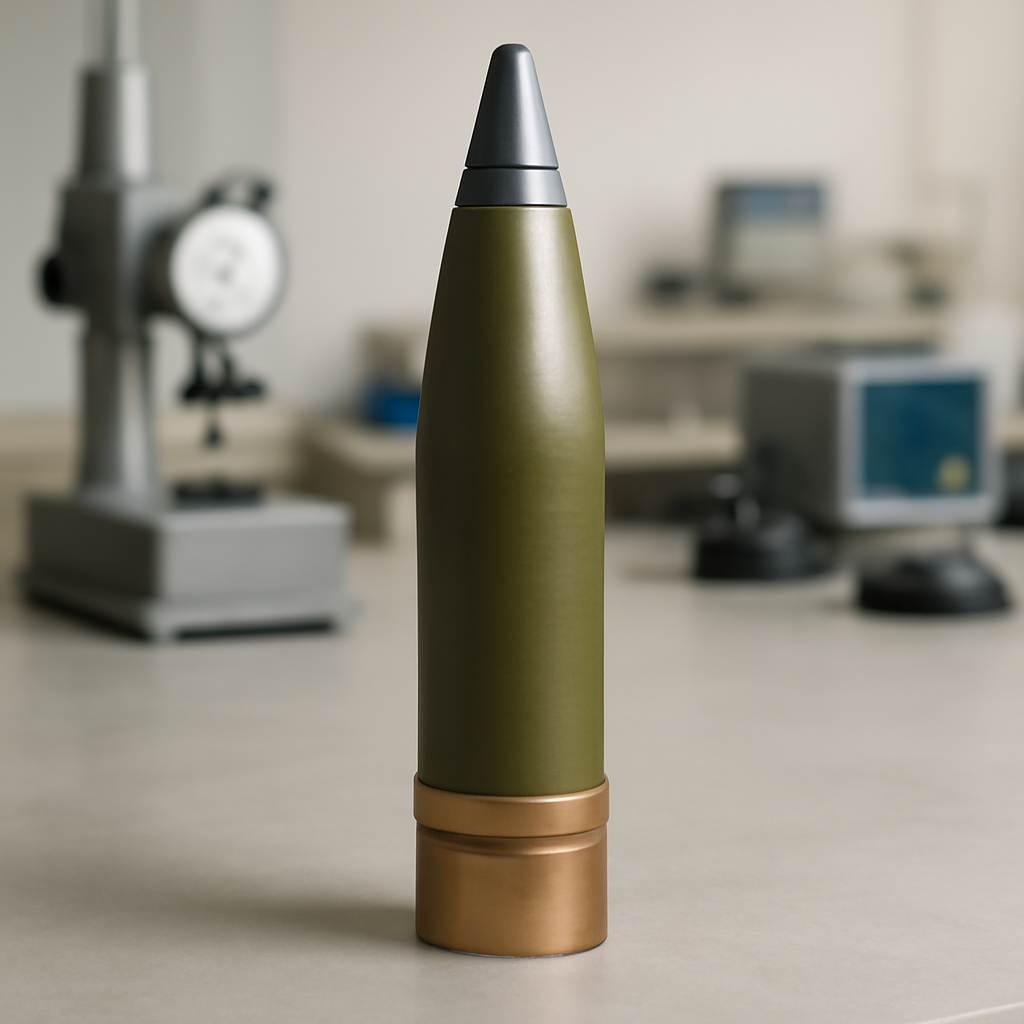
"Over time we have expanded our production capacity, advanced our scaling innovations, and reinforced our readiness to design, qualify, produce, and deliver next‑generation munitions," Scott Forney, president of GA‑EMS, said in a company release Friday.
GA‑EMS joins ERAP with a contract to develop a 155‑mm projectile
General Atomics Electromagnetic Systems (GA‑EMS) announced it was awarded a contract to develop a 155‑mm projectile under the Army’s Extended Range Artillery Projectile program, also known as ERAP or XM1155. The company framed the award as confirmation of its ability to "deliver extended‑range, precision capabilities" intended to give the warfighter greater standoff range and lethality.
The GA‑EMS award adds the firm to a small set of U.S. and international suppliers advancing competing prototypes for the Army’s search for a new long‑range, precision 155‑mm round.
GD‑OTS and the Vulcano: guidance, seekers, and U.S. production transition
General Dynamics Ordnance and Tactical Systems (GD‑OTS) announced one week earlier that it received a developmental contract under ERAP to field the Vulcano 155 Guided Long Range system. The Vulcano, developed by Italy’s Leonardo Electronics and Germany’s Diehl Defence, is being transitioned into U.S. production under GD‑OTS’ responsibility, the company said.
GD‑OTS described the Vulcano as capable of achieving ranges of up to 70 kilometers with high precision, using advanced aerodynamics, GPS guidance and a Semi‑Active Laser (SAL) terminal seeker. The company also said the ammunition is available with an advanced Far‑Infrared seeker for engaging sea targets, and that both seeker configurations "can provide precision engagement even in GPS‑contested environments."

Audit-ready is a season. It shouldn't be.
Evidence in spreadsheets, controls drifting between audits, frameworks multiplying on flat headcount. Nubivance runs continuous compliance on Rapid7 Cyber GRC - SOC 2, HIPAA, ISO 27001, PCI, CMMC.
End the scrambleERAP (XM1155): objectives, timeline, and compatibility constraints
The ERAP program was launched in 2024 to replace work previously done under the now‑scrapped Extended Range Cannon Artillery (ERCA) effort. The Army’s goal for XM1155 is specific: a 155‑mm projectile able to engage moving targets beyond 65 km (40 miles) — targets listed in Army descriptions include self‑propelled howitzers, infantry fighting vehicles, multiple rocket launchers, tanks and maritime targets.
According to a 2024 Army request for information cited in reporting, the service is seeking solutions that can reach Initial Operational Capability (IOC) by fiscal year 2030 and begin low‑rate production by the second quarter of FY29. The Army has also required that candidate munitions be compatible with existing howitzers and with "future howitzers," with the latter language tied explicitly to the service’s ongoing self‑propelled howitzer competition that the Army was expected to award next month, the reporting notes.
BAE Systems’ award listed but muted publicly
The Defense Department’s Ordnance Technology website lists BAE Systems as another contractor awarded to develop its version of the new 155‑mm projectile. Unlike GA‑EMS and GD‑OTS, BAE Systems has not released an announcement about the award and did not respond to a request for comment, according to the reporting.
What this means for the Army, GA‑EMS and GD‑OTS, and warfighters
- The Army and procurement planners — The program’s timelines put concrete milestones on the calendar: low‑rate production slated to begin in the second quarter of FY29 and IOC by FY30, per the Army’s 2024 request for information. Those dates will shape decisions about which projectile designs meet range, moving‑target engagement and platform‑compatibility requirements before production and fielding decisions.
- GA‑EMS and GD‑OTS — Awarded developmental contracts position both companies to move from design toward qualification and production. GA‑EMS emphasizes scaled production capacity and readiness; GD‑OTS is focusing on transferring Vulcano production into the United States and on seeker options that include SAL and Far‑Infrared configurations intended to operate in GPS‑contested conditions.
- Warfighters and tactical commanders — The Army’s stated requirement to engage moving targets beyond 65 km, including maritime threats, suggests forthcoming munitions will be judged on precision and seeker resilience as well as raw range. Compatibility with both current and prospective howitzer platforms will determine how rapidly new rounds can be integrated into operational units.
The ERAP program now counts three developers working on the XM1155; the coming year will test which approaches best meet the Army’s range, precision and platform‑compatibility demands as the service moves toward low‑rate production and an IOC target set in the next fiscal decade. The next concrete dates to watch are the Army’s howitzer award expected next month and the FY29 low‑rate production milestone cited in the Army’s request for information.