“Do you still have that capability? And the truth is, we hadn't fielded it.” — Steve “Doogie” Russell, VP and general manager, GE’s Edison Works.
GE Aerospace’s AVEN nozzle: a 30‑year pause and a fresh start
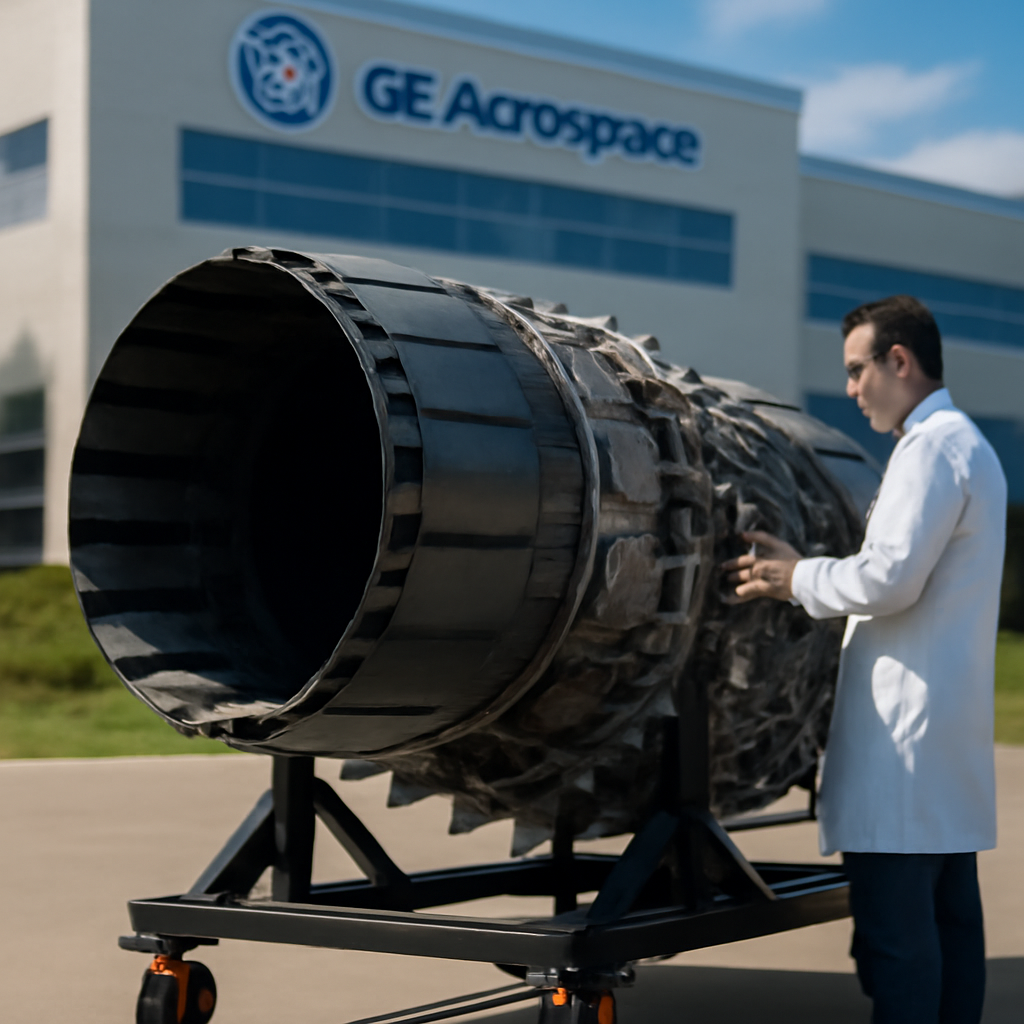
Thirty years after engineers at GE Aerospace demonstrated an axisymmetric vectoring exhaust nozzle (AVEN) intended to increase agility on an F-16, the hardware spent decades in storage until Shield AI asked if the capability still existed. GE offered an F110 engine paired with the AVEN nozzle and—according to GE’s Steve “Doogie” Russell—“the solution that we've offered to Shield” was that legacy pairing. Shield AI’s senior propulsion engineer, Shiva Vallabhaneni, said the hardware was “in very good condition” and that AVEN One, the nozzle used for the X‑BAT prototype, retains “close to 100 percent of the same hardware that was flown from the 90s.”
Shield AI’s X‑BAT and its unique propulsion requirements
X‑BAT is described by Shield AI as a collaborative combat aircraft and an autonomous fighter jet designed to take off and land vertically. That mission profile produces unusual propulsion demands: the aircraft “needs to be able to move quickly…in any direction,” Russell told reporters, and it must produce high thrust to lift off vertically and return for a high‑thrust landing. Vallabhaneni said the aircraft “always needed to have a thrust vector controlled capability to do vertical flight,” and that once airborne it also needs favorable thrust‑specific fuel consumption to meet range requirements.

Audit-ready is a season. It shouldn't be.
Evidence in spreadsheets, controls drifting between audits, frameworks multiplying on flat headcount. Nubivance runs continuous compliance on Rapid7 Cyber GRC - SOC 2, HIPAA, ISO 27001, PCI, CMMC.
End the scrambleRefurbishment, software rewriting, and integrated engine testing
Rather than designing a thrust‑vectoring nozzle from scratch, Shield AI and GE renovated the stored AVEN hardware, completely rewrote the software, and tested the nozzle with an F110 engine. The companies completed integrated testing of the engine and full AVEN nozzle at GE Aerospace’s test facility in Peebles, Ohio. Shield AI’s engineers characterized building a thrust‑vector control nozzle and verifying its technology—done at the speed required for X‑BAT—as potentially “harder than getting an engine,” Vallabhaneni said.
Tethered hover: the planned risk‑controlled demonstration
The immediate flight objective is a tethered vertical flight test to show the prototype can hover and remain stable. Shield AI plans to hang the aircraft from a 180‑foot crane to minimize risk, with success defined as creating slack in the tether during hover. Data collected during that tethered test will be used to develop vertical flight control laws, Vallabhaneni said. She also framed Shield AI’s approach as being “hardware rich” and willing to take risks to accelerate learning—invoking other new‑space companies by name: “much like SpaceX, Rocket Lab, all of these other new space companies—the mindset is: be hardware rich, take risks because the faster we get to test, the faster we can learn what the real problems are.”
Building more AVENs and pursuing performance gains
Shield AI intends to produce additional AVEN nozzles that preserve the legacy design to increase test cadence, and to iterate on the technology in future units. Vallabhaneni said future changes will likely focus on performance improvements—“Lighter, faster, more performance, right? Those are the things that we're going to go and chase and achieve on the future version of AVEN.” The current reuse strategy—refurbishing the 1990s hardware and modernizing its software—was credited as the “biggest key unlock” for reaching an X‑BAT prototype flight test this year.
How engineers, procurement leads, and test planners are affected
- Engineers and test planners: will use tethered hover data to derive vertical flight control laws and validate thrust‑vector behavior; the integrated engine‑nozzle tests at Peebles provide baseline performance inputs.
- Procurement and program managers: can point to the AVEN example as a case where legacy hardware, refurbished and combined with new software, accelerated prototype milestones—Shield AI plans to make more AVEN units to expand testing.
- Operators and maintainers: face demands for a propulsion system that balances high‑thrust vertical operations with in‑flight efficiency; the nozzle must move to balance the aircraft during high‑thrust approaches and docking maneuvers.
AVEN’s resurrection is literal and practical: hardware built before some current engineers were born is now the launching point for an unmanned, vertical‑takeoff fighter prototype. The next concrete step is the tethered hover demonstration scheduled before year’s end; if tether slack appears during hover and the control laws derived from the test perform as expected, Shield AI will have converted three decades of shelf storage into a flying baseline—and a short runway for further nozzle performance work.